Lahore tops world pollution list as AQI hits 465
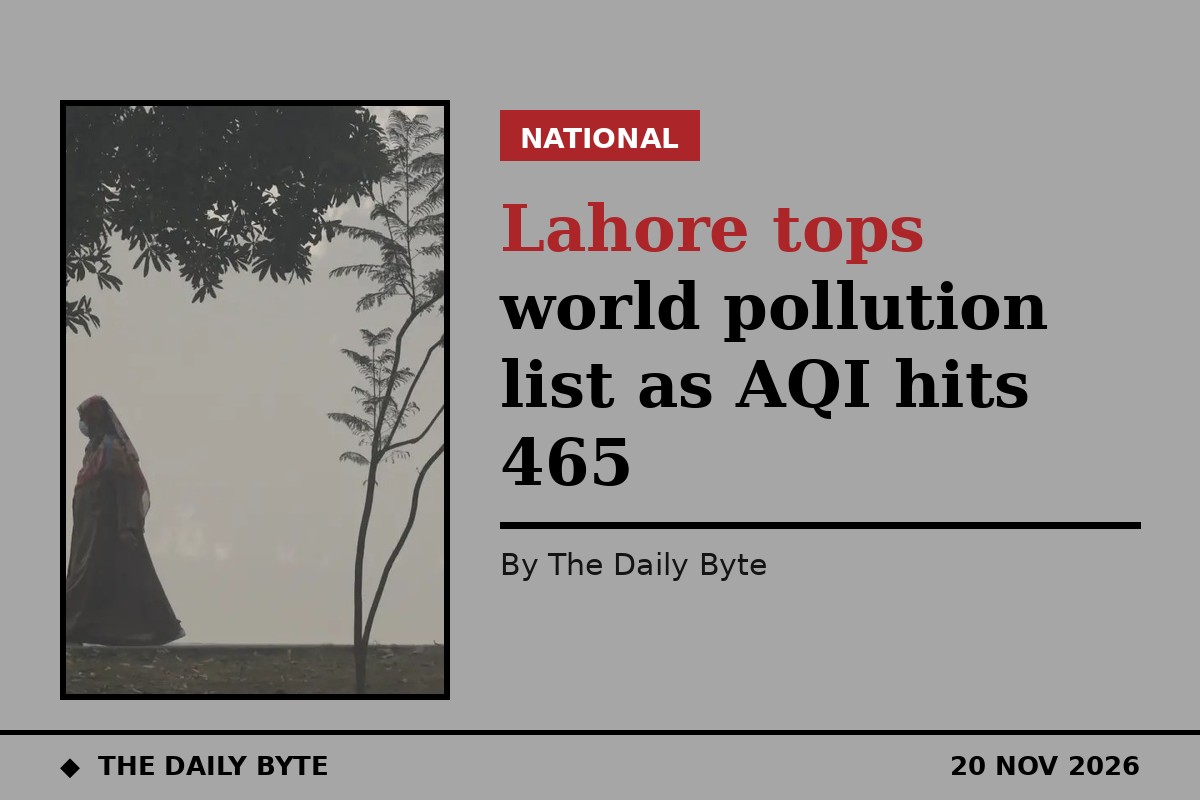
Lahore was once again ranked the world's most polluted major city on Friday morning, as thick smog pushed its air quality index to 465 between 7am and 8am, a level classed as hazardous.
The reading put the Punjab capital at the top of the global ranking of major cities, according to local media reports carried by Dawn. It was the latest bad morning in a smog season that has repeatedly left Lahore leading the world's pollution tables this month.
Other cities in Punjab recorded even worse air on the national ranking. Gujranwala topped the list of Pakistani cities with an index of 661, followed by Multan at 641 and Lahore itself at 426. Sargodha recorded 289, Sialkot 232, Rahim Yar Khan 228 and Bahawalpur 198, leaving much of the province in unhealthy or hazardous air.
Health authorities have advised residents to limit time outdoors, keep windows shut, wear protective masks when they go out and use air purifiers indoors. The warning matters most for children, older people and anyone with breathing or heart trouble, because prolonged exposure to fine particulate matter, known as PM2.5, can aggravate respiratory and cardiovascular conditions.
The deterioration has come despite an enforcement drive by the Punjab Environment Protection and Climate Change Department against sources of pollution, above all brick kilns operating outside the rules. Between 1 January and 18 November, its teams carried out 84,370 inspections of brick kilns across the province, demolishing 1,429 units, sealing 968 and registering 1,248 cases against violators. Fines totalling Rs178 million were imposed.
During the worst of the smog season, from 1 September to 18 November, teams made 29,999 visits, demolished 519 kilns, sealed 494 and registered 408 cases, imposing fines of Rs101.45 million. In the first 18 days of November alone there were 7,509 visits, with 101 kilns demolished, 161 sealed and 96 cases registered. The department says it is now going back to re-check kilns it has already inspected, to catch owners who restart polluting work after the teams leave.
Pakistan's space agency, Suparco, had warned on Thursday that smog would get worse across Punjab. Its assessment for 17 November recorded 690 active fire incidents in Punjab and adjoining transboundary areas in the preceding 24 hours, 386 inside Punjab and 304 across the border, and identified seven districts, including Gujranwala, Sialkot and Hafizabad, as facing high or severe smog conditions.
A report published last month by the Pakistan Air Quality Initiative put the wider cost of the crisis in stark terms. It estimated that polluted air cuts life expectancy in Pakistan by about 3.9 years and contributes to around 128,000 premature deaths each year, at an economic cost equal to 6.5 per cent of gross domestic product. In Lahore, prolonged exposure could cut life expectancy by up to seven years.
The same report found that Lahore's annual average PM2.5 concentration exceeds 110 micrograms per cubic metre, more than 22 times the World Health Organisation's annual guideline of five. Pakistan's average PM2.5 level stood at 67.3 micrograms per cubic metre in 2025, nearly 14 times that guideline. Transport is the largest source of primary PM2.5 emissions in Lahore, followed by industry at 28 per cent and brick kilns at 17 per cent, with cold winter weather trapping pollutants close to the ground.
The smog is already changing daily life in the province. The second Test between Pakistan and Sri Lanka was moved from Lahore to Rawalpindi because of the air quality, and the haze has repeatedly delayed traffic and closed motorways at night during the season. With dry weather and light winds holding pollutants in place, the advice for now remains unchanged: stay indoors where possible, wear a mask outside, and keep windows closed until the air clears.