Lebanon Says Israeli Attacks Caused $512m Environmental Damage
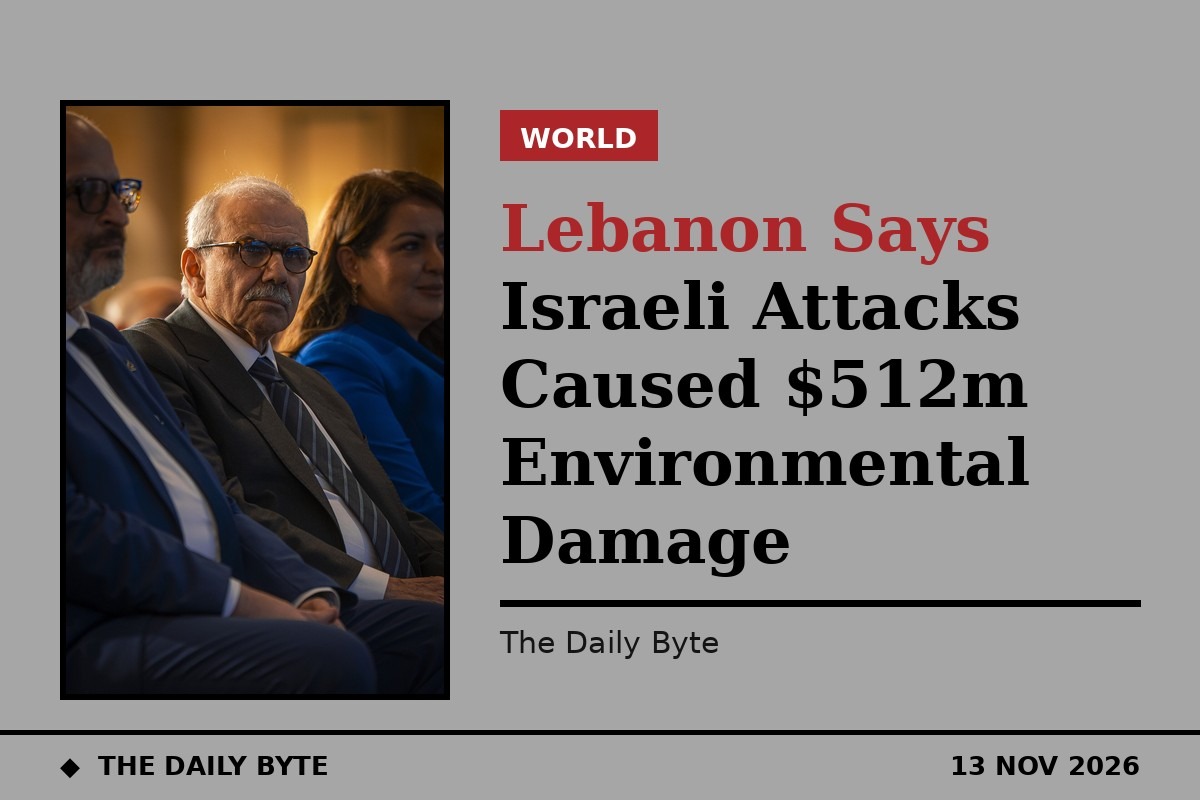
Lebanon has suffered more than $512 million in environmental damage as a result of Israeli attacks in 2023 and 2024, with further losses recorded in 2026, Prime Minister Nawaf Salam said on Thursday, 12 November, as he addressed the COP31 climate summit in Antalya, Türkiye.
Salam told delegates at the United Nations climate conference that Lebanon's environmental crisis could not be separated from the wars the country has endured and the years of economic turmoil that have weakened its institutions. He said the damage had struck infrastructure, agricultural land, forests and ecosystems, and warned that the consequences for local communities and livelihoods would be felt for years.
According to reports of his address, Salam described the environmental losses arising from Israeli attacks as violations of international humanitarian law. He argued that rebuilding Lebanon must go beyond repairing homes and roads to include ecological rehabilitation and the recovery of farmland.
Damage to forests, farms and nature reserves
The figure Salam cited is the Lebanese government's own assessment. A separate 2025 World Bank report estimated the damage to Lebanon's natural resources, including forests, shrublands, grasslands, riverine ecosystems, wetlands and the coastline, at approximately $500 million. Lebanon's National Council for Scientific Research has estimated that at least 2,000 hectares of forests, olive groves, citrus orchards and agricultural land were destroyed during the war.
Lebanon's environment ministry has said eight officially designated nature reserves in the south and Nabatieh governorates suffered varying degrees of damage, and that the war left behind more than 16 million tonnes of debris across the country. The ministry has launched a national programme to assess the environmental impact of the war, based on field verification and scientific analysis, which it describes as Lebanon's first integrated national assessment of its kind.
Environment Minister Tamara El Zein has said Israel's military campaigns and its occupation of parts of the south are threatening Lebanon's climate targets, telling The National that environmental recovery is a central part of national recovery rather than a technical afterthought.
Climate summit hears war damage claims
COP31 opened in Antalya on Monday and is scheduled to run until 20 November, bringing together world leaders, policymakers and climate experts to discuss climate finance, adaptation and measures to reduce greenhouse gas emissions. Salam used the platform to argue that climate adaptation is inseparable from reconstruction for a country still counting the cost of successive conflicts.
Iran's President Masoud Pezeshkian made a similar case at the same summit on Wednesday, asking delegates to document and assess environmental damage Iran attributes to US and Israeli strikes and to create compensation mechanisms for it. The two interventions have put wartime environmental harm on the agenda of a climate conference that normally deals with emissions, finance and adaptation.
Whether either claim leads to compensation is uncertain. Existing climate finance does not cover military-caused harm, and any mechanism would require states to prove attribution, quantify damage to people and ecosystems, and agree on liability and payment rules. For now, Salam's figure stands as Lebanon's official account of what the war has cost its environment.
Frequently asked questions
What did Nawaf Salam say at COP31? Lebanon's prime minister told the climate summit in Antalya that Israeli attacks caused environmental losses of more than $512 million in 2023 and 2024, with further losses in 2026.
What kind of damage is included? According to Salam and Lebanon's environment ministry, the damage covers infrastructure, farmland, forests, ecosystems and nature reserves, along with debris, soil contamination and harm to air quality.
Is the $512 million figure independently verified? It is the Lebanese government's assessment. A 2025 World Bank report separately estimated damage to Lebanon's natural resources at about $500 million.
Sources: AzerNews; Nations Pride; NewsCord, citing TRT World and Elnashra.


