LHC: Private DNA Test Cannot Override Legitimacy
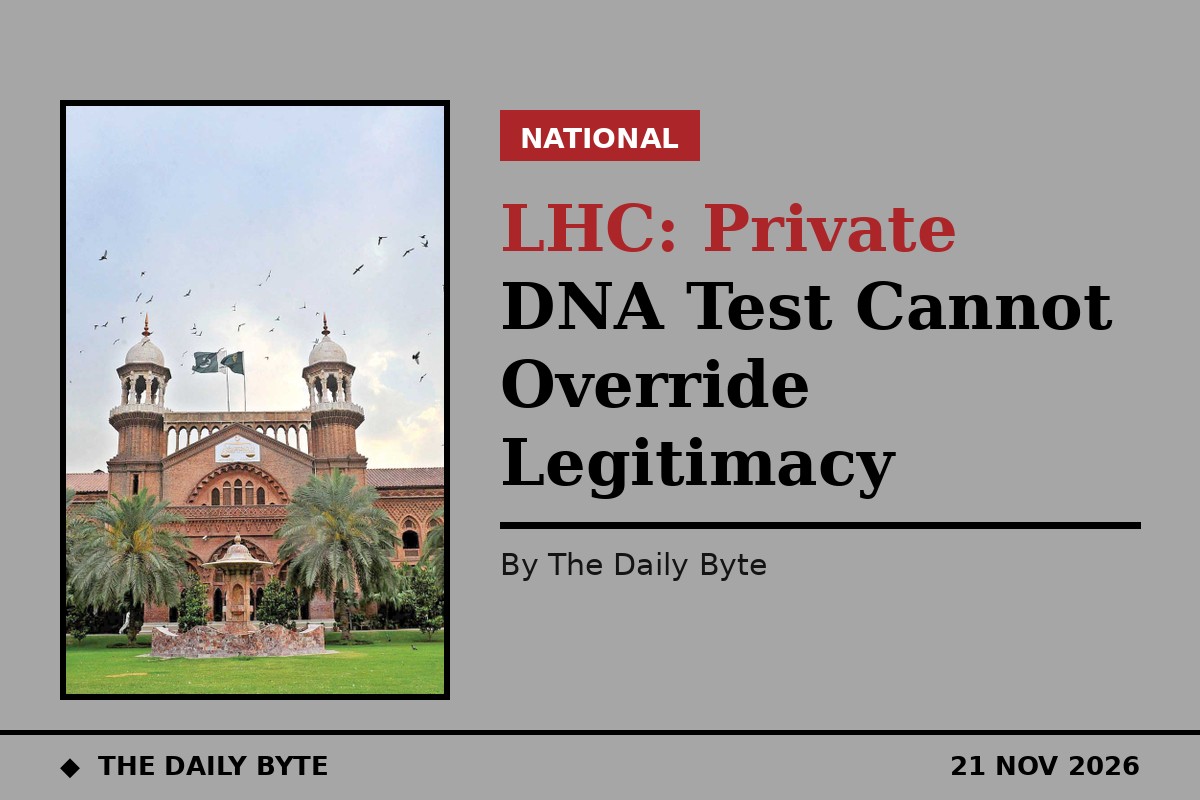
The Lahore High Court has ruled that a privately arranged DNA test cannot displace the legal presumption that a child born during a valid marriage is legitimate, dismissing a father’s challenge to maintenance and dowry recovery orders.
Justice Asad Ali Bajwa gave the ruling in a petition filed by Usama Tahir and others against Zainab Irfan and others, reported in Dawn on 18 November 2026. The court held that a father cannot disown a child born while the marriage was subsisting simply by relying on a DNA test arranged outside court supervision.
The case before the court
The couple married on 18 August 2019, and their son was born on 27 April 2022, while the marriage was still in force. The father, who lives in the United Kingdom, disputed paternity on the basis of a DNA report said to have been obtained from a private laboratory in the United Kingdom on 5 September 2022, which reportedly excluded him as the biological father.
He challenged decisions of the family court and an additional district judge in Gujranwala, which had awarded maintenance for his minor son and ordered the recovery of dowry articles. The family court had already rejected his paternity plea. The High Court heard the petition, recorded as Writ Petition No. 50430 of 2026, on 21 October 2026 and dismissed it in an eight-page judgment, leaving the lower courts’ findings intact.
Article 128 and the presumption of legitimacy
The ruling turned on Article 128 of the Qanun-e-Shahadat Order, 1984, under which the birth of a child during a valid marriage creates a conclusive presumption of legitimacy, subject to the exceptions provided by law. Justice Bajwa held: “A unilateral DNA test report cannot by itself displace the conclusive presumption of legitimacy provided under Article 128 of the Qanun-i-Shahadat Order, 1984.”
The court observed that nothing on the record showed the test had been carried out under the supervision or direction of a competent court, and that it had been arranged without the mother’s consent. It also weighed admissions made by the father’s own family members during evidence that the marriage remained intact when the child was born. The judgment further noted the Supreme Court’s position that a Muslim father seeking to challenge paternity must do so within 40 days of the child’s birth, a window that had long passed.
The child’s interests come first
The court said questions of paternity must be handled cautiously, with regard for the child’s dignity, privacy and emotional well-being. It stressed that children are entitled to privacy and protection from emotional harm even when they cannot voice their concerns, and that courts are responsible not only for resolving disputes but for safeguarding human dignity, particularly where the rights of minors are concerned.
DNA testing in paternity disputes, the court said, is a serious judicial matter that cannot be ordered simply because a party demands it or because the technology is available. Even where both parents consent to testing, a court must independently assess whether it serves the child’s best interests. The father’s duty to maintain his son stands, with the amount set by his financial capacity and the child’s needs.