Libya central bank completes governor handover
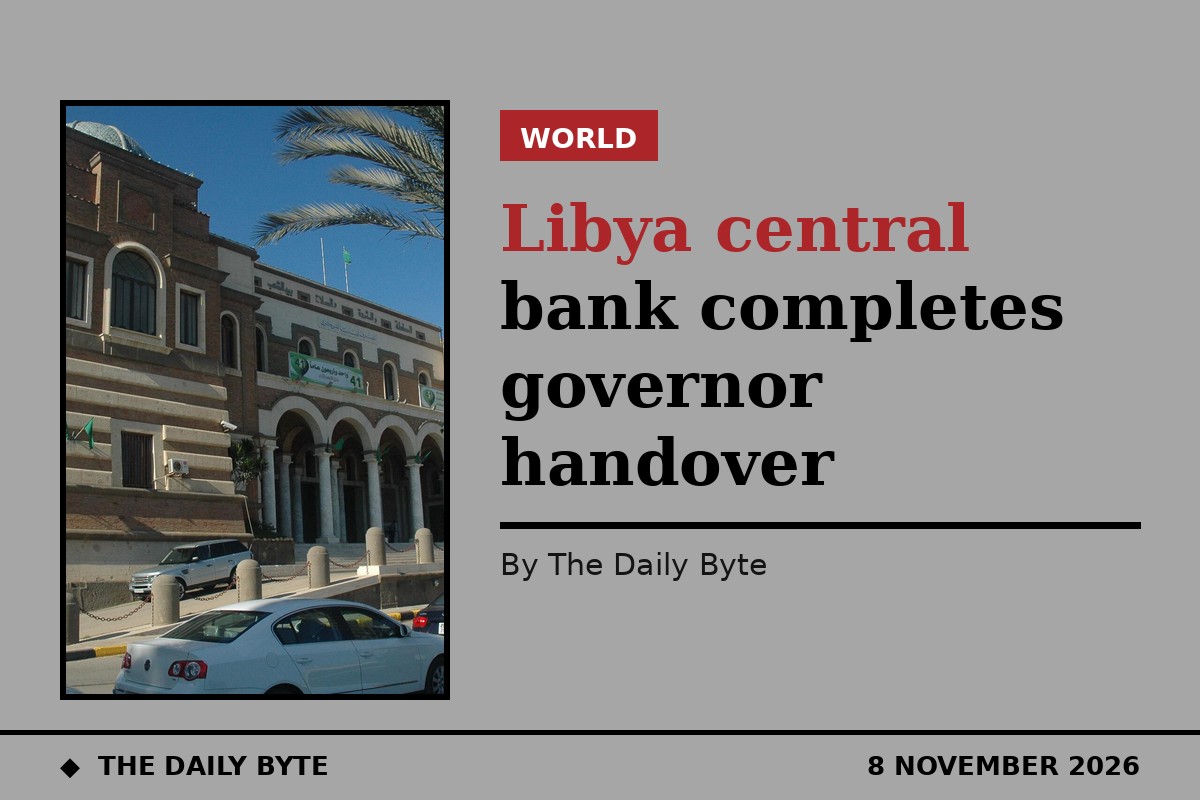
Libya's central bank has completed the formal handover of the governor's office between its new governor, Fawzi Abu Khazam, and the former governor, Naji Issa, the bank said on Sunday. The ceremony closes a leadership change that has been unfolding since October at the centre of Libya's divided financial system.
The Central Bank of Libya said the proceedings took place in the presence of several members of its board of directors and the bank's department heads. The ceremony included the signing of an official handover protocol documenting the transfer of duties and responsibilities and finalising the established administrative and institutional procedures, the bank said.
Photographs of the two governors shaking hands, and of the outgoing governor signing documents and receiving commemorative plaques, were published by the bank. The former governor was also honoured during the ceremony in recognition of his efforts and contributions throughout his tenure.
How the change unfolded
Issa submitted his resignation in August, saying he could no longer continue in the post. Abu Khazam, previously a member of the central bank's board, took over the governor's duties on an interim basis on 22 October, after the presidency of the eastern-based House of Representatives accepted Issa's resignation in principle.
On 2 November, the House of Representatives voted in a session in Sebha to accept Issa's resignation and appoint Abu Khazam as his successor, with 78 of the 90 lawmakers present backing the decision. Abu Khazam was then sworn in as governor on Wednesday, 4 November, taking the oath before House Speaker Al-Salihin Abdul Nabi at parliament's headquarters in Benghazi, Libya Review reported.
A contested handover
The formalities have not settled the questions around how the change was made. The Libya Herald noted that there was nothing institutional about Abu Khazam's installation on 22 October, describing it as a forcefully imposed, coup-like action carried out with no public announcement and no debate in the High State Council or the House of Representatives, with the appointment only rubber-stamped afterwards.
Commentators believe the powers behind the change are now going through the motions of institutional procedure to allay international fears, most prominently those of the US Federal Reserve, the Herald reported. The one positive noted about the appointment is that Abu Khazam was a consensus choice, sparing Libya the polarisation that has usually accompanied appointments to sovereign positions since the 2011 revolution.
The central bank said the transition underscores a commitment to institutional governance and administrative stability, and that the bank continues to fulfil its responsibilities under applicable legislation. It has also stated that its operations and banking services are continuing normally following the leadership change.
Whoever holds the governor's office matters well beyond the bank itself. The central bank manages Libya's oil revenues and the dinar in a country still split between rival administrations in Tripoli and the east, so a disputed handover at its top carries weight for public finances, salaries and subsidies across the country.