llama.cpp 1.0 brings stable API to local AI apps
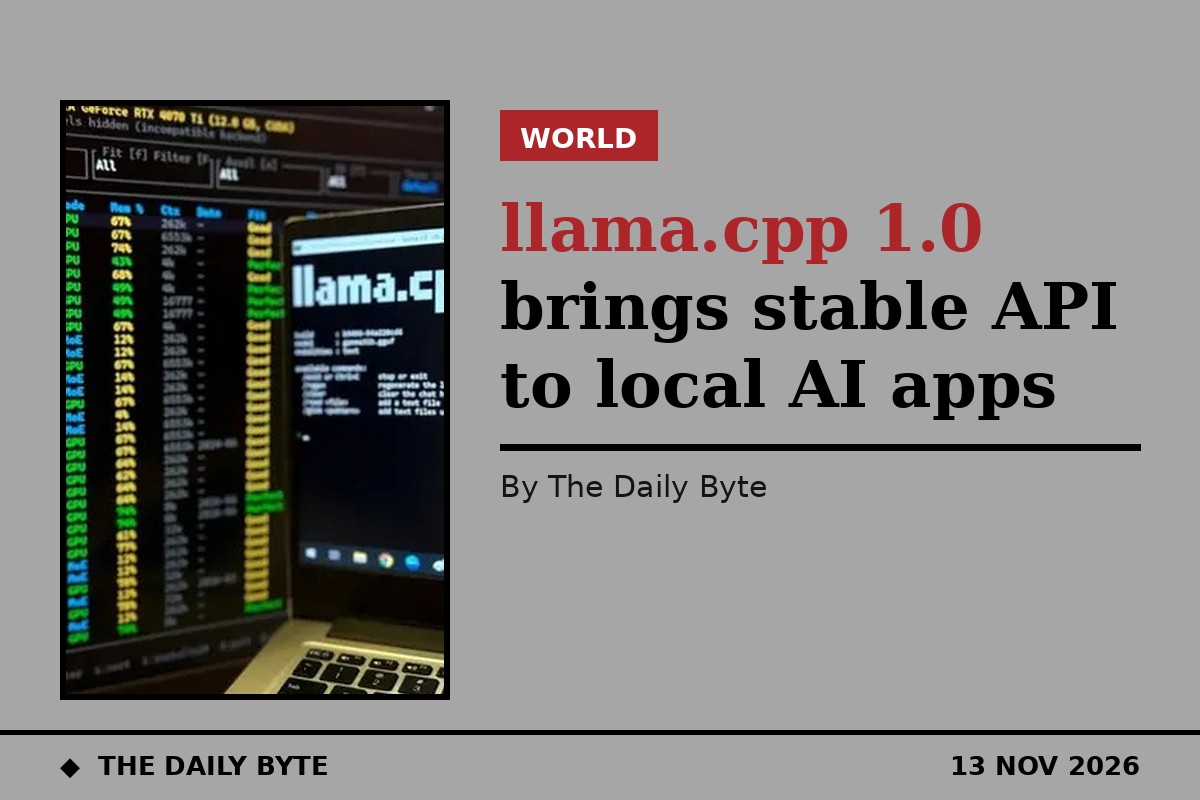
llama.cpp, the open-source C and C++ engine behind much of the local AI world, has reached version 1.0.0, its maintainers announced on Thursday, 13 November. The release gives developers a first: a formal promise that its public programming interface will stay stable, with breaking changes signalled only by a new major version number.
A stable contract after three and a half years
The project began in March 2023 and has until now identified its builds by raw commit numbers, which said nothing about compatibility. Under the new rules, a breaking change to the public C API triggers a major version bump, a compatible new feature triggers a minor bump, and a bug fix triggers a patch release. The companion ggml tensor library has reached version 1.0.0 at the same time, under the same rules.
What changes in version 1.0
Version 1.0 is also a clean-up release. It removes 35 deprecated functions and promotes the NextN speculative-decoding API from an extension header into the main public header. It adds support for new model architectures, including Kimi-K3.1-Pro, Ripple and xing4_0, plus OCP FP8 KV-cache support and a host-memory cache for mixture-of-experts models. The built-in server has been hardened against cross-site request forgery, cross-origin and DNS-rebinding attacks, and now offers an OpenAI-compatible audio endpoint and a redesigned web interface.
Why it matters for local AI
llama.cpp powers popular tools such as Ollama and LM Studio, which let people run AI models on ordinary laptops and desktops without sending data to the cloud. A stable API makes it safer for app developers to build on the library, and easier for package managers to ship it. The release is available through Homebrew, conda-forge, Winget, MacPorts, Docker and Debian, with pre-release builds for Linux, macOS, Windows, Android and iOS.
Sources: Hugging Face and Unite.AI.