llama.cpp Hits 1.0 With a Stable API for Local AI
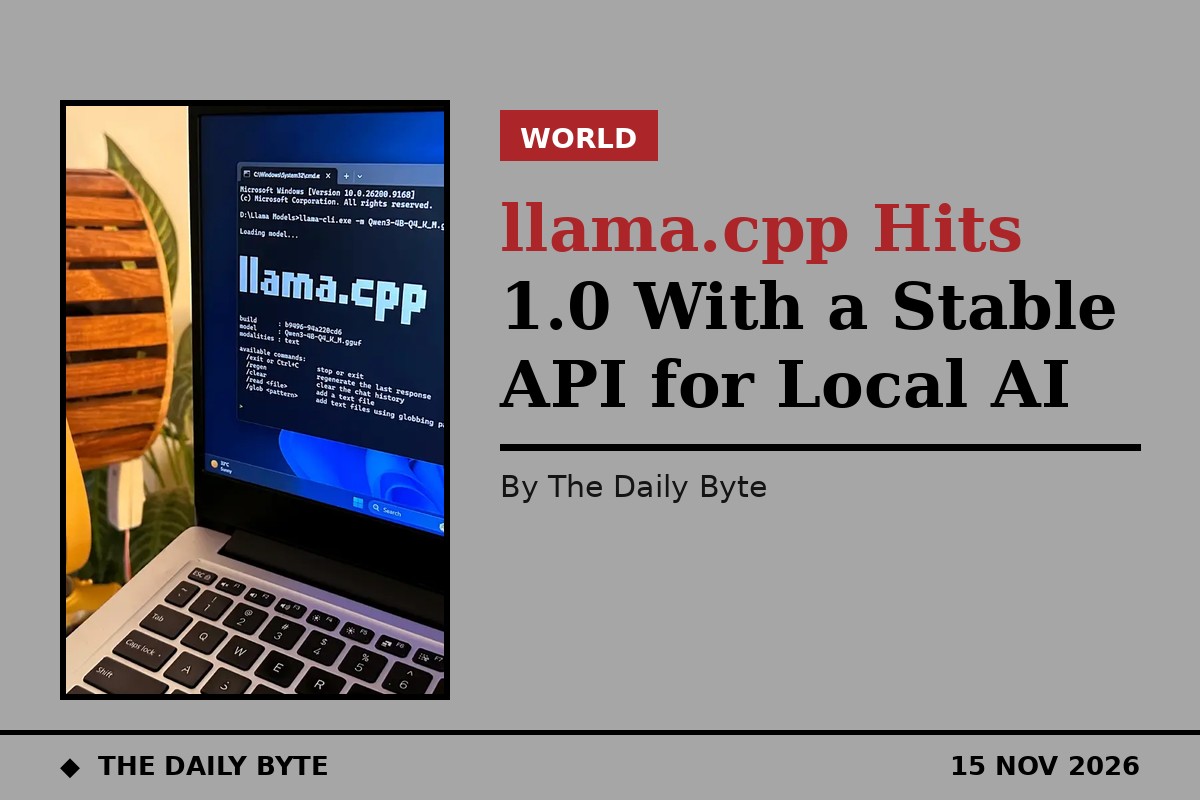
llama.cpp, the open-source engine behind much of the local AI world, has reached version 1.0.0, giving developers a stable public API for the first time in the project's three-and-a-half-year history.
The release, announced on 13 November 2026 through a Hugging Face blog post and a GitHub release, covers both llama.cpp and its underlying tensor library, ggml, which also shipped as version 1.0.0. From now on, both projects follow semantic versioning: a major version bump will signal a breaking change to the public C API, a minor bump will mean a backward-compatible feature or new model support, and a patch will mean a bug fix.
For the developers who build on the libraries, that promise matters. llama.cpp is the C and C++ inference engine that powers popular local AI tools such as Ollama and LM Studio, letting people run large language models on ordinary laptops, phones and servers instead of in the cloud.
What version 1.0 actually changes
The headline change is a clean-up. Version 1.0.0 removes the deprecated public API, including 35 deprecated functions, along with the warmup setter and the defragmentation-threshold option. The NextN speculative-decoding API moves from the extension header into the main llama.h header, placing it inside the public API covered by the new stability rules.
The release also adds practical improvements for running models locally. It brings support for FP8 key-value caches, a host-memory cache for mixture-of-experts models, and security fixes for llama-server against server-side request forgery and DNS rebinding attacks.
Three new text model architectures are supported: Kimi-K3.1-Pro, Ripple and xing4_0. The project now supports more than 150 model-architecture variants, a measure of how far it has grown since it began in March 2023.
A promise, not a drop-in upgrade
The maintainers are clear that version 1.0 is a contract about breakage, not a guarantee that every existing app will upgrade without work. Any application that calls one of the 35 removed functions will fail to compile until it is updated, so developers should check their code before moving to the new release.
Until now, llama.cpp used raw commit numbers as version strings, such as build 12360, which told developers nothing about compatibility. The move to semantic versioning brings the project in line with the expectations of the large ecosystem that now depends on it.
The project's maintainers joined Hugging Face in February, and the 1.0 announcement was published on the company's blog. The release does not change any model or make local AI suddenly faster. What it does is give the people who build local AI apps a dated, inspectable baseline they can rely on: if a future release breaks their code, the version number will say so.
Sources: TSN Media, reporting the Hugging Face blog post and GitHub release, and AI Frontier Post.