Macron meets student protesters as France awaits decisions
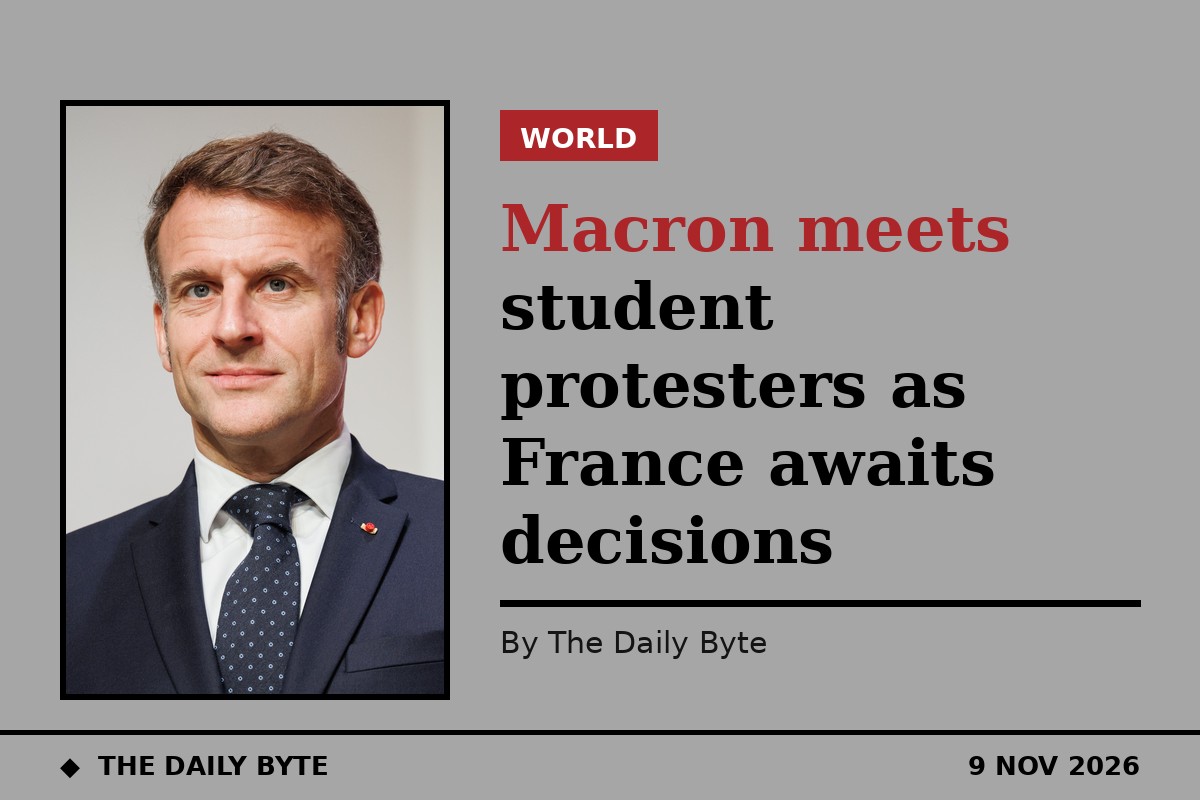
President Emmanuel Macron has met representatives of France's student protest movement for the first time since the demonstrations began, promising more teachers and a deep overhaul of the university admissions system as his government prepares to announce its first decisions on Monday.
The meeting, held on Friday, came after almost two months of protests that began in mid-September, when high school students blockaded their schools over teacher shortages, overcrowded classrooms and dilapidated buildings. What started as a dispute over conditions in schools has grown into a wider movement over the cost of living, inequality and the direction of the Macron presidency, with France approaching a presidential election in six months.
Student representatives said the meeting had failed to defuse tensions and called for further mobilisation until the government presents concrete action. A further meeting is scheduled for Monday, at which the government said it would present a first set of decisions on staffing, teacher replacements and Parcoursup, the university admissions system many students consider unfair.
What the students are demanding
The student groups have set out two central demands: a comprehensive overhaul of Parcoursup and a 1.5-billion-euro emergency plan to improve school infrastructure before winter and summer. Other student organisations and unions are calling for an additional 10 billion euros for education, more teachers on permanent rather than precarious contracts and 250,000 additional university places.
Soumaya Sarre, an 18-year-old student and a leading figure in the Federation of High School Students from Working-Class Neighbourhoods, said students wanted promises backed by concrete results. Nathanael Combary, 18, president of the board of directors of the student organisation Renouveau Lyceen, said the demands were not impossible to meet and that his primary goal was to provide very concrete solutions.
Higher Education Minister Philippe Baptiste has said he is not considering abolishing Parcoursup, calling the idea pure demagogy, but has said he is ready for profound changes to the system. The government has so far announced 3,000 additional substitute teachers and an online consultation, while its 2027 budget allocates an extra 1.1 billion euros to national education.
Weekend protests and police deployment
Hundreds of thousands of people marched across France on Saturday in a further wave of protests, with young students, teachers, ecologists, nurses and union representatives among those taking part. More than 70,000 police officers and gendarmes were deployed across the country, and police arrested nearly 1,000 people nationwide, according to Interior Minister Laurent Nunez.
In Paris, a march that began at Porte d'Italie ended at Porte de Vincennes, where tension flared as night fell and police fired tear gas and water cannon to disperse the crowd. Some demonstrators threw items from the streets, and around 500 people clashed with law enforcement, according to the authorities. Protests were banned in several city centres, including Montpellier, Rouen, Nice and Lyon, where police fired tear gas to disperse around 150 protesters. Clashes were also reported in Marseille, where a union-organised march had been authorised under strict conditions.
The movement has announced a further protest for next Saturday. Prime Minister Sebastien Lecornu is expected to meet representatives of trade unions and employers' associations on Monday to discuss wages and household purchasing power, a separate strand of the discontent that has driven the protests.
A government with little room to move
Some observers doubt that the measures on offer can address the deeper causes of the unrest, including anxiety over a diploma that no longer guarantees a job, the rising cost of living and a sense that the state can no longer provide services. Jacques Reland, a senior research fellow at the Global Policy Institute, said the crisis pointed to a breakdown in dialogue between the government and young people, and that young people's prospects depended on the social status and wealth of their families.
Macron governs with a minority in parliament, which makes it difficult to pass meaningful reforms, and the biggest obstacle to concessions is finance. Public debt is projected to reach 121.7 percent of France's gross domestic product in 2027, up from 119.3 percent this year, according to the government's budget bill. Macron offered 10 billion euros in tax cuts to quell the yellow vest movement in 2018, but a similar response may be more difficult this time.
The unrest comes as France approaches a presidential election in six months. Macron is constitutionally barred from seeking a third consecutive term and will leave office in 2027. Over the weekend, the far-right National Rally held its party congress in Orleans, where Jordan Bardella was confirmed as party president with nearly 99 percent of the vote, and Marine Le Pen is described in recent polls as the leading contender to be the next president.


