Mari Energies Reports Copper-Gold Find in Chagai
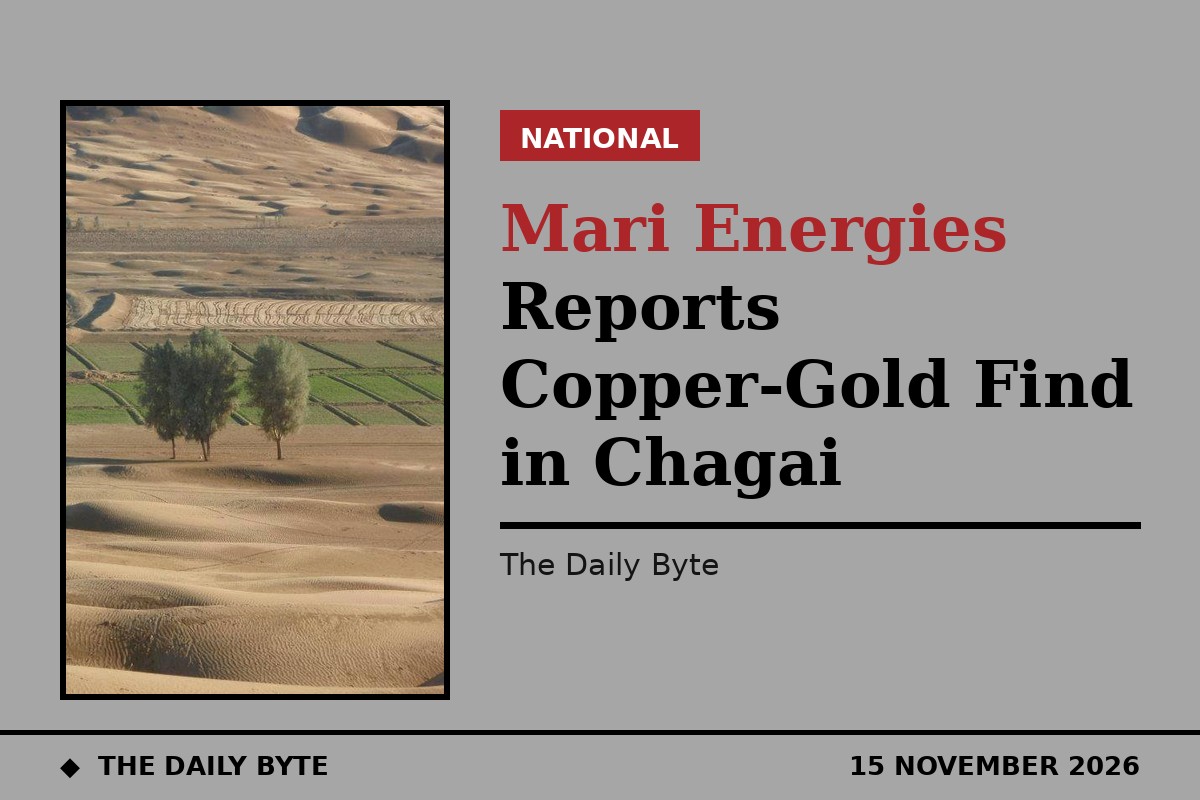
Mari Energies Limited has announced a significant copper-gold discovery at its East Siah Diq exploration target in Chagai district, Balochistan, in a development that lifted Pakistan's stock market on Friday.
The company disclosed the find to the Pakistan Stock Exchange on 13 November 2026, saying the discovery was made through its wholly owned subsidiary, Mari Minerals (Private) Limited. The target, known as ESD-1, sits in the Koh-i-Sultan area, about 50 kilometres east of the Reko Diq copper-gold project and about 25 kilometres north-west of Nokkundi.
What the drilling found
According to the company's filing, Mari Minerals has completed about 25,000 metres of exploration drilling at ESD-1 in two phases, with drill holes reaching depths of up to 500 metres. The drilling identified porphyry-style copper mineralisation beneath about 100 metres of unconsolidated overburden, extending across an area of about 1.4 square kilometres.
One drill hole, ESD-1-DD-017, recorded 0.50 per cent copper over 400.25 metres, with 0.11 grams of gold per tonne. The highest gold concentration in the first-phase results was 0.19 grams per tonne, found in two separate holes. Assay results from the first phase of drilling have been completed, while laboratory analysis of second-phase samples is under way and is expected to be finished in the first quarter of 2027.
The company was careful to set out the limits of the announcement. It said further drilling, geological interpretation, metallurgical test work, resource estimation and technical studies would be required before the scale, grade continuity, economic significance and development potential of the mineralisation could be determined. The exploration results reported so far do not amount to a mineral resource or a mineral reserve.
Why Chagai matters
Chagai is already known as one of Pakistan's most mineral-rich districts. It is home to the Reko Diq project, one of the world's largest undeveloped copper-gold deposits, and to the Saindak copper-gold mine. A porphyry deposit is the geological type found at both of those sites, which is why the description carried weight with investors.
Even so, the distance from an exploration discovery to a producing mine is measured in years rather than months. Reko Diq was identified in the early 1990s and is still not in production more than thirty years later. The East Siah Diq find is the beginning of a long assessment process, not the end of one.
The discovery was announced by Mari Energies managing director and chief executive Faheem Haider at the Pakistan Mineral Investment Forum 2026, as the government seeks to attract investment into the country's mining sector.
Market reaction
The announcement moved the stock market on Friday afternoon. The benchmark KSE-100 index closed 500.11 points higher at 177,873.87, a gain of 0.28 per cent, recovering part of the 1,710 points it had shed on Thursday in profit-taking.
The index had traded as high as 179,284.34 during the session before settling lower. Mari Energies was among the day's top gainers, rising 5.77 per cent, alongside Lucky Cement, Pakistan Petroleum, Pakistan Services and Fatima Fertiliser, which together added roughly 722 points to the benchmark between them.
Trading volume across the market reached about 1.04 billion shares, with a traded value of about Rs31 billion. The index remains below the 180,000 mark it crossed earlier in the week, and whether the Chagai discovery leads to a lasting re-rating of mining stocks will depend on the drilling results still to come.
Source: Pakistan Stock Exchange disclosure by Mari Energies Limited