Mehfooz Dawa app lets Pakistanis check fake medicines
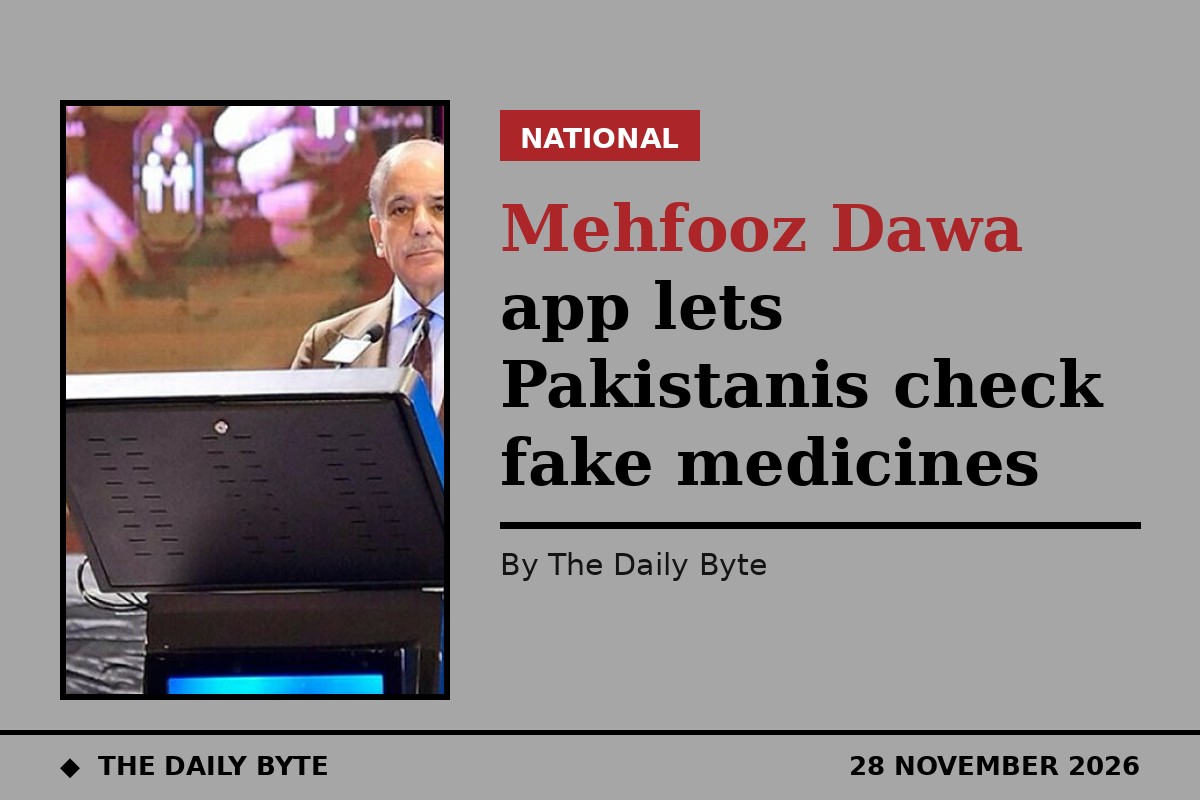
Prime Minister Shehbaz Sharif formally launched the Mehfooz Dawa mobile application in Islamabad on Thursday, 26 November 2026, giving people across Pakistan a new way to check whether the medicine they are about to buy is genuine. At the launch ceremony, the prime minister scanned the code printed on a medicine packet, and the application showed a green signal confirming that the product was genuine.
The application, whose name means safe medicine, was developed by the Ministry of National Health Services, Regulations and Coordination together with the Drug Regulatory Authority of Pakistan (DRAP). It is designed to help households protect themselves against counterfeit, substandard and unregistered medicines, and to give them a simple check they can run before they pay.
How the app works
Users point their phone camera at the two-dimensional code printed on a medicine pack. The application checks the code against a government database and shows a colour-coded result: green means the product details match the official record, while red warns that the medicine may be counterfeit or otherwise suspicious.
The same check also shows the medicine's registered price and its expiry date, and users can report suspected fake medicines, quality problems and drug shortages directly to the regulator. Complaints are handled through an enforcement mechanism, and the system is backed by an integrated Rapid Alert System so that risks can be identified and acted on quickly.
Around 700 pharmaceutical companies have shared data covering about 92,000 medicines, according to the health minister, Syed Mustafa Kamal. He said that with nearly 200 million mobile phones in the country, the application could reach people across Pakistan, and that the green and red indicators were designed so that even people with limited literacy could use them.
DRAP chief executive Dr Obaidullah said the government had directed the complete digitisation of the authority's regulatory system, and that all of its regulatory processes had now been digitised end to end. The underlying track-and-trace platform became operational on 9 October 2026, and the launch ceremony marked its formal public introduction. The application is available for download on both Android and Apple devices.
A barcode check confirms that a product's details match the official database. It cannot by itself test the chemical contents of the medicine inside the packet, so a copied code on falsified packaging remains a risk the system cannot remove on its own.
Why the prime minister backed it
Addressing the ceremony, the prime minister recalled a tragedy from his time as chief minister of Punjab in 2010 and 2011, when around 100 heart patients at the Punjab Institute of Cardiology died after being given the wrong medicine. He said samples were sent to laboratories in London, Geneva and Paris, which found that medicines intended to treat malaria had been given to cardiac patients, even though the federal government at the time had maintained that nothing was wrong with the drugs and blamed the provincial government.
The prime minister said such painful incidents showed why stronger regulatory oversight and modern technology were needed. He said the Mehfooz Dawa application was an important step towards better healthcare and the supply of safe medicines, and he congratulated the teams behind it, including the health ministry, DRAP, the information technology ministry and representatives of the pharmaceutical industry.
What happens next
The prime minister directed the information and information technology ministries, working with the health ministry, to run a public awareness campaign so that the application reaches every household. He said education and healthcare should be equally available to every citizen, noting that privileged families could afford treatment at leading hospitals while millions of ordinary people struggled to meet even their basic food needs, with medical treatment an added burden.