Mercury and Venus Turn Direct on Friday 13 November
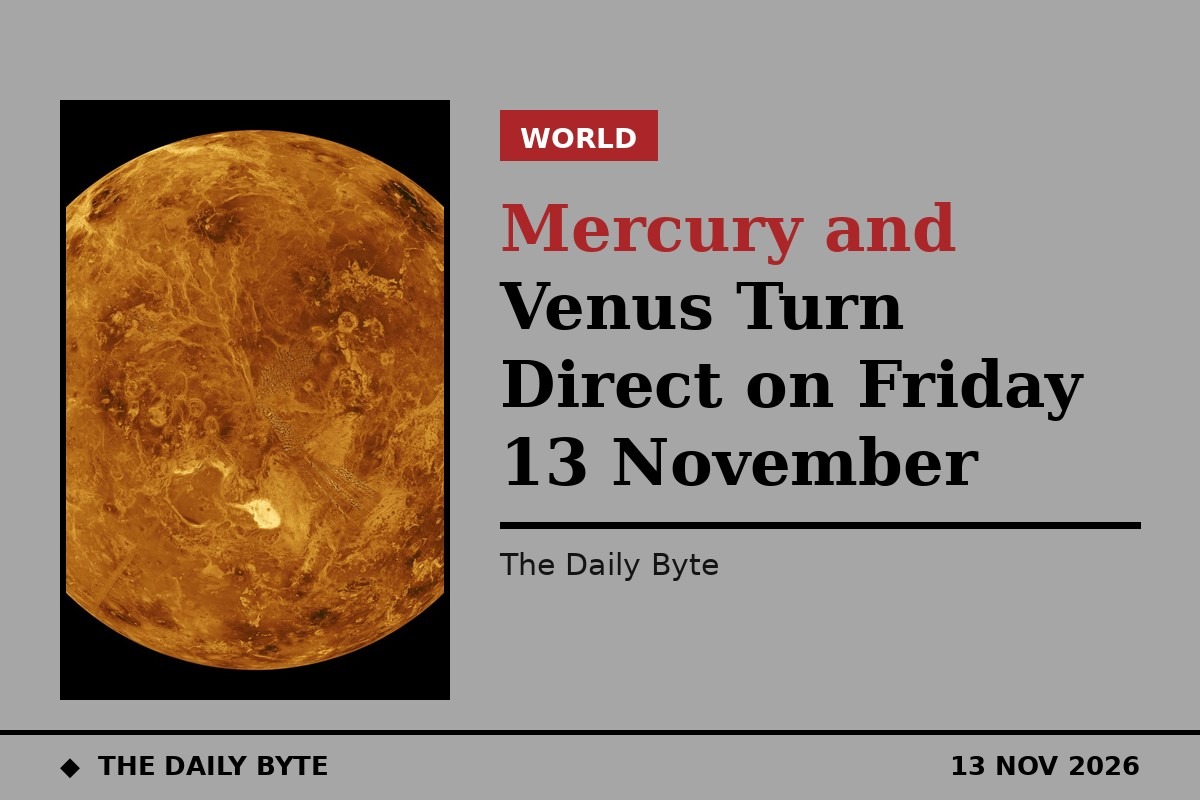
Mercury and Venus both turn direct on Friday, 13 November 2026, ending the stretch in which the two planets appeared to move backwards across the sky. Mercury resumes forward motion at 15:56 UTC (10:56 a.m. Eastern time) at 5 degrees Scorpio, and Venus follows at 00:21 UTC on 14 November (7:21 p.m. Eastern on 13 November) at 22 degrees Libra, less than nine hours later. Neither planet actually reverses in its orbit: the backward motion is an illusion created by the different speeds at which the planets travel around the Sun.
The double turning point is unusual. Mercury has been retrograde since 24 October, while Venus has been retrograde since 3 October, so the two planets have been moving backwards together for three weeks. Both stations fall on Friday the 13th in the Americas, while in Britain Venus turns direct in the early hours of Saturday, 14 November.
When exactly do Mercury and Venus turn direct?
Mercury stations direct on 13 November 2026 at 15:56 UTC, at 5 degrees 2 minutes Scorpio, according to ephemeris calculations published by Charting Stars. It turned retrograde on 24 October at 07:13 UTC, at 20 degrees 59 minutes Scorpio, so this retrograde lasted 20 days and stayed entirely within Scorpio. Venus stations direct on 13 November at 7:21 p.m. Eastern time, which is 00:21 UTC on 14 November, at 22 degrees 52 minutes Libra, according to calculations published by Totally Tarot using the Astronomy Engine ephemeris. Venus turned retrograde on 3 October at 3:09 a.m. Eastern, at 8 degrees 29 minutes Scorpio, and backed into Libra on 25 October. Its retrograde lasted 42 days.
The two stations are less than nine hours apart. That is why 13 November stands out: two separate retrograde cycles, one lasting three weeks and the other six weeks, close on the same calendar day in the Americas. In London the picture is split across midnight: Mercury turns direct during the afternoon of Friday, 13 November, while Venus turns direct at 00:21 UTC, in the early hours of Saturday, 14 November.
What does retrograde actually mean?
Retrograde motion is apparent, not real. Every planet orbits the Sun in the same direction, and none of them ever turns around. A planet looks as if it is moving backwards against the background stars when the geometry of the orbits lines up in a particular way. For planets beyond Earth, it happens when faster-moving Earth overtakes them. For Mercury and Venus, which orbit inside Earth's path and travel faster than we do, it happens when they lap Earth as they swing around the Sun. Astronomy magazine explains that the same effect makes a slower car appear to move backwards when a faster car overtakes it on a motorway.
Mercury, the fastest planet, goes retrograde about three times a year, and each episode lasts around three weeks. Venus goes retrograde far less often, roughly once every 19 months, and each episode lasts about six weeks. That is why a Venus retrograde is treated as the rarer event: the last one before this cycle was in 2023, and the next one does not begin until May 2028.
Why do both turn direct on the same day?
There is no shared cause; it is a coincidence of two independent cycles overlapping. Venus began its retrograde on 3 October, and Mercury joined it on 24 October, so from 24 October to 13 November both planets were retrograde at the same time. Because Mercury's retrograde is shorter, it ends first, in the morning in the Americas, and Venus, whose retrograde began three weeks earlier, ends the same evening. The two planets also sit in neighbouring signs: Mercury turns direct in Scorpio, the sign it has occupied throughout, while Venus turns direct in Libra, the sign it moved back into on 25 October.
What is a shadow period?
A shadow period is the stretch before and after a retrograde during which a planet crosses the same degrees of the sky it covers while retrograde. Astrologers use the term to describe a gradual return to normal rather than an overnight reset. Mercury's post-retrograde shadow runs until 30 November, when it passes the degree at which it turned retrograde. Venus takes longer: it re-enters Scorpio on 4 December and does not leave its post-retrograde shadow until 15 December.
In practical terms, that means the planets will spend the rest of November retracing ground they have already covered. Mercury will move forward through the degrees of Scorpio it travelled backwards through in late October and early November, and Venus will do the same through Libra and then Scorpio. The stations on 13 November mark the turning point, but the full cycle is not complete until those shadow periods end.
What astrologers say, and what science says
In astrology, Mercury is traditionally linked with communication, travel and technology, and Venus with relationships, money and values. Astrologers therefore describe Mercury retrograde as a time of mixed messages, delayed plans and technical glitches, and Venus retrograde as a time of reviewing relationships and finances. The double station on 13 November is presented in that tradition as a moment when stalled conversations and decisions can start moving again.
None of that is supported by scientific evidence. There is no known mechanism by which the apparent direction of Mercury or Venus, as seen from Earth, could affect phones, travel or relationships. The astronomical facts — the dates, the positions and the geometry — are real and measurable. The interpretations attached to them are a belief tradition, and they should be read as such. What is certain is the sky itself: after 13 November, both planets will once again appear to move steadily eastward against the stars, as they do for most of the year.
Frequently asked questions
When did Mercury retrograde start? Mercury turned retrograde on 24 October 2026 at 20 degrees 59 minutes Scorpio, and turned direct on 13 November at 5 degrees 2 minutes Scorpio.
When does Venus retrograde end in the UK? Venus stations direct at 00:21 UTC on Saturday, 14 November 2026, so in Britain the retrograde ends in the early hours of the 14th, not on the 13th itself.
Will everything change overnight on 13 November? No. Both planets have post-retrograde shadow periods — Mercury's ends on 30 November and Venus's on 15 December — so astrologers describe the return to momentum as gradual rather than instant.
When is the next Mercury retrograde? The next Mercury retrograde begins on 9 February 2027 and ends on 3 March 2027, according to the same ephemeris calculations.
When is the next Venus retrograde? Venus does not turn retrograde again until May 2028, with the next cycle beginning on 10 May 2028.
Sources: Charting Stars Mercury retrograde 2026 almanac; Totally Tarot Venus retrograde 2026 dates; Astronomy magazine on what retrograde means for the planets.