Mia Latter urges staggered age of consent law change
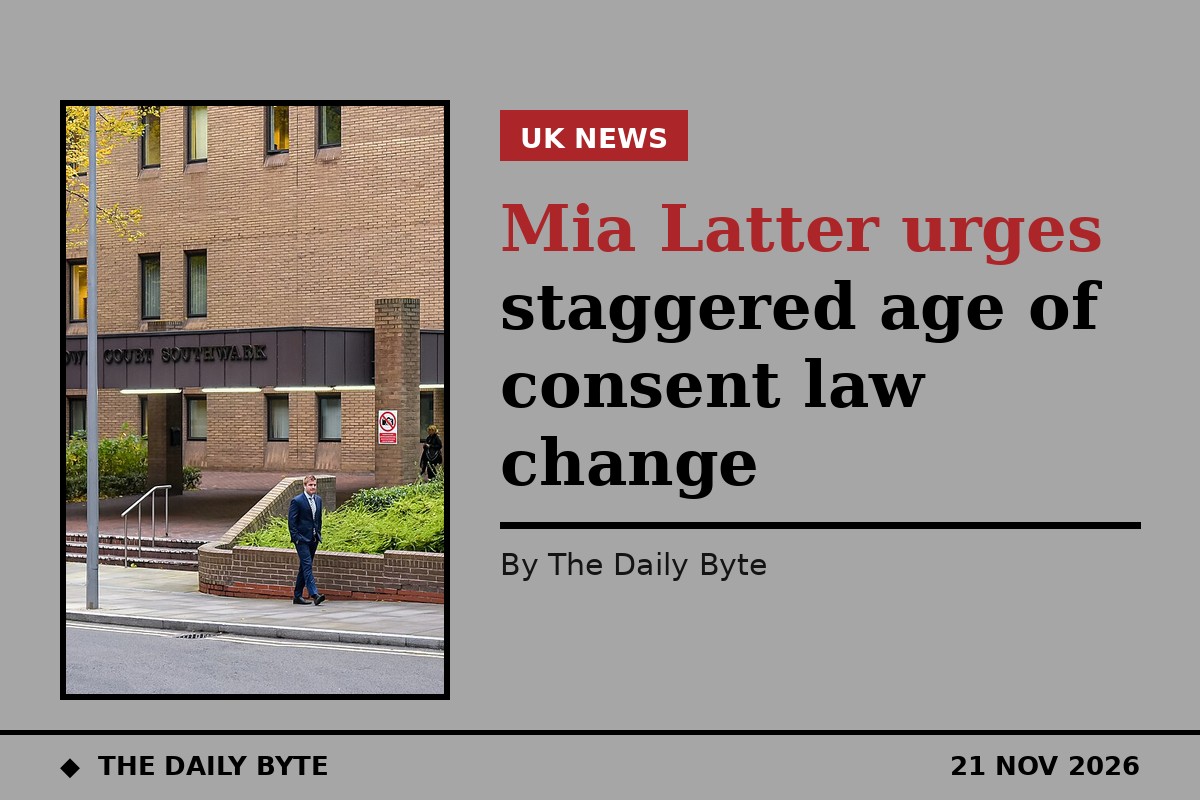
Mia Latter, who alleges Russell Brand raped her when she was 16, has waived her right to anonymity to campaign for a staggered age of consent, arguing it would stop adults sexually exploiting teenagers.
Latter, now 37, told BBC Radio 4's Today programme that a staggered law would have stopped her relationship with Brand dead in its tracks. Work and Pensions Secretary Pat McFadden has said ministers will discuss the idea.
Who Mia Latter is
Latter was known publicly only as Alice, the pseudonym given to her by The Sunday Times in its 2023 investigation into Brand, conducted with The Times and Channel 4's Dispatches. She is the first woman accusing Brand of rape to reveal her identity publicly.
She alleges that Brand raped her in 2006, near the end of a three-month relationship, when she was 16 and he was 30. She says he told her to keep the relationship secret from her school friends and called her the child in front of his entourage. Brand denies her claims, and her allegation was not part of his criminal trial and has not been tested in court.
Brand, 51, is serving ten years and six months after a jury at Southwark Crown Court convicted him on 5 November of one count of rape and three counts of sexual assault, involving four women, for offences between 2004 and 2009. He was acquitted of three further counts. His convictions do not relate to Latter.
Latter told The Sunday Times that the Crown Prosecution Service decided not to include her in Brand's trial, although police wanted her in subsequent proceedings. She said she would not continue with the criminal process so she could concentrate on campaigning, and the Metropolitan Police says its investigation remains ongoing.
Upset by the prison message
Latter spoke out after Brand's wife, Laura, read a message from him on their Sunday Service show on YouTube, in which he said he was not guilty of the offences he had been jailed for. Latter told the BBC she found it appalling to hear this Christian message alongside absolute lies.
She said she felt for the women who stood trial and everything they went through, adding that they got their verdict and there was no arguing with the fact that Brand is now a convicted rapist.
Latter also said she and the complainants in Brand's trial had been accused of being money hungry. It's a criminal trial, there's no money, she said. We're just doing this in the pursuit of justice.
What a staggered age of consent would mean
Under Latter's proposal, sex between adults and 16- and 17-year-olds would become a criminal offence, while relationships between teenagers themselves would not be criminalised. If you're between the ages of 16 and 18, it seems reasonable that you can have relationships with each other, she said. But if you're in your thirties, forties and fifties and you're trying to have a relationship with someone under the age of 18, it should be a criminal offence.
The age of consent in England and Wales is 16, a threshold set in 1885. Latter said a staggered law would have made a difference in her own case. It would have 100% made a difference because my parents tried to stop the relationship, she said. They tried to prevent me from seeing him. But if it had been a criminal offence for him to be having a relationship with me, none of the subsequent abuse would have ever happened because they would have been able to stop the relationship dead in its tracks.
Brand has said the relationship was exploitative because of the power differential, but consensual. On Megyn Kelly's channel he admitted he had manipulated consent, a description Latter called laughable.
Ministers say they will discuss it
Louise Haigh, the de facto deputy prime minister, said changing the age of consent would be a massive step, but that it deserved proper consideration and scrutiny, and that lawmakers should put victims' experience at the heart of what they consider.
Baroness Harriet Harman, the government's special envoy on women and girls, called it a good idea, and MP Jess Phillips has urged ministers to draft policy on the change. McFadden told BBC One's Sunday with Laura Kuenssberg that ministers will discuss the proposal.
The campaign group Close the Consent Gap, founded by Layla Stone in April, is also arguing for a staggered law. Stone said the catalyst came earlier this year, when Brand described his relationship with a 16-year-old girl as awful but not unlawful. The campaign has been given fresh impetus by separate allegations about the comedian David Walliams, reported by ITN and The Guardian, which he denies.