Michel Zecler Trial: Three French Police Officers Face Court
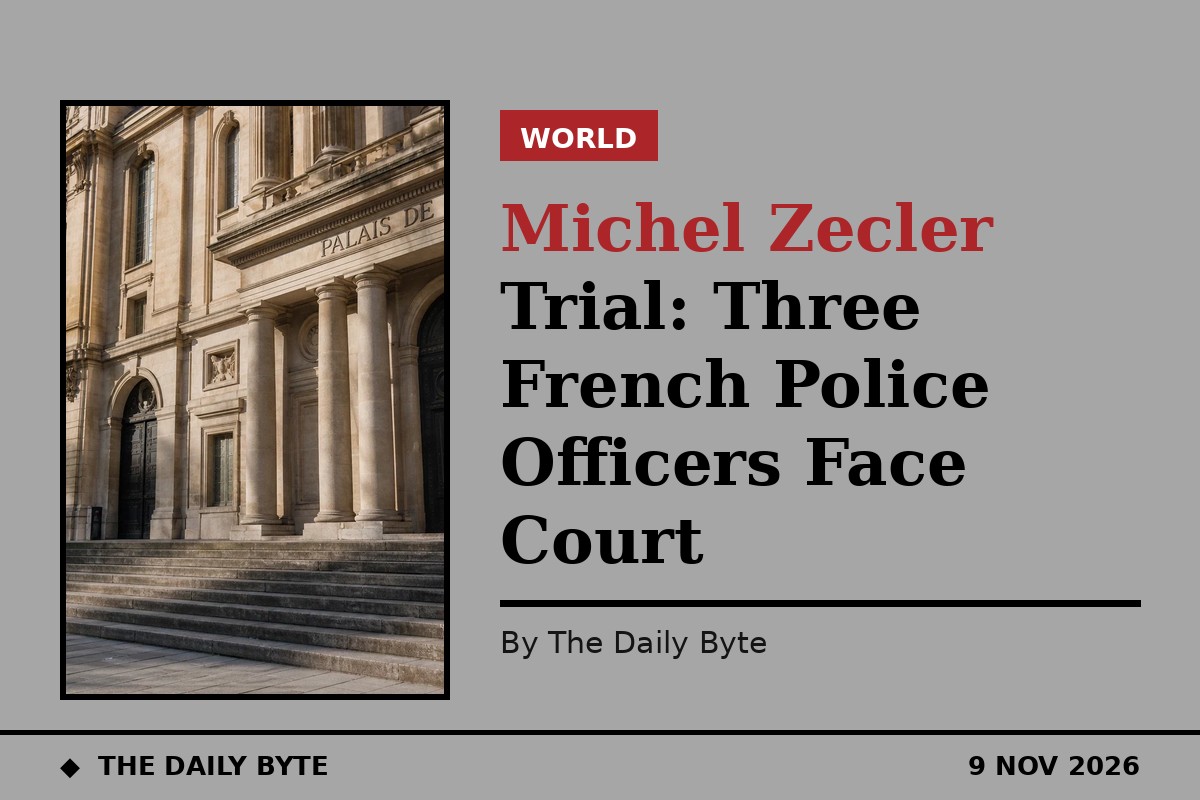
Three French police officers have gone on trial in Paris over the beating of music producer Michel Zecler in his recording studio in November 2020, in one of the most emblematic police violence cases in modern French history. The trial opened at the Paris criminal court on Monday, 9 November, and is expected to last two weeks, almost six years after the attack.
The officers, aged 29, 37 and 50, are accused of violently assaulting Zecler, now 47, inside his studio in the 17th arrondissement of Paris on 21 November 2020, and of falsifying official records to cover up what happened. They face charges of intentional violence committed by a group, by a person holding public authority and with a weapon, as well as forgery of a public document by a person holding public authority. Because the violence was allegedly committed by police officers, the charges carry a maximum sentence of 15 years in prison.
Five minutes of violence caught on camera
According to the indictment, the officers followed Zecler into his studio after stopping him in the street for not wearing a surgical mask, which was compulsory at the time because of the Covid-19 pandemic. Zecler later said he did not understand that he was being stopped and did not realise his assailants were police officers. During the beating he called for help and asked for someone to call the police.
The indictment describes five minutes of sustained violence in which Zecler, offering only passive resistance, was kicked three times, punched 16 times and struck 10 times with a metal baton, including several blows to his face and head. The officers then called for backup and used a tear gas grenade inside the premises, a use described as illegal and dangerous, before subduing and arresting him. Zecler was left injured and disfigured and was later given 45 days of temporary incapacity for work.
Surveillance footage changed the case
The following day, faced with Zecler’s injuries and his account, the judge overseeing the case ordered investigators to review the studio’s surveillance footage. The video completely changed the direction of the case. On 23 November the investigation into Zecler was dropped, and the next day the Paris prosecutor’s office asked the Inspectorate General of the National Police to investigate intentional violence and falsification of a public document by a person holding public authority. Days later the footage was published by the news site Loopsider, causing an immediate public outcry.
President Emmanuel Macron wrote on Facebook a week after the beating that the footage was unacceptable and that it shamed France.
Forgery charge rarely brought against officers
After the judicial inquiry, prosecutors and investigating judges decided the three officers should also be prosecuted for falsifying a public document. The offence is particularly difficult to prove because it requires ruling out the possibility that the author of the false document made an honest mistake, and police officers are rarely prosecuted for it. In this case the judges noted falsehoods in the report that clearly went beyond differences in human testimony and indicated a desire to distort reality, adding that the violence committed by the officers was, to a very large extent, omitted from the report, which could only be interpreted as an attempt to conceal what really happened. The officers deny any intent to conceal or distort the facts.
The trial is also expected to hear debate on whether racism played a role in the officers’ actions, as alleged by Zecler, who is Black and said one of the officers used racial slurs during the attack. The investigating judges noted that it was impossible to prove that considerations other than the missing mask lay behind the stop, and that Zecler’s statements about the insults changed over several interviews, so it was not possible to identify with certainty who was behind them. The indictment nevertheless acknowledges that Zecler endured traumatic moments and was the victim of thoroughly illegitimate and particularly intense violence over a prolonged period.
Ten days after the incident, two of the officers were placed in provisional detention at the Santé prison in Paris before being released under conditional release three weeks later, on 22 December 2020. The third officer was placed under conditional release from the outset. All three were suspended from duty, and in July 2021 the police inspectorate recommended that they appear before a disciplinary board. The court will now decide whether the three men are guilty of the violence and the alleged cover-up, in a case that has followed France’s debate over policing for six years.


