Missing Man Formation Explained: Remembrance Flypast
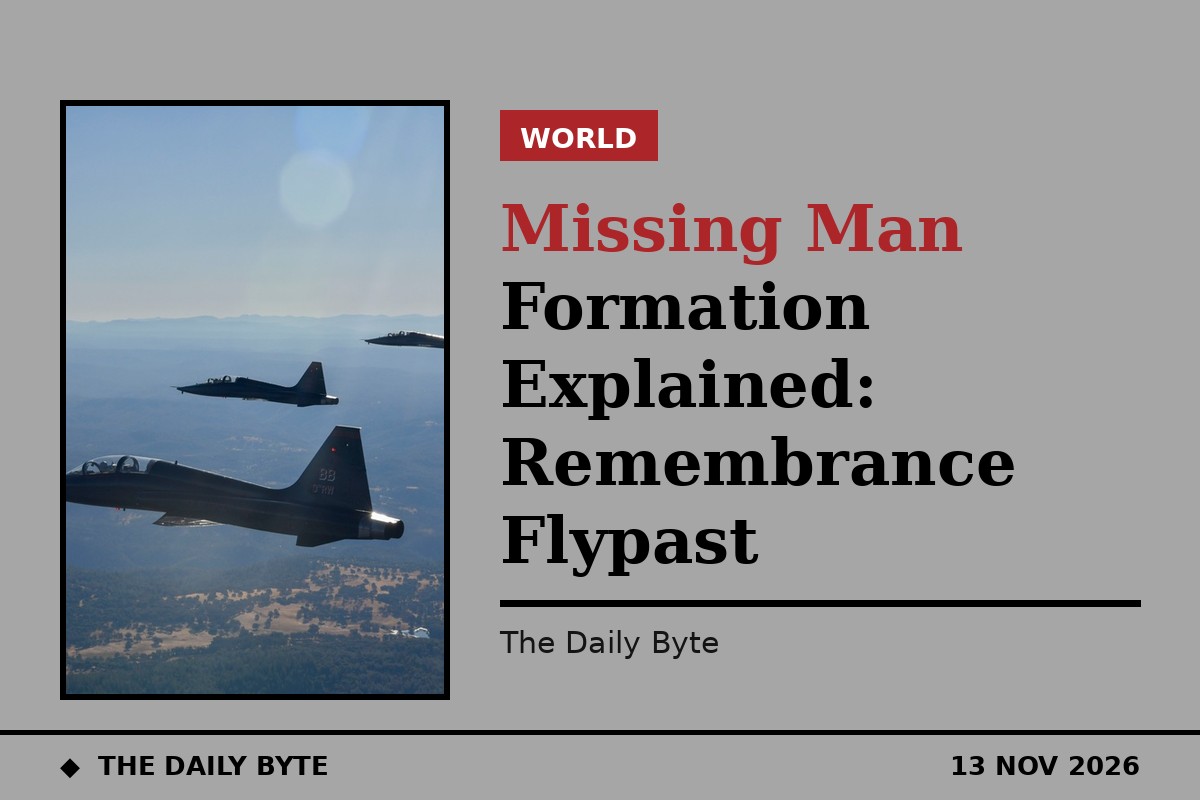
A Missing Man formation is an aerial salute flown by aircraft at a funeral or memorial event, in memory of a fallen pilot, a well-known member of the armed forces or veteran, or a well-known public figure. The aircraft fly in a formation that leaves a space where one plane should be, symbolising the person's absence. In the standard version, four aircraft fly in a "finger-four" formation and the third aircraft suddenly pulls up into a steep climb, leaving a solemn empty spot in the sky. On 11 November 2026, six small aircraft were flying this salute over a Remembrance Day ceremony in Saint-Georges, Quebec, when one of them crashed, killing the pilot. This explainer sets out how the formation works, where it comes from, and exactly what happened in Quebec.
What is a Missing Man formation?
The Missing Man formation is an aerial salute performed as part of a flypast of aircraft at a funeral or memorial event. The planes fly in a formation with a space where one plane should be, symbolising the person's absence. The formation most commonly used in the United States is based on the "finger-four" aircraft combat formation, composed of two pairs of aircraft. The aircraft fly in a V-shape, with the flight leader at the point and the wingman on the left, and the second element leader and wingman on the right. The formation flies over the ceremony low enough to be clearly seen, and the second element leader, the third aircraft in the formation, abruptly pulls up out of the formation while the rest continue in level flight until all the aircraft are out of sight.
The War Zone, the defence publication, describes it as a fingertip arrangement that sees the third aircraft pull up into a steep climb, "ascending to the heavens while leaving a solemn empty spot in the formation from which they departed". The climb is the heart of the salute. It is meant to be seen by everyone gathered below, and it is deliberately dramatic: one aircraft rises away from the group while the others carry on, and the gap it leaves behind is the point of the whole manoeuvre.
The salute is not limited to fast jets. Other aircraft, including helicopters, execute Missing Man formations as well. One place where the formation occurs periodically is over Arlington National Cemetery in the United States, where the thunder of jets overhead interrupts the quiet of the cemetery as a final tribute to a fallen service member. The salute is also used at memorial events outside the military, including in motorsport, in memory of a recently deceased driver.
Where did the tradition come from?
The Missing Man formation aerial salute dates back to the 1930s, with its origins in Britain, and there have been a few variations over the decades. The finger-four version, with a division of aircraft and the number three pilot pulling up into a steep climb over the target, has become pretty much standard by now, according to The War Zone. The first flypast in the modern formation of four planes is believed to have occurred in 1931, at the funeral of the American aviator Charles W. "Speed" Holman.
The tradition has been kept alive by military aviators ever since. Dedicated funeral and memorial flyovers, which often include Missing Man formations, are especially important within the culture of military aviation and among the aircrews who are tasked to fly them. The War Zone notes that aircrews go to great lengths to execute these flyovers even in the most abhorrent of conditions, which it describes as a testament to the esprit de corps of America's flying forces.
What does the 1996 Oceana display show?
One of the most famous Missing Man displays took place in 1996, at the Naval Air Station Oceana air show in Virginia. The legendary high-time Tomcat pilot Dale "Snort" Snodgrass flew the missing man in an F-14 Tomcat alongside three other legendary "Grumman Cats". The other aircraft were all piston-powered Second World War fighters: an F8F Bearcat, an F6F Hellcat and a F7F Tigercat. Snodgrass not only stayed in position with the comparatively slow-flying Second World War fighters, he did so with the Tomcat's wings swept fully back, and then pulled up into the climb. The War Zone describes the display as "especially unique and downright fantastic", and the climb out as "just chilling". It is a good example of how the salute works in practice: the aircraft fly together, low and in tight formation, and then one of them leaves, and the crowd watches it climb away alone.
When is the formation flown?
The formation is flown at funerals and memorial services for pilots and service members, at Remembrance Day and Memorial Day ceremonies, and at commemorations for well-known public figures. Permanent memorial sculptures depicting the formation exist at Randolph Air Force Base in San Antonio, Texas, at Joint Base Pearl Harbor-Hickam in Honolulu, Hawaii, and at Valour Park near the National Museum of the United States Air Force in Dayton, Ohio.
In Canada, the salute is a familiar part of Remembrance Day. Remembrance Day is marked every year on 11 November, and small local ceremonies across Canada often include a flypast by civilian pilots from local flying clubs, as happened in Saint-Georges this year.
What happened in Saint-Georges, Quebec, on 11 November 2026?
A formation of six small aircraft crossed the sky over Place des Veterans in Saint-Georges, Quebec, on Wednesday morning, 11 November 2026, flying the Missing Man salute for Remembrance Day over a town gathered below. Then one of the planes broke away, dropped towards a wooded lot near the airport, and caught fire. Within minutes the ceremony was over and a man was dead.
The ceremony at Place des Veterans was under way when the planes came over. The mayor's speech was prepared and waiting, but it was never delivered. The crash was announced to the crowd during the ceremony, and the service stopped. Mayor Manon Bougie later told CBC that a formation of six aircraft was performing the Missing Man formation as part of the ceremony when one of the pilots crashed. She told the broadcaster LCN that the aircraft was "a small plane that left the city's airport", flying in "Missing Men" formation with five other aircraft, and that "it was on approach to the airport that one of those planes crashed in a wooded area near our airport". The city later issued a statement placing the crash at around 11 a.m. in a wooded area near 10th Street. The aircraft came down on land belonging to the erabliere Aurelien Lessard on 10th Street, near Parc des Sept-Chutes, close to the airport. The site sits in the sector of 30th Avenue and 10th Street, behind a home.
The pilot was a man in his 60s from the region, and he was alone in the aircraft. The Surete du Quebec, the provincial police, first said the pilot had very serious injuries and was in critical condition. The death was then confirmed at the scene. CBC News reported that the Surete confirmed the death shortly before 1:30 p.m. The pilot was later identified as 68-year-old Daniel Parent of Saint-Georges. The Quebec coroner's office named him on Thursday 12 November. Parent was a member of the local flying club, the Club Aeronautique de Beauce, and was flying in formation with five other members of the club when the crash happened.
Witnesses described what they saw and heard. Serge Doyon, watching from his balcony, told TVA Nouvelles that the planes flew in a triangle formation, and that the last plane on the right, at the back, went down a bit and then made a detour. "When they passed over here, you could hear there was a plane with a mechanical problem. The engine was burping, it would quit and restart. It roared and then it didn't roar anymore." His account is a witness description, not a finding, and investigators have not identified a cause. Marie-Soleil Lessard-Rancourt, who was taking a driving lesson when the formation passed overhead, told Le Journal de Quebec that she saw six aircraft and quickly noticed one of them detaching from the group, heading in the opposite direction, before it nose-dived. A resident, Melanie Quirion, wrote on Facebook that she saw six planes overfly the region at 10:50 a.m., about ten minutes before the crash, and that everything seemed normal at that moment.
Rescuers reached the site in under six minutes, according to Frederic Morin, director of the Saint-Georges fire service. They could do nothing to save the pilot. The aircraft was already in a generalised blaze. An air-ambulance helicopter was dispatched to the Saint-Georges airport. Michel Rodrigue, who lives about two kilometres from the ceremony site, heard the crash in the woods bordering his home. He told CBC the sound was metallic, like sheet metal. He grabbed two fire extinguishers, then realised two small fire extinguishers would not have been enough for a fire that size.
The effect on the ceremony was immediate. Yvon Thibodeau was at the ceremony as the six pilots flew over. He told Radio-Canada the accident was announced minutes later by the master of ceremonies, Lieutenant-Colonel Robert Bergeron, himself a member of the group flying in formation. "He said a plane had crashed. He collapsed, he was in total panic, he was crying and the ceremony stopped," Thibodeau said. Danny Lizotte, present as the representative of Beauce-Sud member of the National Assembly Jonathan Poulin, gave Le Devoir a similar account: "The officer burst into tears. The victim was his friend. Many people were crying, it was really very emotional."
Quebec Premier Paul St-Pierre Plamondon announced the death on X shortly after 1 p.m. "I have just learned of the death of the plane's pilot. I want to offer my sincere condolences to his family and his loved ones," he wrote. He said he was following the situation closely and was in contact with Interior Security Minister Guy Lapointe Jr. Charles Milliard, leader of the Quebec Liberal Party, offered condolences on X, and the Conservative leader Pierre Poilievre offered his sympathies and thanked the emergency teams. Jason Groleau, the federal MP for Beauce, said: "As we were gathered to honour our veterans at the Remembrance Day ceremony, a pilot participating in a commemorative flypast tragically lost his life in the crash of his plane."
What happens next in the investigation?
The Surete du Quebec and the Transportation Safety Board of Canada are handling the investigation. The Surete's role is to make sure the crash is not linked to a crime, which the police say is rarely the case in an aircraft crash, and to let investigators rule that out. The Transportation Safety Board's expertise, the police said, "will be to determine whether there was a breakage, a mis-manoeuvre, a mechanical failure, that led to the loss of control". The board deployed a team of investigators to the site, and a spokesperson said no further information was available at the time. The police invited witnesses to contact them, and officers were meeting witnesses on Thursday 12 November.
The cause of the crash is not known. Le Journal de Quebec reported that it has not been possible to establish whether a mis-manoeuvre or a mechanical break is at the origin of the crash. Witnesses described engine trouble, but that is a witness account, not a finding. No make, model or registration of the aircraft had been released in the first reports, and the pilot's name was not released until the coroner's office identified him the following day. The Transportation Safety Board will determine what happened. Until then, the questions outnumber the answers, and the town is left with what it saw.
Frequently asked questions
How many aircraft fly in a Missing Man formation? The standard formation is four aircraft in a finger-four arrangement, with the third aircraft pulling up into a climb. But the number can vary. In Saint-Georges on 11 November 2026, six small aircraft flew the salute together. The point of the formation is the gap that is left behind, not the exact number of aircraft.
Is the missing aircraft always the third one? In the standard finger-four version, yes. The flight leader is aircraft number one, the wingman is number two, and the second element leader, number three, is the one that pulls up out of the formation over the ceremony while the rest continue in level flight.
Did the Quebec crash happen during the pull-up manoeuvre? No, according to the reports available on 13 November 2026. The mayor of Saint-Georges said the aircraft crashed on the approach to the airport, after the flypast over the ceremony. One local report said the accident happened on the return towards the airport, after the flypast. The cause has not been established, and the Transportation Safety Board of Canada is investigating.
Who was the pilot who died? The Quebec coroner's office named the victim on Thursday 12 November 2026 as 68-year-old Daniel Parent of Saint-Georges, Quebec. He was flying in formation with five other aircraft as part of the Remembrance Day commemoration.
Is the Missing Man formation only flown by the military? No. It began as a military tradition, but it is now also flown by civilian pilots at Remembrance Day ceremonies and memorial events, and the salute is used at memorial events outside the military, including in motorsport. The Saint-Georges flypast was flown by civilian pilots from a local flying club, not by the Royal Canadian Air Force.


