Modi opens Bengaluru Metro Pink Line in Rs 15,600 crore push
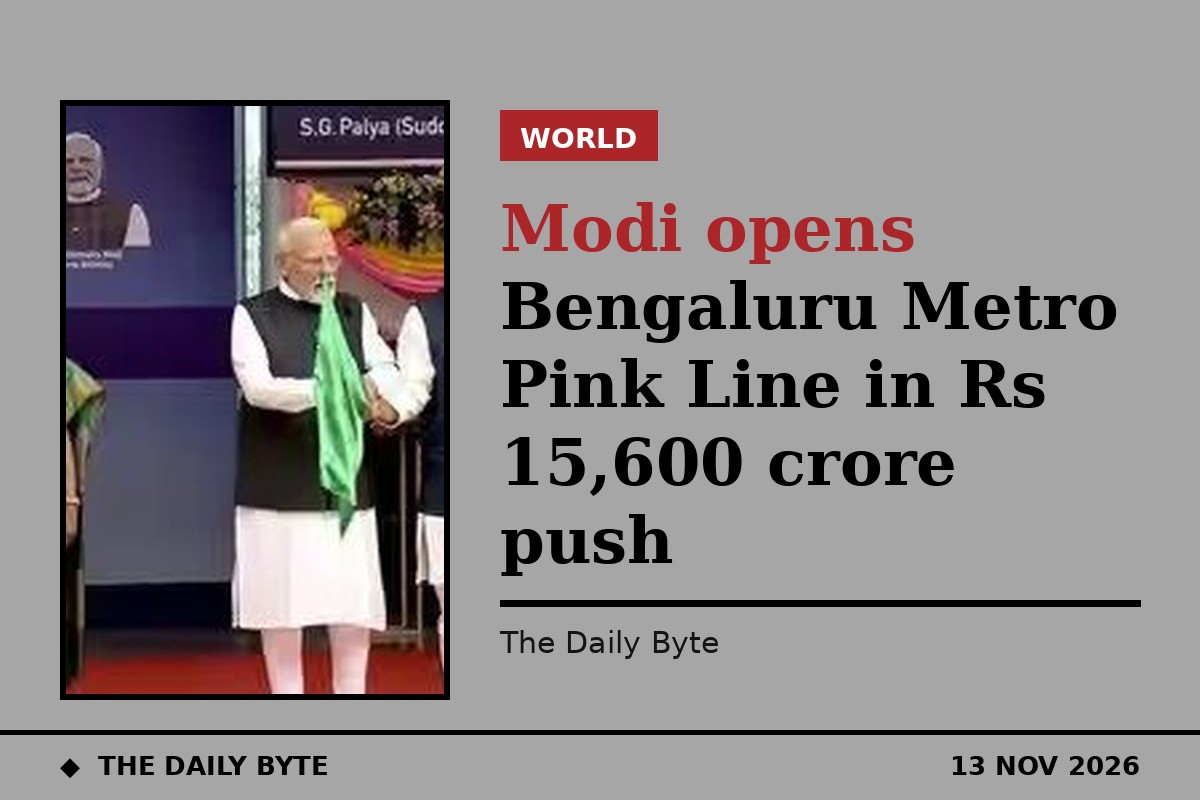
Indian Prime Minister Narendra Modi has inaugurated the elevated stretch of Bengaluru Metro’s Pink Line and unveiled development projects worth more than Rs 15,600 crore across Karnataka, in a visit centred on urban transport, renewable energy, railways and petroleum infrastructure. The new metro section opens to passengers from 6am on Saturday 14 November.
Modi on Friday inaugurated the 7.5 km elevated section of the Namma Metro Pink Line between Kalena Agrahara and Tavarekere, developed at a cost of around Rs 3,470 crore, the Hindu BusinessLine reported. He and Karnataka Chief Minister D. K. Shivakumar together flagged off the new services, travelled on the metro train and were seen buying separate tickets from the counter.
The elevated corridor has six stations: Kalena Agrahara, Hulimavu, IIMB, JP Nagar 4th Phase, Jayadeva Hospital and Tavarekere, also known as S. G. Palya. The full Pink Line is 21.25 km long with 18 stations; the remaining 12 stations are underground and still under construction. With the new section open, Bengaluru’s operational metro network passes 100 km, reaching 103 km and becoming the second-largest metro system in India after Delhi.
A double-decker corridor for southern Bengaluru
The Pink Line stretch runs along Bannerghatta Road in southern Bengaluru, one of the city’s busiest corridors. The chief minister explained to the prime minister the advantage of the double-decker elevated corridor, which carries a metro rail line as well as a flyover to ease traffic congestion in the city.
The new stretch is expected to connect with the Electronic City line at Jayadeva station, which is being developed as a multimodal interchange between the Pink and Yellow lines. The corridor passed its final inspection by the Commissioner of Metro Railway Safety on 8 October and received formal safety clearance on 28 October. Completion of the remaining underground portion of the Pink Line is planned for 2027.
Governor Sudha Yadav, MP Tejasvi Surya and minister K. B. Gowda also travelled on the metro train with the prime minister, who was presented with a model of the upcoming Jayadeva station during his visit to S. G. Palya station.
Rs 15,600 crore of projects across Karnataka
The metro opening was part of a wider programme of project launches, dedications and foundation stones valued at more than Rs 15,600 crore, Construction Mirror reported. In renewable energy, Modi inaugurated the transmission scheme for integrating renewable energy zones at Koppal-II and Gadag-II, developed at a cost of around Rs 4,450 crore and able to carry about 2 GW of renewable power, and a Rs 1,370 crore transmission scheme for the solar energy zone in Bidar that will enable the evacuation of 2.5 GW of solar power. He also laid the foundation stone for two further transmission projects, costing more than Rs 3,450 crore and over Rs 1,100 crore, to integrate renewable energy zones across Davanagere, Chitradurga and Ballari.
In the petroleum sector, Modi dedicated to the nation India’s largest underground LPG storage cavern at Mangaluru, built at a cost of more than Rs 850 crore with a storage capacity of 80,000 metric tonnes and connected to New Mangalore Port through a 9.4 km LPG pipeline. He also dedicated the Rs 330 crore Devangonthi marketing terminal of Mangalore Refinery and Petrochemicals Ltd, and laid the foundation stone for a GAIL compressed biogas plant at Haralakunte in Bengaluru designed to process about 300 tonnes of municipal solid waste a day and produce 12.6 tonnes of compressed biogas.
Railway infrastructure also featured prominently. Modi inaugurated four redeveloped stations under the Amrit Bharat Station Scheme — Chamarajanagar, Chikkamagaluru, Sakleshpur and Subrahmanya Road — dedicated the 45 km Bagalkot–Wandal railway doubling section, and dedicated the electrification of the 55 km Sakleshpur–Subrahmanya Road ghat section, completing electrification of the entire Bengaluru–Mangaluru railway route. He also flagged off the Bengaluru–Mangaluru–Madgaon Vande Bharat Express, which will run through Hassan, Sakleshpur, Mangaluru, Udupi, Murdeshwar, Gokarna and Karwar before reaching Madgaon in Goa.
Earlier in the day Modi took part in the golden jubilee celebrations of Prashanti Kutiram, the residential headquarters of the Swami Vivekananda Yoga Anusandhana Samsthana in Bengaluru, and the visit also included a programme in Mysuru, where he was scheduled to inaugurate the COSMOS-Mysuru Planetarium, India’s first LED dome planetarium.
Sources: The Hindu BusinessLine and Construction Mirror.


