Morgan Stanley Most Bullish on Stocks Since April
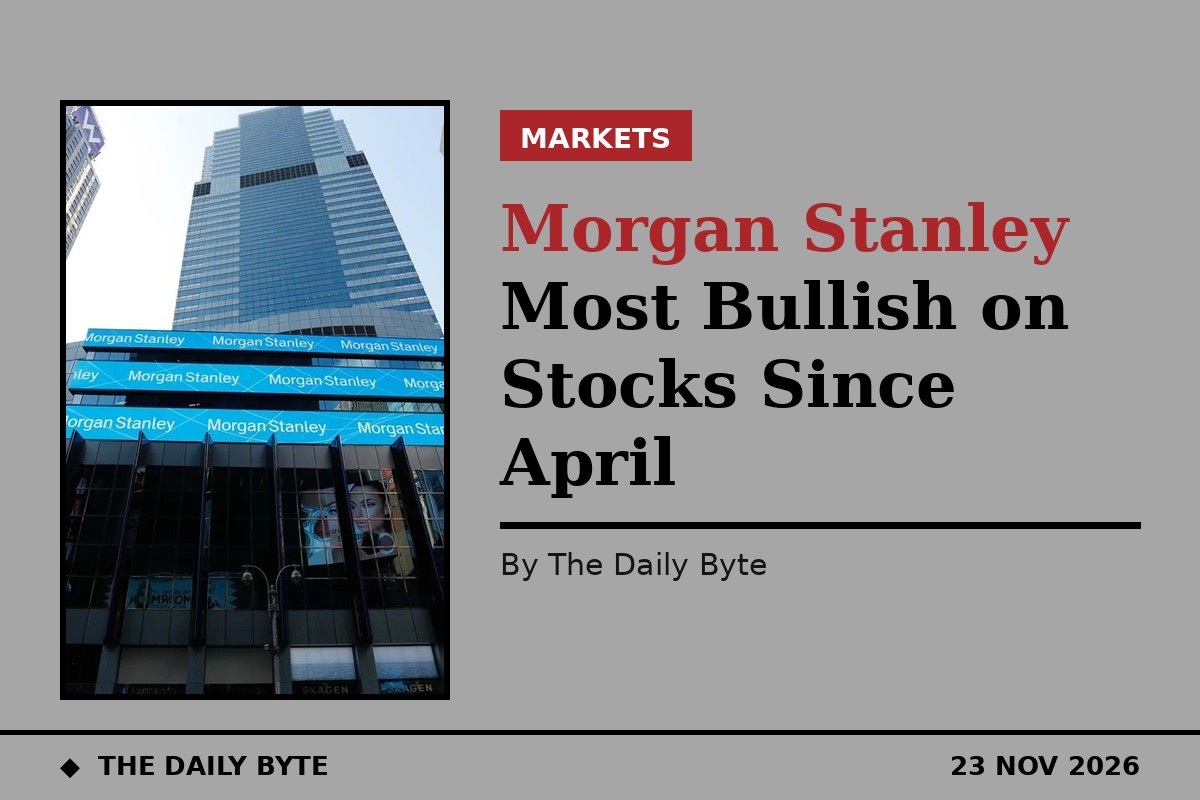
Morgan Stanley turned the most bullish on United States stocks it has been since early April, telling clients on Monday, 23 November, that last week's heavy sell-off has set the stage for a rebound because battered valuations now offer cheaper entry points.
The call came in the bank's weekly note from a team led by chief United States equity strategist Mike Wilson. The strategists described the sell-off as an overshoot that did not reflect a deterioration in the underlying fundamentals of corporate America, arguing that the market had already priced in an economic slowdown that may never arrive.
The scale of the decline explains why the note attracted so much attention. The benchmark S and P 500 and the Dow Jones Industrial Average both entered correction territory on Friday after seven consecutive sessions of losses, and the S and P 500 had fallen about 12 per cent from its early October record. The CBOE Volatility Index, Wall Street's fear gauge, spiked to 36 during the rout.
Wilson's team pointed to sentiment, valuation and positioning as the three reasons to step in now. Morgan Stanley's own sentiment indicator, a measure of market stress and risk appetite built from ten signals including volatility, fund flows and positioning, has fallen to minus 1.6, a level last seen in December 2018 and again in the March lows of 2026. Hedge fund net leverage has dropped to 41 per cent, fractionally below its December 2018 level, in a sign that leveraged investors have already cut exposure sharply.
The valuation argument is the centrepiece of the call. According to the bank, share prices are currently discounting a 6 per cent contraction in earnings in 2027. Morgan Stanley's own analysts expect profits to grow 14 per cent next year, while the broader Wall Street consensus is for growth of 17 per cent. The S and P 500 now trades on about 16 times earnings, against Morgan Stanley's fair value range of 19 to 19.6 times, after its forward price-to-earnings ratio fell from nearly 23 in late October to about 16.5.
The fundamental backdrop is considerably healthier today than it was after previous drawdowns, the analysts wrote, noting that earnings revision breadth stands at positive 10 per cent, compared with minus 10 per cent in December 2018, and that the labour market looks robust. That combination, they argued, gives little reason to read the current correction as a signal of a recession in 2027.
With the valuation reset and sentiment washout, we are now more bullish tactically than we have been since early April, Wilson and his team wrote. This is the fat pitch we have patiently been waiting for, and we are not going to miss it. The strategists said the sell-off had improved entry points in hyperscale cloud companies, industrial businesses, high-quality cyclical stocks with improving earnings revisions, and companies benefiting from the adoption of artificial intelligence.
The view is a striking counterpoint to the gloom that has gripped global markets. Worries about heavy spending on artificial intelligence, political headwinds and the hotly anticipated stock market debut of Anthropic, which failed to revive the sector, had amplified pressure on technology shares and dragged the major indexes down for a week.
Wilson's team did flag one main risk to the call: a hawkish Federal Reserve. Investors have been pricing in higher interest rates, with traders seeing at least two rate increases by March next year, according to data compiled by LSEG. Morgan Stanley argued that market pricing looks far too hawkish against the eventual path for rates, since markets have already done the tightening.
Futures pointed to a strong open for Wall Street's main indexes on Monday, with shares of some artificial intelligence heavyweights up in premarket trading. Nvidia, Alphabet and Meta each gained between 4 and 8 per cent before the bell, in an early sign that buyers were returning after the week's rout.