Mount Marapi Erupts Twice, Ash Blankets Agam
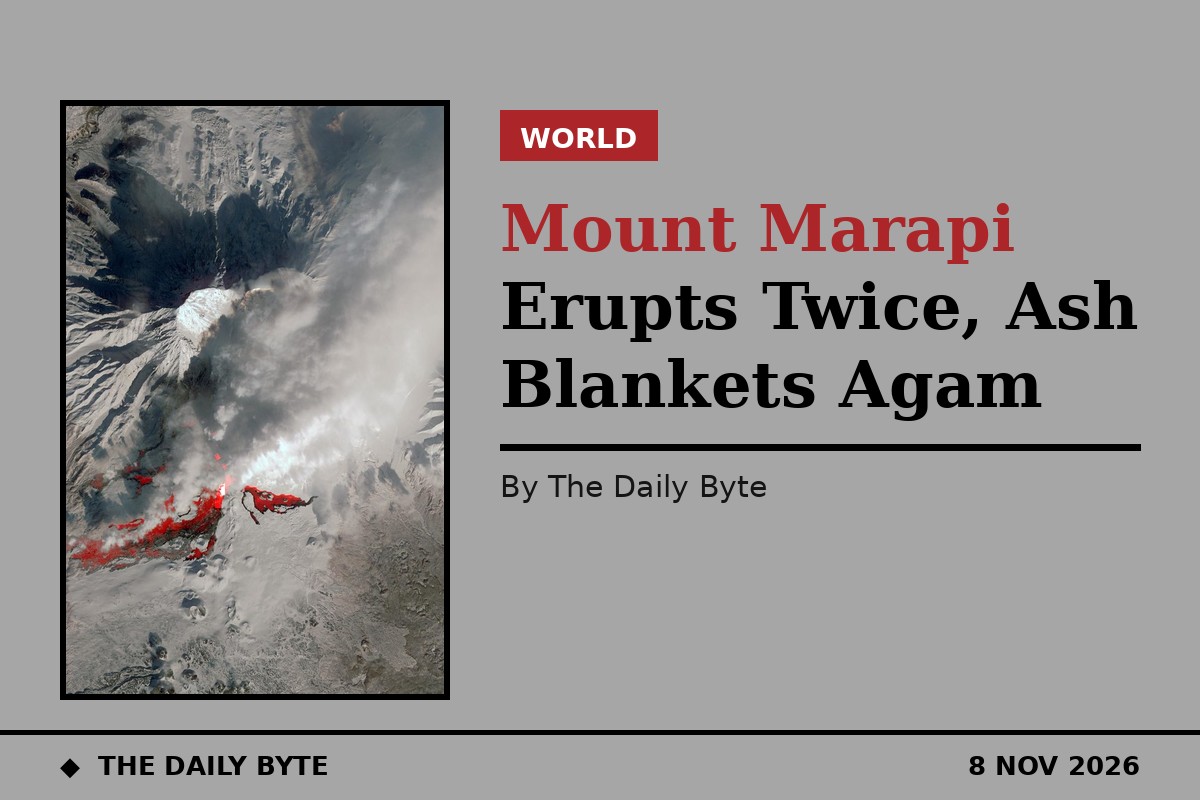
Mount Marapi in West Sumatra erupted twice in the space of about 15 hours, sending volcanic ash over villages in Agam regency and leaving residents struggling to breathe, Indonesian monitoring officials have said.
The first eruption took place on Saturday, 7 November, at 09:55 local time. A second, weaker eruption followed in the early hours of Sunday, 8 November, at 00:34 local time. Both were recorded by seismic stations at the volcano observation post, according to the volcanology news service Vulkane.net, which reported the events on 8 November.
Ash from the Saturday eruption fell on Sungai Pua district in Agam regency. The village of Sariak, in Nagari Sariak, was among the worst affected, with ash reducing visibility and causing breathing difficulties for residents. Ismail Damar, head of the local disaster-preparedness group in Sariak, said the ashfall was felt across the village and interfered with sight and breathing.
"Hujan abu vulkanik kami rasakan di Nagari Sariak, Sungai Pua. Sangat mengganggu penglihatan dan membuat nafas sesak," Damar said, describing how the volcanic ash rain was felt in Sariak and made breathing laboured. A local hamlet head, Ismail, said he had taken shelter inside a hut in his garden while the ash fell, because it was disrupting outdoor work.
Volcanic ash also covered farmland and plantations on the slopes of the mountain, according to local disaster officials, raising concern about damage to crops in the area.
Ahmad Rifandi, an officer at the Marapi volcano observation post, said the eruption on 7 November was recorded on a seismogram with a maximum amplitude of 15.6 millimetres and a duration of about 48 seconds. The second eruption, on 8 November, was weaker, with an amplitude of 4.9 millimetres and a duration of about 30 seconds. The height of the ash columns could not be determined from the observation post because of heavy cloud cover.
Marapi, which rises 2,891 metres above sea level between Agam and Tanah Datar regencies, remains at Level II, known as Waspada, the second level on Indonesia's four-tier alert system. The Centre for Volcanology and Geological Hazard Mitigation has told residents, climbers, visitors and tourists not to enter or carry out activities within three kilometres of the Verbeek crater, the centre of the eruption.
People living in valleys and along rivers that flow from the summit have also been told to stay alert for lahars, fast-moving flows of volcanic mud and debris, particularly when it rains near the peak. Residents have been advised to wear masks covering the nose and mouth if ash falls again, to reduce the risk of acute respiratory infection.
Monitoring data show that the volcano remained restless around the eruptions. On 7 November, the observatory recorded three degassing earthquakes, two non-harmonic tremor phases and continuous tremor, alongside local and distant tectonic earthquakes. The Darwin Volcanic Ash Advisory Centre could not identify an ash cloud in its latest satellite observation, and the aviation warning linked to the eruption was lifted after the earlier cloud had dispersed.
Marapi is one of Indonesia's most active volcanoes and is known for sudden eruptions that are difficult to predict, because they are not always preceded by the deep magma movement that registers clearly on seismic monitors. In December 2023, a surprise eruption killed 24 climbers who were caught near the summit.
Authorities have urged residents to stay calm, to follow official instructions from the local governments of Bukittinggi, Padang Panjang, Tanah Datar and Agam, and not to spread unverified information about the volcano's activity.