MPs Warn UK Dangerously Reliant on China for Minerals
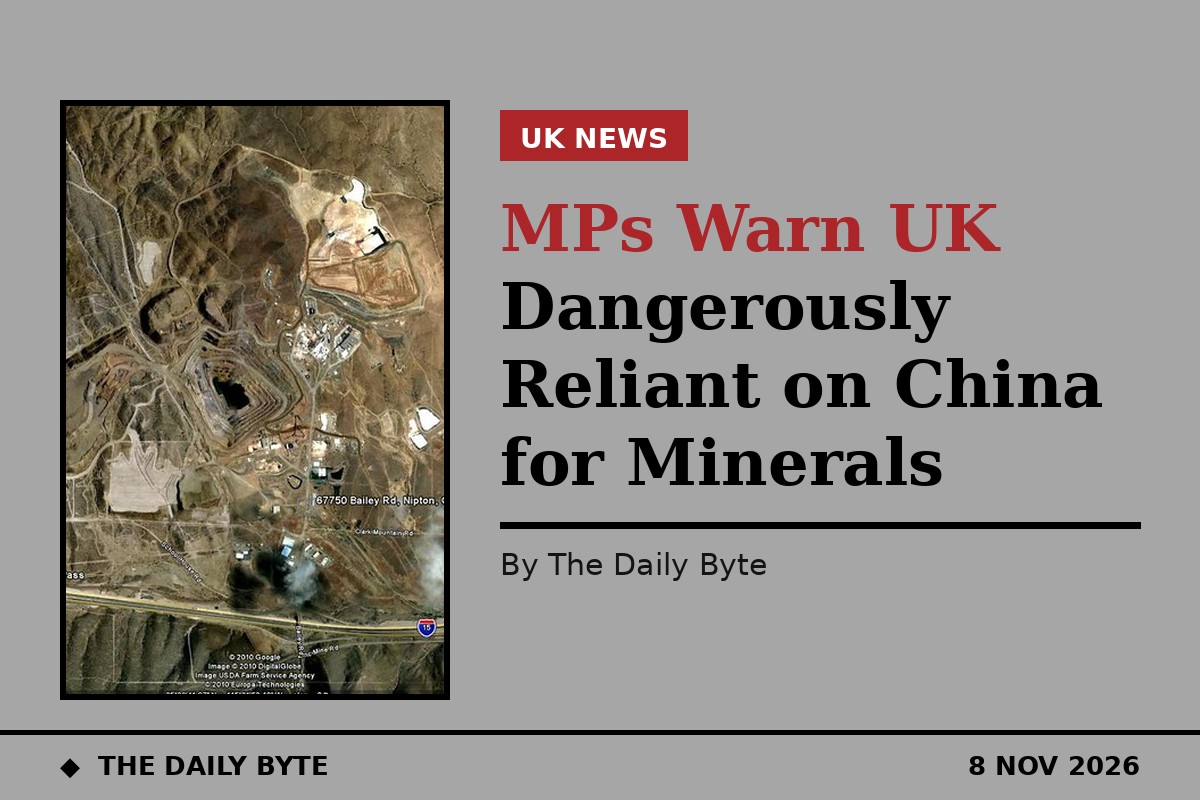
Britain is dangerously dependent on China for the critical minerals it needs to rebuild its armed forces, build artificial intelligence infrastructure and reach net zero, MPs have warned, and the government has no credible plan to reduce the risk.
The warning comes in a report published on 5 November 2026 by the House of Commons Business, Innovation, Science and Trade Committee. The committee set ministers ten tests for securing critical mineral supplies, and concluded that the government does not currently appear able to pass any of them.
China dominates refining, not just mining
The committee found that the bottleneck is not mainly who digs the minerals out of the ground, but who processes them. Citing International Energy Agency figures, it said China is the leading refiner for 19 of the 20 strategic minerals, with an average market share of 70%.
The concentration is even starker for some materials. China accounts for 95% of global gallium production and 93% of germanium, both used in advanced semiconductors for radar, communications and electronic warfare.
That dependence has already caused disruption. China's rare earth export controls in April 2025, introduced after US tariffs, rippled through manufacturing supply chains and forced temporary closures at car plants. British manufacturers can suffer even when Britain is not the intended target, the committee warned.
Demand is set to surge
The pressure is only going to grow. MPs were told that British demand for lithium, used in electric vehicle batteries, could rise 45-fold by 2030, while demand for the rare earths used in permanent magnets for military jets and other equipment could rise 16-fold.
At the same time, Britain is throwing away valuable material. The report found that 80% of UK metal products classified as waste are exported rather than recycled at home, and that high energy costs make domestic processing uneconomic. The committee also said Britain lacks up-to-date geological surveys and that outdated rules are holding back public finance institutions from investing in alternative supplies.
A five-part plan to cut the risk
The committee called for a five-part plan to, in its words, precision de-risk Britain's most dangerous dependencies. It wants the government to identify which sovereign capabilities must be protected, forecast demand by combining government and industry intelligence, and maximise domestic mining, processing and recycling.
It also wants allied buyers' clubs to share the costs of new mines and smelters, which can cost as much as $3 billion each, and a dedicated Critical Minerals Finance Facility to back strategic projects through equity, loans, guarantees and long-term purchase agreements.
Stockpiles could provide a short-term buffer. The committee called for an initial reserve covering about 60 days of the minerals needed for defence, while stressing that warehouses are no substitute for diversified supply.
Committee chair Liam Byrne said: "Critical minerals are the alpha of the new economy. We cannot re-arm Britain, build AI or deliver net zero unless we secure the minerals these technologies depend on." He added: "De-risking even a prudent proportion of our supplies will take over a decade. Britain cannot afford to drift. We must act now before dangerous dependencies become strategic liabilities."
The committee was clear that cutting China out entirely is neither realistic nor desirable. Its argument is that Britain needs to decide what it must protect, work out what those industries actually consume, and help finance alternatives before the next disruption arrives.