MSF Moves 76 Patients as Drones Hit Bunyakiri
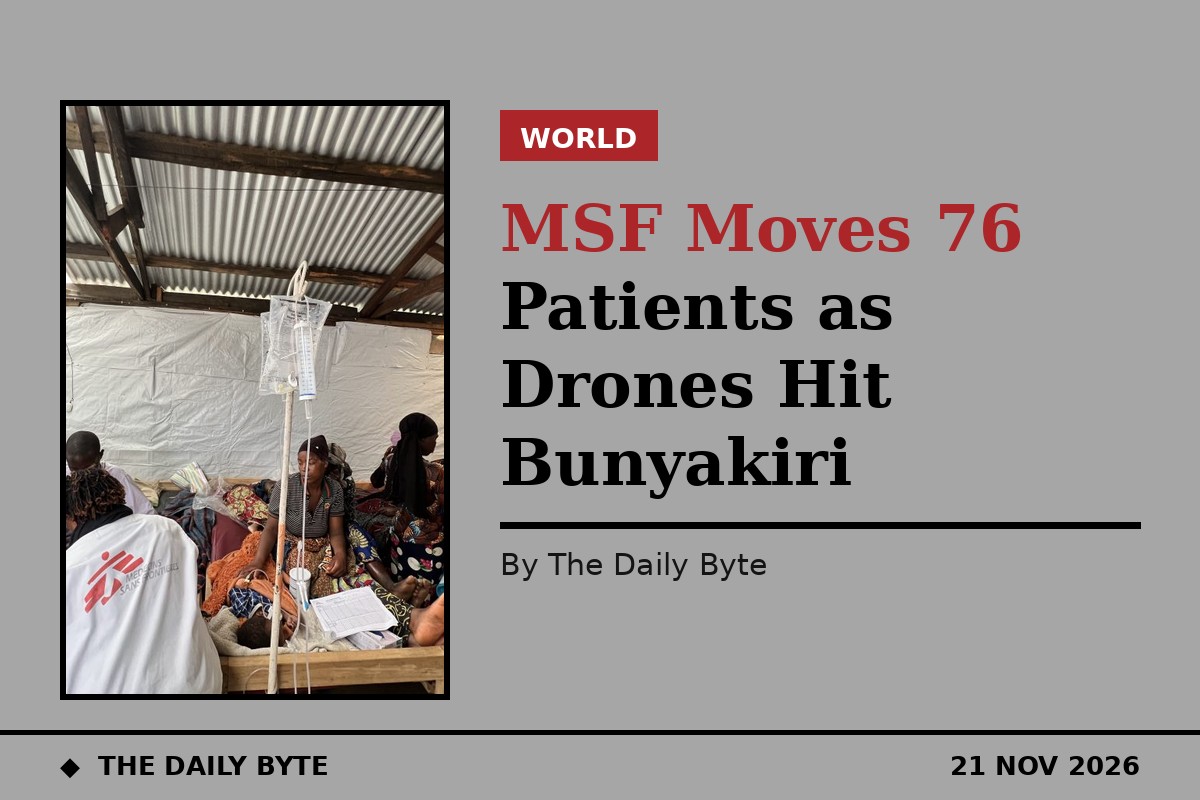
Doctors Without Borders has moved 76 patients out of a hospital in eastern Democratic Republic of Congo after drone strikes landed near the facility, warning that the fighting around the town of Bunyakiri is putting civilians and medical care at grave risk.
Medecins Sans Frontieres, known as MSF, said the security situation in Bunyakiri Health Zone in South Kivu deteriorated further on 13 November, when drone strikes hit the Bulambika area, including in the vicinity of civilian areas and the MSF-supported Bunyakiri General Referral Hospital.
Health workers had to move towards Maibano Health Centre in search of safety, trying to transport the 76 patients who were admitted to the hospital at the time. Most medical supplies, medicines and equipment remain at the hospital, with teams not yet able to transport them to Maibano, MSF said.
Care under fire
"Medical personnel must be able to carry out their work safely, and patients must be able to access healthcare without fear," said Giulia Panseri, MSF head of mission in South Kivu. "Any disruption to medical services puts lives at risk, particularly those of the most vulnerable."
The hospital is a critical lifeline for the area. In recent months it has recorded more than 1,280 admissions a month, including 1,438 new admissions in October alone. MSF said the relocation raises serious concerns about patient safety and the continuity of essential medical care, possibly affecting thousands of people in urgent need of care.
The fighting in Bunyakiri Health Zone has intensified since 6 November between the Congolese army, known as the FARDC and supported by the Wazalendo militias, and the Front pour la Refondation de la Nation, or FRN, the rebel movement formerly known as AFC/M23. The insecurity has caused civilians to flee the area amid fears of further violence and additional drone strikes, including staff members from MSF's own team in Bunyakiri.
The health zone was already facing a cholera outbreak and a peak in malaria cases when the fighting escalated, further increasing the vulnerability of affected communities, MSF said.
Staff pulled back as fighting continues
MSF said it had been forced to temporarily reduce its staff presence in Bunyakiri by partially relocating personnel to Bitale and Bukavu to limit their exposure to the hostilities. It has donated medications and essential medical supplies to health centres in the area, but restricted access because of the fighting makes it difficult for teams to assess evolving medical needs.
The group remains committed to continuing its medical activities in the zone in close coordination with the Ministry of Health, Panseri said, but added: "We hope to resume all medical activities in the area as soon as possible in order to restore the continuity of medical supplies and healthcare services to the population. But this will only be possible if security for civilians, patients and medical personnel can be ensured."
Separately, the Critical Threats Project reported that the Congolese army targeted three FRN positions in Bunyakiri, reportedly in Bulambika, in at least six reported drone strikes on 15 November, causing casualties and damaging civilian infrastructure. Clashes resumed on the Bunyakiri axis the same day, and the FRN reportedly retook the village of Ebisha, about four miles from Bunyakiri, on 16 November after dislodging government-aligned fighters.
The FRN captured Bunyakiri town in early November after an offensive through Kahuzi-Biega National Park, and has since consolidated control of the RN3 road through the area despite government attempts to retake the town. MSF called on all parties to respect their obligations under international humanitarian law and ensure the protection of civilians, healthcare facilities, patients and humanitarian personnel.
In Bunyakiri Health Zone, MSF supports the general referral hospital and the hospitals in Bitale and Tchigoma, as well as four health centres, providing treatment for malaria and malnutrition, maternity care, emergency services and medical assistance for survivors of sexual violence.