Munir Visits Miran Shah, Vows to End Terrorism in KP
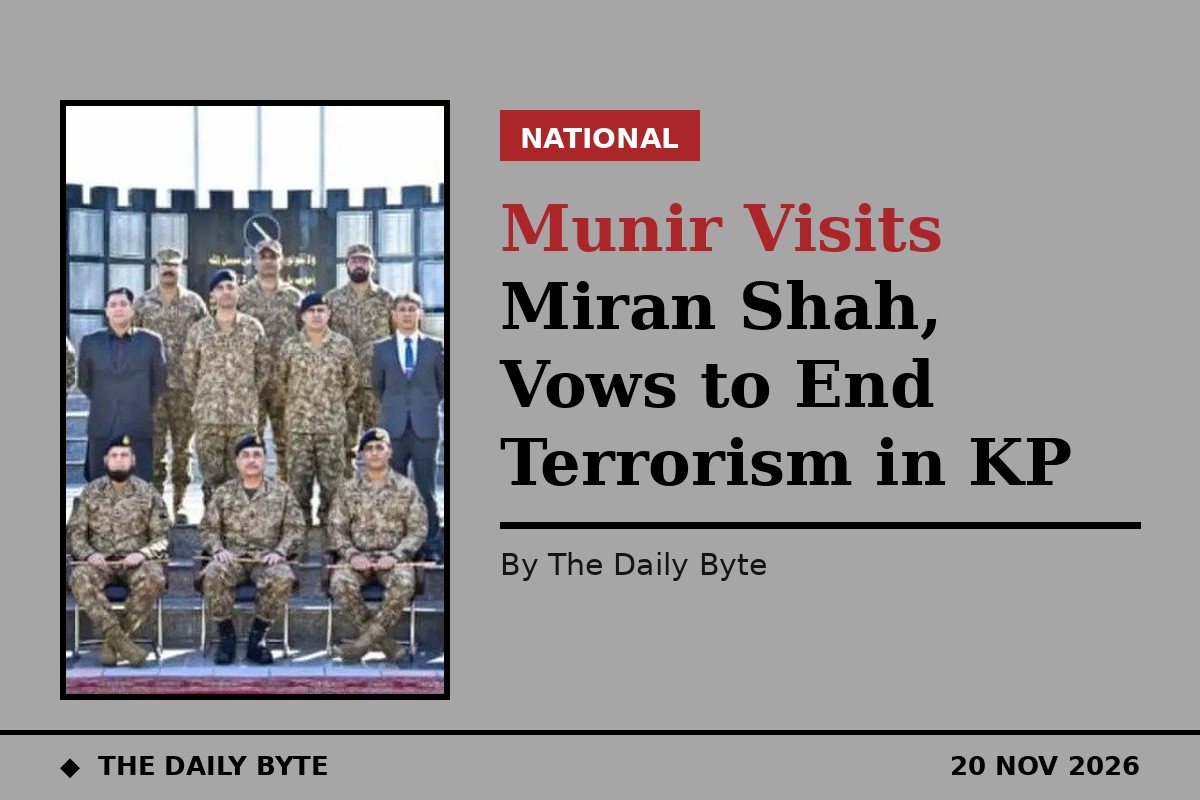
Chief of Defence Forces and Chief of Army Staff Field Marshal Asim Munir has reaffirmed the security forces' commitment to eliminate terrorism and preserve peace in Khyber Pakhtunkhwa, during a visit to Miran Shah in North Waziristan on Friday.
According to the Inter-Services Public Relations, the military's media wing, Munir visited Miran Shah, where he received a briefing on the security situation, ongoing intelligence-based operations and counterterrorism measures.
On arrival, he laid a floral wreath at Yadgar-e-Shuhada, the martyrs' memorial, to pay tribute to soldiers of the Pakistan Army who died in the line of duty. The Commander Peshawar Corps received him on arrival.
The visit in detail
During the visit, Munir was given what the ISPR described as a comprehensive briefing on the prevailing security situation, ongoing intelligence-based operations and the measures being taken to consolidate the gains achieved through sustained counterterrorism efforts and ensure lasting peace and stability in the area.
He also interacted with officers and troops, and praised their preparedness, professionalism and commitment to the defence and security of the country.
Munir singled out the Khyber Pakhtunkhwa Police for praise, describing the force as a brave frontline force in the fight against terrorism and expressing pride in its resilience and sacrifices. The reference matters because police personnel have borne a large share of recent attacks in the province.
"The Field Marshal reaffirmed the unwavering resolve of the security forces, in close coordination with law enforcement agencies, to decisively eliminate the menace of terrorism and preserve the hard-earned peace and stability of Khyber Pakhtunkhwa," the ISPR statement said.
A violent fortnight in the north-west
The visit came after a sharp round of operations in the region. According to reports, security forces killed 16 militants, including two Afghan nationals, in Mir Ali, Datta Khel and Ali Khel in North Waziristan on 14 November, in an operation in which two soldiers were also killed.
A day earlier, 74 militants were reported killed in operations across Khyber Pakhtunkhwa and Balochistan, including 35 in Mir Ali. The ISPR reported 22 more killed on 16 and 17 November in South Waziristan, Bannu and Tank.
The figures underline how active the conflict in the north-west remains. According to a report by the Centre for Research and Security Studies, Khyber Pakhtunkhwa and Balochistan together accounted for nearly 96% of all violence-related fatalities recorded in the country during the second quarter of 2026, with Khyber Pakhtunkhwa the worst-affected region.
Two security reports presented to the federal cabinet in October showed that terrorist incidents in Khyber Pakhtunkhwa had risen 195% between March 2024 and September 2026, and that 73% of attacks in the province in 2026 targeted police and security personnel, with drones and improvised explosive devices named as growing threats.
What the military says it wants
Munir's message in Miran Shah was one of resolve rather than new policy: security forces, working with law enforcement agencies, would continue efforts to eliminate terrorism and preserve lasting peace and stability in the province.
He also used the term Fitna al-Khawarij, the military's label for the Tehreek-i-Taliban Pakistan, when praising the police role in the fight against the group, which has been blamed for much of the recent violence in the province.
The visit followed a trip to Turbat in Balochistan the day before, a sign of how much of the military leadership's attention is now focused on the two provinces where violence is concentrated.
The wider context
Pakistan has seen a surge in militant attacks, particularly in Khyber Pakhtunkhwa and Balochistan, since 2021, when the Afghan Taliban returned to power in Kabul. The military says its intelligence-based operations are designed to prevent a resurgence of militant groups in areas cleared in earlier campaigns.
For residents of North Waziristan, the test of Friday's visit will not be the briefing or the wreath-laying, but whether the operations that follow bring the lasting stability the ISPR statement promised.