Musée d'Orsay Displays Nazi-Looted Art to Find Owners
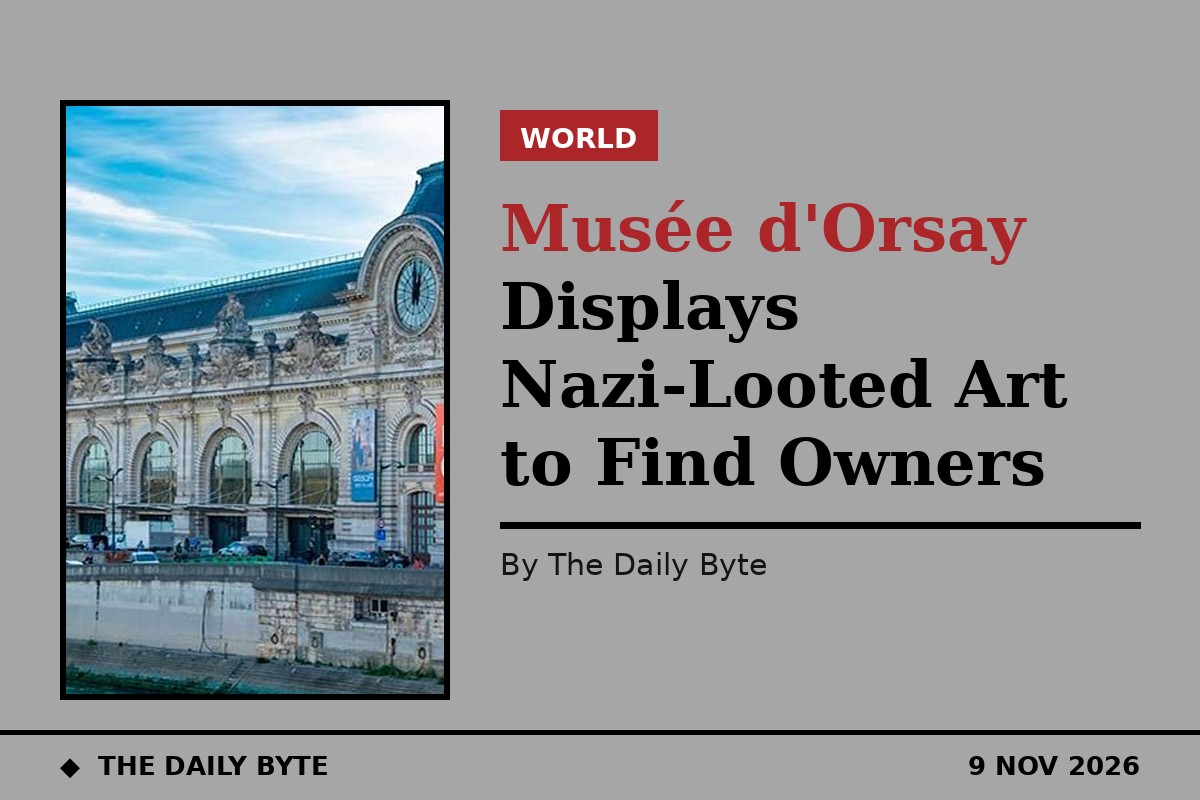
Paris's Musée d'Orsay has opened a permanent gallery devoted to artworks that were most likely stolen from Jewish families during the Second World War, in a renewed effort to find the people they were taken from. The small room, off one of the museum's main galleries, carries a sign over its entrance asking, in French, to whom do these works belong?
The museum, best known for its impressionist collection, opened the space this year as the first permanent gallery in its history given over to works whose ownership remains uncertain. The paintings and sculptures on show were recovered in Germany and Austria after the war and entrusted to French national museums because no owner could be traced. Each work on display carries a QR code giving its known history, and the museum plans to rotate its holdings through the room over time.
A painting that once hung at Hitler's retreat
Among the works on display is a large 1891 painting by the Belgian artist Alfred Stevens, showing a girl with her arm around a younger boy as they lean over a balcony looking out over a beach in Normandy. The painting was sold twice at auction in Paris, in 1939 and again in 1942, when it was acquired for Adolf Hitler. It later hung at his Bavarian Alpine retreat, known as the Eagle's Nest.
The painting's original owner has never been found. It is one of 225 works of unknown provenance held by the Musée d'Orsay, all of which will be rotated through the new gallery. Ines Rotermund-Reynard, the museum's head of provenance research, told NPR that the looting was organised from the start of the occupation, with Nazi officials going to Jewish families' homes in Paris from June 1940 to take their art.
100,000 works taken, most never claimed
About 100,000 artworks were taken from France during the Nazi occupation, through pillage, confiscation and sale under duress. Many were destined for a museum Hitler planned for his home town of Linz in Austria, a project that was never built. After Germany's defeat, a large recovery effort brought some 60,000 paintings and other art objects back to France, and 45,000 were returned to their owners or surviving family members.
The restitution work largely stopped in 1950 as the world moved on. Interest revived in the late 1990s, and at a conference in Washington in 1998, 44 countries agreed to investigate works with gaps in their ownership between 1933 and 1945. Much of the recovery was made possible by the secret notes of Rose Valland, a volunteer at the Jeu de Paume museum in Paris who recorded the looted art passing through the building while Nazi officials, unaware she spoke German, came and went.
French museums remain in temporary custody of about 2,000 works believed to have been looted by the Nazis. The works have a special legal status and are held in trust until their owners are found. David Zivie, who heads the French government's renewed mission to return looted cultural property, said the new gallery is part of a push to reopen files and explore archives with fresh eyes, even eight decades after the war.
The search for owners continues
Formerly sealed wartime archives have been opened and others digitised, and researchers say tracing a painting's last owner before the war is now far more feasible than it was twenty years ago. The museum has also launched a research unit of six French and German provenance researchers who will spend three years working through the files, funded by a one-million-euro donation from the American Friends of the Musée d'Orsay. The museum believes about 30 cases in its files could lead to restitutions.
Progress has been slow but is gathering pace. The Musée d'Orsay has returned 15 works since 1994, most recently a Sisley and a Renoir handed back to the heirs of Grégoire Schusterman in 2024. Writer Pauline de Perignon, who recovered a painting that belonged to her great-grandfather, now helps other families pursue claims. She described the restitution ceremony, attended by her elderly uncles, as a moment that brought her family together around the story of a grandfather they had all loved.
The gallery displays 13 works at a time, including paintings by Edgar Degas and Pierre-Auguste Renoir, hung so that visitors can read the backs of the canvases, where stamps, labels and inventory marks map how each piece moved from a private home into Nazi hands. For the museum, the room is both an exhibition and an appeal: the families who owned these works are largely gone, but their descendants may still recognise a painting that was once theirs. The Associated Press reported when the gallery opened in May that it was the first room of its kind in France.


