NAB secures Rs100bn railways land in Attock
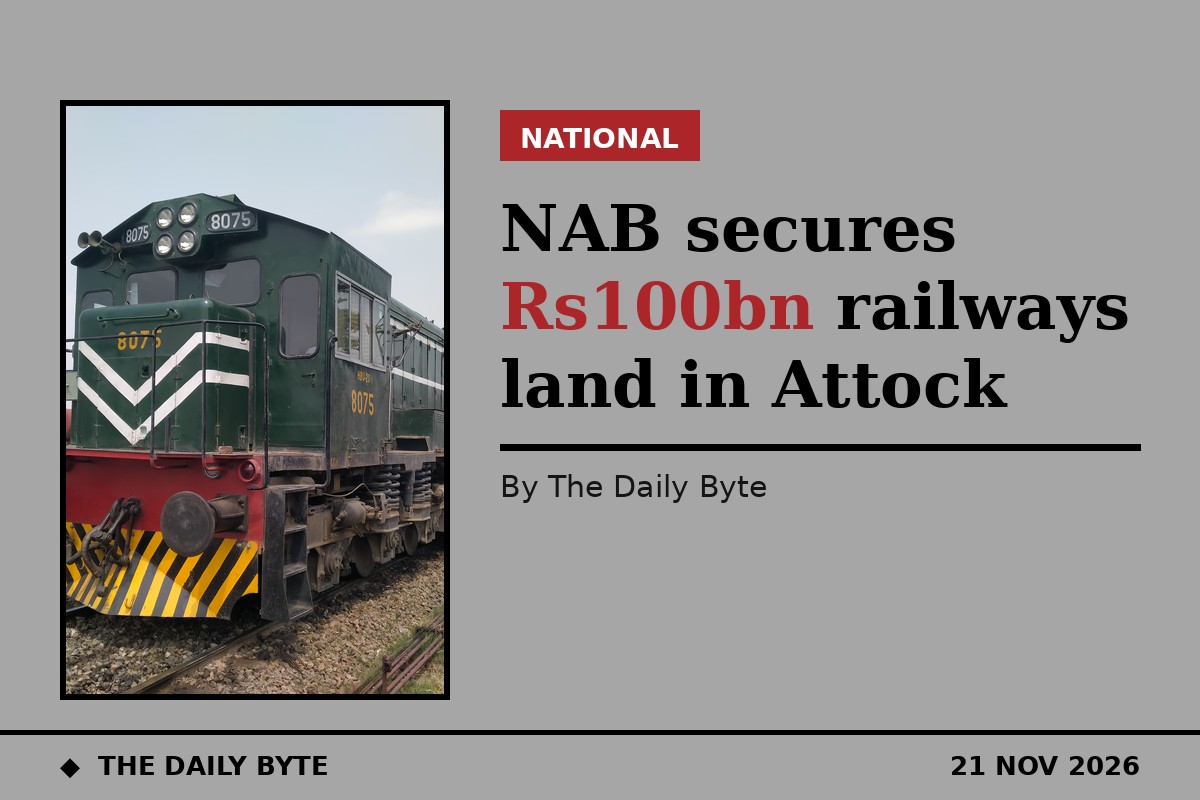
The National Accountability Bureau (NAB) has secured and mutated about 5,360 kanals of Pakistan Railways land in Attock district, with an estimated market value of Rs100.618 billion, the bureau said in a statement reported on 16 and 17 November. The land, spread across seven revenue estates in the district, has now been recorded in the name of Pakistan Railways after a detailed exercise to sort out its ownership records.
The work was carried out by NAB's Islamabad and Rawalpindi offices in coordination with the relevant revenue authorities. According to the bureau, officials scrutinised ownership documents, reconciled discrepancies in the land records and established the legal status of the railway property. The exercise also led to the retrieval of missing revenue records, and the mutation proceedings were then completed in favour of Pakistan Railways.
Seven revenue estates
The land covers about 5,360 kanals, or roughly 670 acres, across seven revenue estates, known as mouzas, in Attock district. They are Nara Taraf Saidan Khel, Injra, Jand, Hassan Abdal, Gurshin, Rakh Sarkar and Jassian, including its Androon and Bairon areas. The bureau said the value of Rs100.618 billion is its own estimate of the market worth of the land, based on the revenue record exercise, rather than a sum of money recovered in cash.
Pakistan Railways' Divisional Superintendent has formally acknowledged and appreciated the bureau's role in scrutinising, reconciling and verifying the records, according to both the bureau's statement and the official news agency report of the exercise. The Associated Press of Pakistan report said the achievement came under the guidance of NAB Chairman Lieutenant General (retired) Nazir Ahmed and Director General NAB Islamabad and Rawalpindi Muhammad Rizwan Khan, whose emphasis on safeguarding state-owned assets and strengthening coordination between institutions was credited with the outcome.
Why the record matters
For Pakistan Railways, the importance of the exercise lies less in the headline valuation than in the paperwork. Land that is not properly recorded in the revenue records is hard to protect, hard to use and easy to dispute. By completing the mutation in the railway's name, the bureau has put the ownership of these seven estates on a clear legal footing, so the land is now formally reflected in the official records as railway property.
The bureau presents the recovery as part of a wider drive to protect public assets. In a separate announcement on 11 November, NAB said its Islamabad and Rawalpindi offices had protected public assets worth about Rs241.408 billion over two months through three initiatives, including the securing of 3,927 kanals of railway land in five other districts, valued at about Rs118 billion. The Attock land is a separate recovery from that earlier announcement, and the two figures should not be added together.
What happens next
With the mutation complete, the Attock land now stands in the revenue records in the name of Pakistan Railways. Neither the bureau nor the railway has announced any further step in connection with these seven estates, such as a sale, lease or development plan, and none should be assumed. The bureau's statement describes the completion of the exercise as a significant step towards securing the legal ownership of valuable state property and ensuring that it is properly reflected in official records.
The case also underlines how much of the value of state land depends on the state of its records. The bureau said the Attock exercise involved reconciling discrepancies and retrieving records that had gone missing, work that had to be done before the ownership of the land could be settled at all. For the railway, the result is that more than 5,000 kanals of its land in one district is now documented as its own, with the valuation attached to it a matter of public record.