Naga City Votes to Become 34th Highly Urbanized City
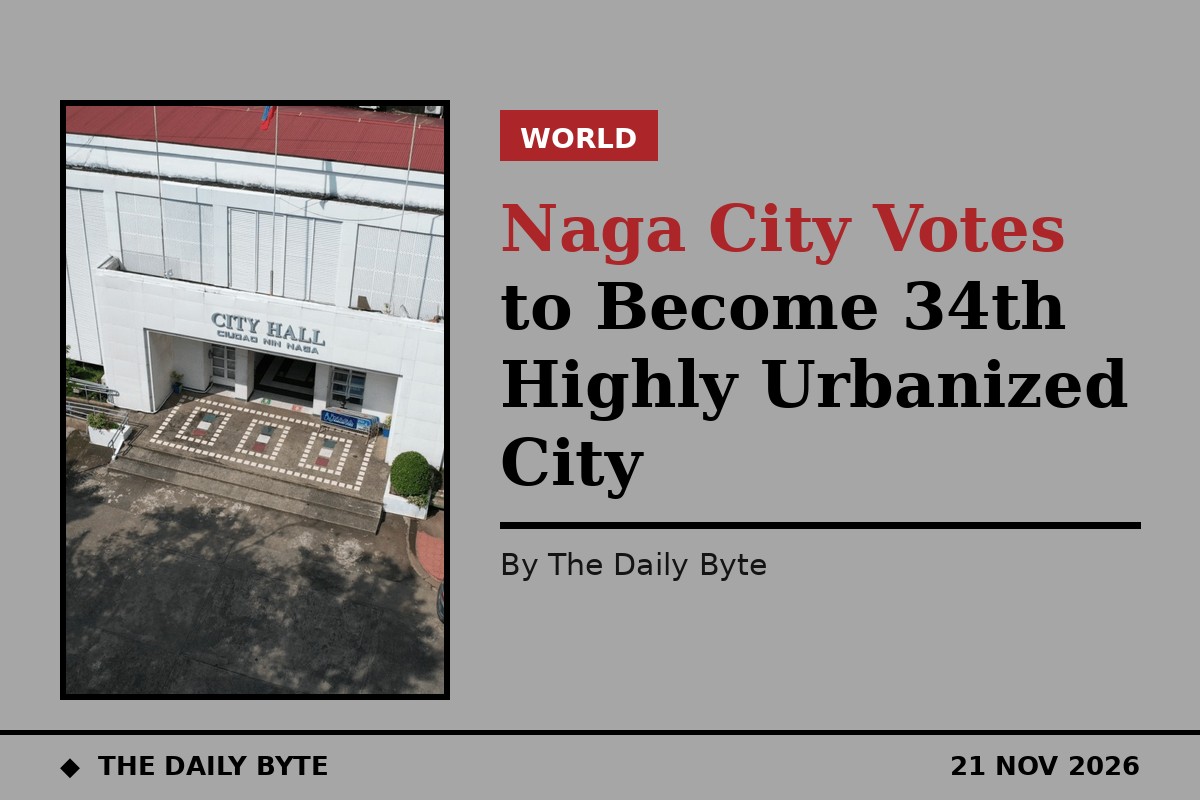
Naga City has voted to become the Philippines' 34th highly urbanized city, after voters backed the change by 30,538 votes to 6,648 in a plebiscite held on Saturday, 21 November 2026.
The city's election officer, Atty. Maico Julia, announced the result on Saturday night, once the board of canvassers had finished all 232 clustered precincts. A total of 37,247 ballots were cast. The "yes" side took 82.12 percent of the votes cast, a figure confirmed by Mayor Leni Robredo, who voted at Naga City Science High School in the morning.
The vote ratifies Proclamation No. 1267, signed by President Ferdinand Marcos Jr. on 26 May 2026, which declared Naga a highly urbanized city subject to approval by its qualified voters. Naga, the capital of Camarines Sur, cleared the legal thresholds for the status: the Inquirer reported a population of 210,545 in the 2024 census and an annual income of P298.53 million at 1991 constant prices, against requirements of at least 200,000 residents and P50 million in annual income at the same price base.
What highly urbanized status changes
Highly urbanized cities manage their own affairs and make their own decisions without being under the direct control of a provincial government. Residents of such cities are also barred from voting for provincial elective officials. For Naga, the change pulls the Camarines Sur capital out from under the direct control of the provincial government.
Robredo said Naga joins the list of highly urbanized cities after 78 years as an independent component city. Naga is the regional centre of commerce, trade, education, culture and religion in Bicol, and GMA News put its land area at about 84.48 square kilometres.
The two mastheads reporting the result differ on the size of the electoral roll: the Inquirer put it at 113,259 registered voters, while the Daily Tribune's 1 p.m. update cited 119,259. Both reported the same manual count, with returns brought to the PAGCOR Multipurpose Building at the Balatas Development Complex for the official canvass.
How the vote was run
Commission on Elections chairman George Erwin Garcia and the poll body's commissioners spent the day in Naga observing the voting, the canvassing and the proclamation of the results. Precincts closed at 3 p.m., but the board of canvassers still accepted qualified voters who were already inside the 30-metre radius of a polling place, the city government said.
Senior citizens, people with disabilities and pregnant voters were allowed to cast ballots as early as 5 a.m. Voting was also held at the city's jail, where nearly 60 percent of detainees voted, the Daily Tribune reported. The plebiscite ran on a manual count, with votes for and against counted separately at each precinct.
The result settles the city's status after months of preparation, and it lands as the Commission on Elections reopens voter registration for the 2028 national elections, a separate exercise from Saturday's ratification vote. For Naga's voters, the decision means the city now governs itself free of provincial oversight, with the new status taking effect from the ratification.
Read the reporting: ASTIG and Bicol Mail.