National Assembly passes bill to abolish FBR Policy Board
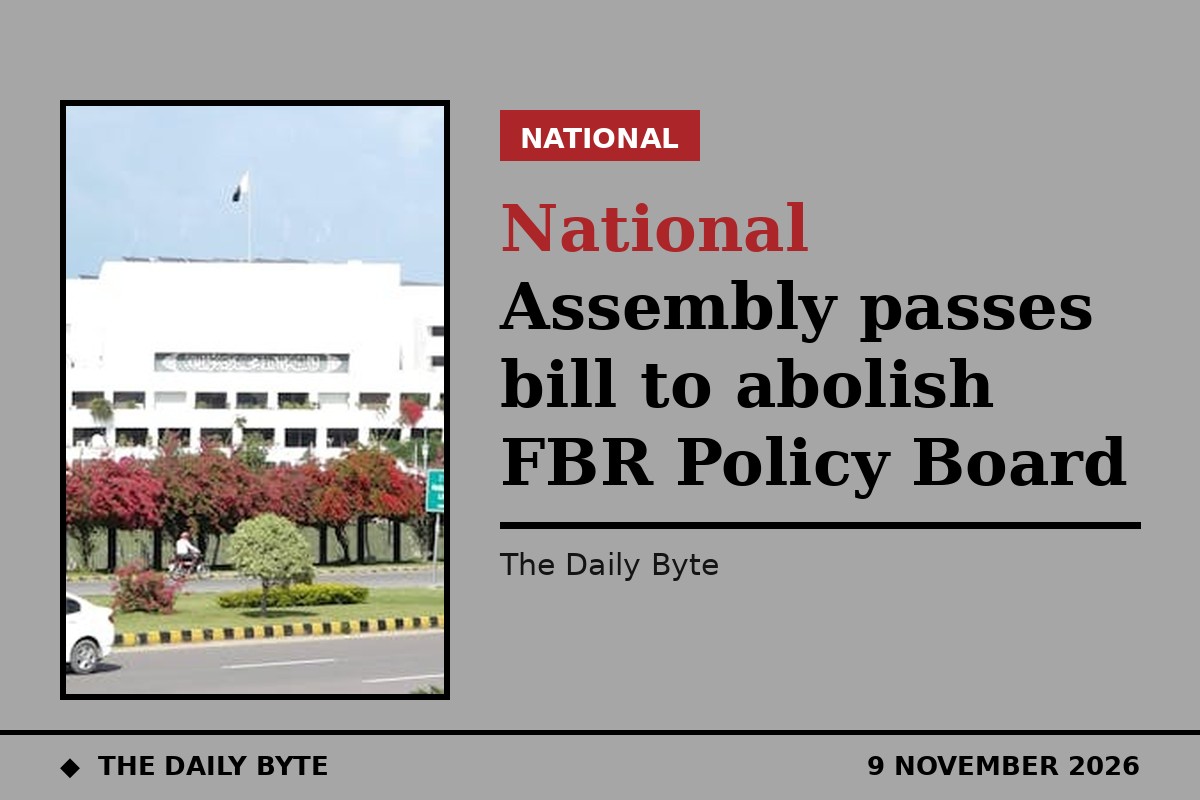
The National Assembly has passed the Federal Board of Revenue (Amendment) Bill, 2026, abolishing the FBR Policy Board and completing a restructuring that moves tax policy-making out of the revenue collector and into the Ministry of Finance.
The bill was approved by a majority vote on Wednesday after Finance Minister Muhammad Aurangzeb moved it in the House, following approval of supplementary grants. Amendments proposed by Alia Kamran of the Jamiat Ulema-e-Islam-Fazl were rejected during the proceedings. The Senate had already passed the legislation on 18 June 2026, so the bill now completes its passage through Parliament.
What the bill changes
The amendment removes Section 6 of the Federal Board of Revenue Act, 2007, along with all ancillary and consequential references to the Policy Board in the law. Section 6 had provided for the establishment of the board, which was tasked with issuing policy guidance on fiscal matters and helping the FBR achieve its strategic goals and revenue targets.
According to the legislative rationale accompanying the bill, the federal government has set up a dedicated Tax Policy Office within the Ministry of Finance to analyse, formulate and develop fiscal policy on behalf of the government. With that office in place, the role previously assigned to the FBR Policy Board was deemed redundant.
The change is part of a broader policy shift aimed at separating fiscal policy formulation from tax administration and revenue collection. Under the revised framework, the FBR keeps its operational and administrative mandate — collecting revenue and enforcing tax law — while decisions about what the tax policy should be sit with the Finance Ministry.
Appointments and the Tax Policy Office
The amendment leaves the federal government's authority to appoint the chairman and members of the FBR unchanged. It also expands the role of the Secretary of the Revenue Division, authorising the secretary to appoint members of the FBR through the transfer and posting of officers in BS-21 and above who are placed at the disposal of the board.
The Tax Policy Office itself is not new. It was established in February 2025 within the Finance Ministry, and in August 2025 Aurangzeb announced that the office had moved to the Finance Division and that the FBR would no longer play a role in preparing the annual budget. The budget for the 2026-27 financial year was to be led by the Finance Division and the Tax Policy Office instead.
The government first set out the plan to amend the FBR Act in March 2026, when Aurangzeb told the Senate Standing Committee on Finance that tax policy responsibilities would shift to the new office. The bill was introduced in the Senate in February 2026 and referred to the standing committee for consideration. As introduced, it also sought to validate appointments of FBR members made before the amendment took effect, addressing legal questions raised after a 2016 Supreme Court judgment on executive authority.
Why it matters
The abolition of the Policy Board removes a layer of governance that included federal ministers and parliamentary representatives from tax policy decisions. Its functions now pass to the Tax Policy Office, led by civil servants, with the stated aim of clearer lines between those who design tax policy and those who collect the tax.
For businesses and taxpayers, the practical effect is that tax proposals for the federal budget are now prepared by the Tax Policy Office rather than the FBR. The government presents the change as a structural reform of tax governance; whether it produces different tax policy in practice will be tested in the next budget cycle.