National Assembly and Senate Sessions from 16 November
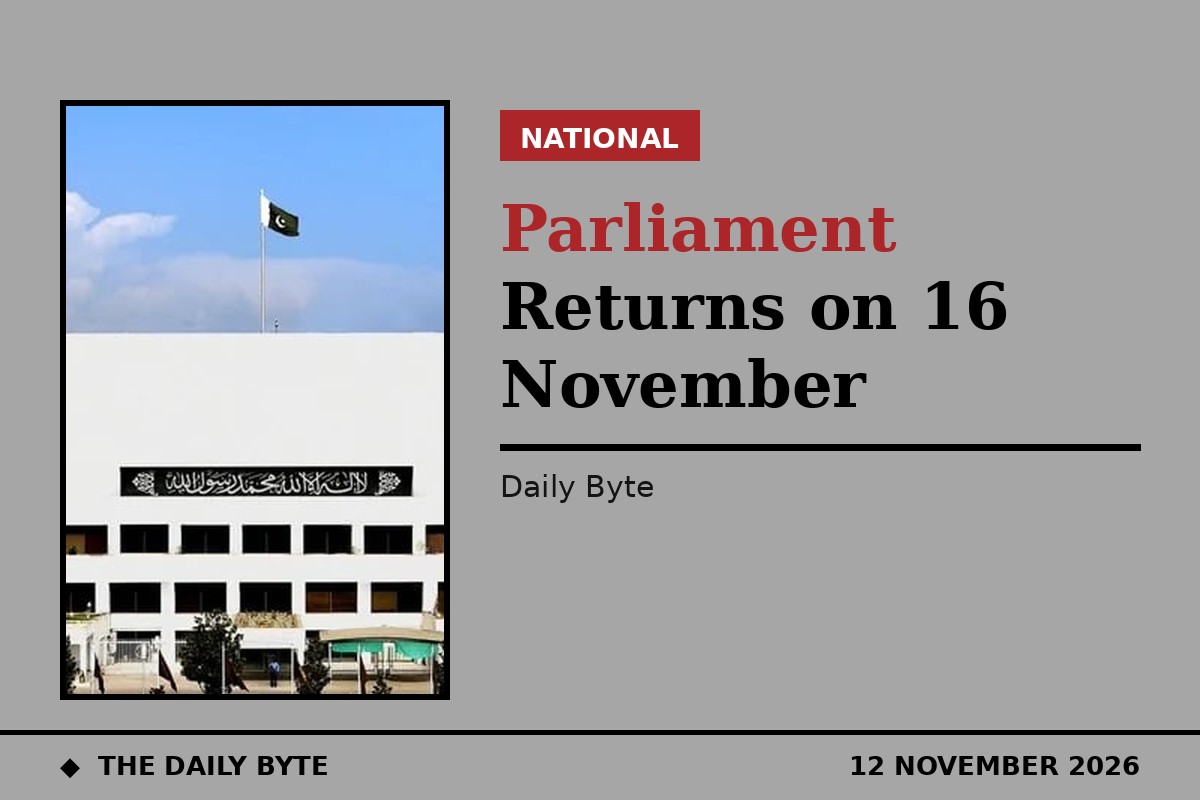
Pakistan's National Assembly and Senate will both begin new sessions on Monday, 16 November 2026, but no proposal for a constitutional amendment, a referendum or electoral reforms is on the agenda of either house, according to sources in the Parliament Secretariat.
The National Assembly session will start on Monday and continue for two weeks, and the Senate session will commence the same day. The President has formally summoned the National Assembly to meet at Parliament House in Islamabad, under Article 54(1) of the Constitution, according to a press release published by the National Assembly on 11 November.
What the sessions will, and will not, cover
Highly placed sources in the Parliament Secretariat told The News/Jang on Sunday that the proposals and treasury and private bills received so far gave no clue to any constitutional amendment, including legislation for electoral reforms or a referendum.
That is significant because speculation in recent weeks had linked the coming sessions to possible constitutional changes, including a referendum proposal. On the material received by the secretariat so far, none of that business is listed. The agenda as it stands points to ordinary legislative business rather than a constitutional overhaul.
The referendum question
The sources were also asked about a referendum, and their answer underlined where the power to call one actually sits. The move for holding a referendum is the sole prerogative of the prime minister, they said, and the president has nothing to do with it. It is the joint sitting of parliament that would consider and decide the matter.
Article 48(6) of the Constitution states that if the prime minister decides it is necessary to hold a referendum on any matter of national importance, he may refer the matter to a joint sitting of Parliament, the Majlis-e-Shoora. The referendum proposal must first be approved by a joint sitting, and only then can the prime minister put the matter to the electorate as a question that can be answered with a simple yes or no.
The current version of Article 48(6) was substituted by the Eighteenth Amendment Act of 2010, which shifted the power to initiate a referendum to the prime minister, subject to joint parliamentary approval. Older versions of the provision had allowed the president, acting in discretion or on advice, to call one.
National referendums in Pakistan have historically been held under special or military-backed regimes, such as in 1984 under General Zia-ul-Haq and in 2002 under General Pervez Musharraf. Both took place without the approval or consent of parliament, since the Constitution was held in abeyance at the time.
The new-provinces proposal and the politics
Political observers quoted by The News said the passage of a proposal for a referendum on new provinces or administrative units would be an uphill political task, even if the prime minister agreed to put it before a joint sitting. Such a proposal, without assured majority support, could disturb the whole political arrangement and create new instability, they said.
The politics cut across party lines. The PTI is willing to support such a proposal, according to the observers, but the ruling PML-N and PPP alliance would not want to become party to it, since both parties would lose their political strongholds if the existing provincial arrangement were broken up.
It is understood that the wider reset move would ultimately be shelved after acceptance of its first agenda item, relating to revision of the National Finance Commission (NFC) Award, in the longer run, the observers said. The NFC Award determines how federal revenues are shared between the federation and the provinces, and it is one of the most sensitive subjects in Pakistani politics.
What to watch when the sessions open
When the two houses meet on 16 November, the first test will be whether the published agenda matches what the secretariat sources have indicated. Any constitutional amendment, referendum motion or electoral reform bill would have to appear in the orders of the day, and its absence would confirm that the sessions are proceeding on routine business.
The second test will be the government's own messaging in the opening days. If ministers use the sessions to advance the NFC Award revision while leaving the referendum and new-provinces questions untouched, that would match the assessment that the more ambitious proposals have been set aside, at least for now.