NATO jets scrambled as drones enter Lithuania
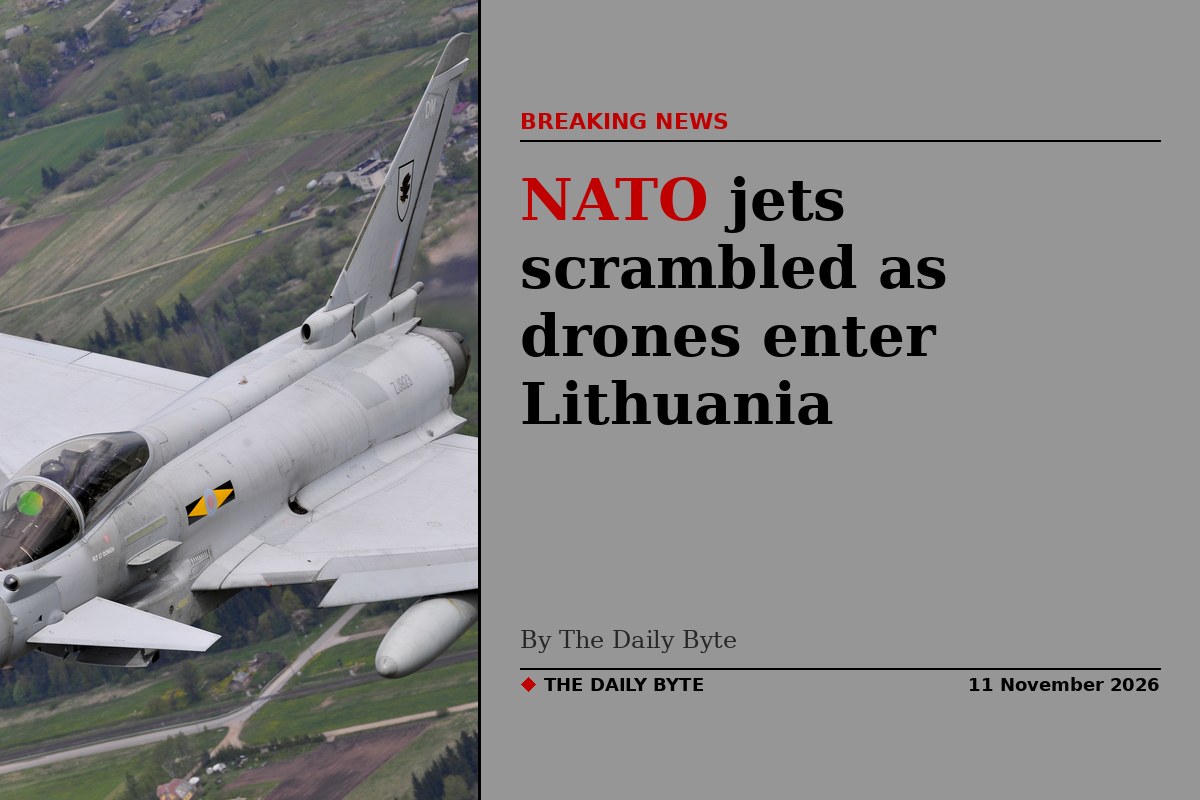
NATO fighter jets were scrambled twice overnight after suspected drones triggered air alerts across large parts of Lithuania, closing Vilnius and Kaunas airports and prompting Latvia and Estonia to warn residents as well. At least one drone is believed to have entered Lithuanian airspace from Belarus before flying north across the country and on towards Latvia.
Lithuania's National Crisis Management Centre said the alerts were issued overnight between Tuesday, 10 November and Wednesday, 11 November 2026. No injuries were reported, and the origin of the drones has not been officially established.
Two alerts in one night
The first yellow alert was issued for the Vilnius and Utena regions at about 11pm on Tuesday and lifted shortly after midnight. Vilmantas Vitkauskas, head of Lithuania's National Crisis Management Centre, said three drones had initially been detected in Belarus during the first incident, but none entered Lithuanian airspace. One of them later entered Latvia.
A second alert was then declared, initially in the Alytus region, before being extended to parts of central and northern Lithuania and upgraded to red, urging residents to seek shelter. The alert covered Kaunas, Lithuania's second-largest city, home to about 300,000 people.
During the second incident, a drone was believed to have entered Lithuania from Belarus near the southern town of Druskininkai, possibly flying briefly into Poland, before turning north through Marijampole, Kaunas county and Panevezys and leaving Lithuanian airspace near Pasvalys, close to the Latvian border. Daily Baltic, reporting the account of public broadcaster LRT, said NATO fighter jets detected the object but did not shoot it down.
Two attempts to bring the drone down failed
Lithuania's Chief of Defence Staff, Rear Admiral Giedrius Premeneckas, said NATO jets had two opportunities to neutralise the drone over Lithuania but both attempts were unsuccessful. He told a news conference that the jets identified the drone visually near Kaunas but could not engage it because of the risk to civilians on the ground, and that shots were fired when possible.
Prime Minister Mindaugas Sinkevicius said four drones had been spotted across the region during what he called a difficult night, and said an attempt had been made to bring down a drone above northern Lithuania. The drone later left Latvian territory, entered Estonia and, as far as the Lithuanian military knows, then went on into Russia. Its type and origin have not been officially established.
Airports closed and flights disrupted
The incidents disrupted civilian aviation, forcing the temporary closure of Vilnius and Kaunas airports. Vitkauskas said three flights at Vilnius Airport were affected, disrupting the travel plans of more than 400 passengers. The crisis centre had first warned at about 9.30pm about possible balloons that could disrupt airspace, and the airports were closed before the drone alerts forced further restrictions.
Latvia and Estonia also warned
After 3am, Latvia's National Armed Forces issued an airspace threat warning for the municipalities of Cesis, Smiltene and Gulbene, activating drone interceptors, air defence units and NATO air policing fighter jets. Similar warnings were issued in some areas of Estonia, and NATO jets were scrambled from Amari Air Base in Estonia. Estonia's government security cabinet was due to meet on Wednesday evening to review the incidents.
Finland, another Russian neighbour, adopted temporary airspace and maritime curbs in the eastern Gulf of Finland on Wednesday before withdrawing them later, Devdiscourse reported, citing Reuters.
What is still not known
Authorities have not said how many drones were involved in total, or whether any crashed or were shot down. No damage to people or property had been found in the first hours, though officials said that could change once checks on the ground are done.
The alerts came on a night when Ukrainian drones attacked Russia's Baltic port of Ust-Luga, where the regional governor said a fire broke out in the port area and three workers were injured. Reuters said it could not immediately independently confirm those reports. The Baltic states have no fighter jets of their own, and allies supply them on a rotating basis under NATO's Baltic Air Policing mission, flying from Siauliai in Lithuania and Amari in Estonia.