New Zealand election deadlocked as special votes decide
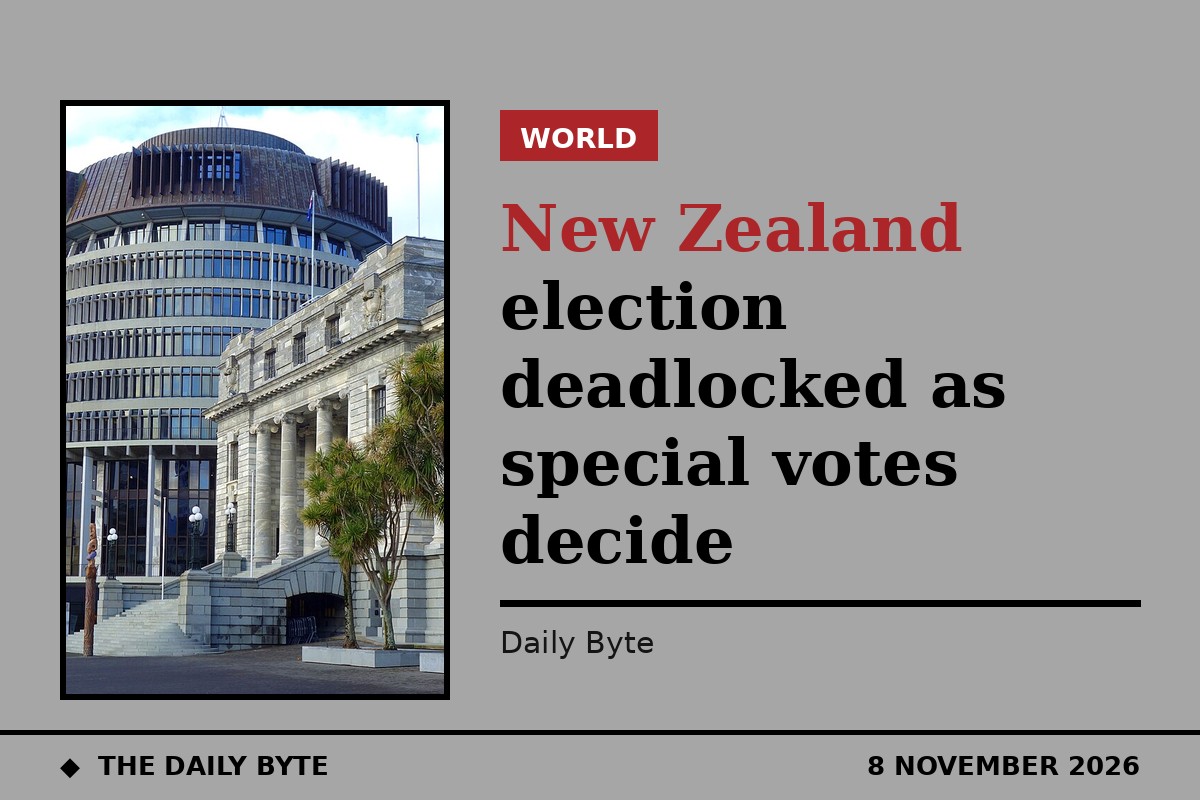
New Zealanders will wait for weeks to learn who will lead their country after Saturday's general election ended without a clear winner. The preliminary count is complete, but with nearly 400,000 special votes still to be tallied, neither of the two big parties can claim government yet.
On the election-night figures, Labour finished a fraction ahead on the party vote, 29.36 per cent to National's 29.21 per cent, a gap of only a few thousand votes. Yet under New Zealand's mixed-member proportional system, winning the most votes does not mean winning the most seats. National won 42 seats to Labour's 36, because National won far more local electorate races.
A one-seat edge, and 400,000 votes still to count
With 100 per cent of the preliminary count done, the 131-seat Parliament breaks down as follows: National 42, Labour 36, the Greens 16, ACT 13, New Zealand First 12, the Opportunity Party seven and Te Pati Maori five. Sixty-six seats are needed for a majority.
On those numbers, Prime Minister Christopher Luxon's National Party, together with its governing partners ACT and New Zealand First, would hold 67 seats, just one more than needed. The left bloc of Labour, the Greens and Te Pati Maori holds 57. But the result is far from settled: electoral officials began counting nearly 400,000 special votes on Sunday, including ballots cast overseas and by people voting outside their home electorate, and the official result is not due until 27 November.
Special votes have historically leaned to the left, and in 2023 they handed extra seats to Te Pati Maori and the Greens. Even a small shift could wipe out the right bloc's one-seat edge, although the left would still struggle to reach a majority of its own.
Neither leader claims victory
Luxon told supporters in Auckland around midnight that his party had a pathway to forming the next government, but that the result was too close to call. Speaking to reporters on Sunday, he said his coalition had a mandate, pointed to the war in the Middle East and the global fuel shock behind New Zealand's economic difficulties, and urged people to take a break from politics for the next three weeks while the count finishes. He will lead a caretaker government until the outcome is known.
Labour leader Chris Hipkins refused to concede, joking that the country had spoken but that it might take a little longer to work out exactly what it had said. Despite Labour's narrow lead on the party vote, the result looks like a second election defeat for Hipkins, who was voted out of office in 2023 largely over discontent about the cost of living.
The kingmaker in the middle
The night's biggest story was the rise of the minor parties. The Greens recorded their best result, and the centrist Opportunity Party, led by 38-year-old business consultant and political newcomer Qiulae Wong, won seven seats and entered Parliament for the first time after three failed attempts. Wong has said she could work with either side, and with neither bloc holding a comfortable majority, her party could decide who governs.
Luxon had repeatedly ruled out negotiating with Wong before the election, but on Sunday he sidestepped the question, saying it was unlikely he would need her party while adding that he was willing to work with her on issues where they agree. Hipkins, meanwhile, would apparently need Wong's support to govern even if the special votes break his way.
The election was also a bruising night for National's senior ranks: several of its most senior lawmakers are set to leave politics on the results so far, including the finance and defence ministers, the speaker of parliament and the attorney general.
What happens next
No coalition talks can begin in earnest until the official result is declared on 27 November. If neither bloc can then put together a majority, New Zealand could face a fresh election. For now, voters are left in limbo: as one report put it, the question of who won the election was the top trending Google search in New Zealand on Sunday. The cost of living dominated the campaign, with prices stubbornly high and unemployment at its highest in more than a decade, and whichever side eventually forms a government will face a Parliament where no party can govern alone. Read the full results coverage at Bytes Europe and the African News Agency.