NHS pilots new Budget Impact Test for medicines
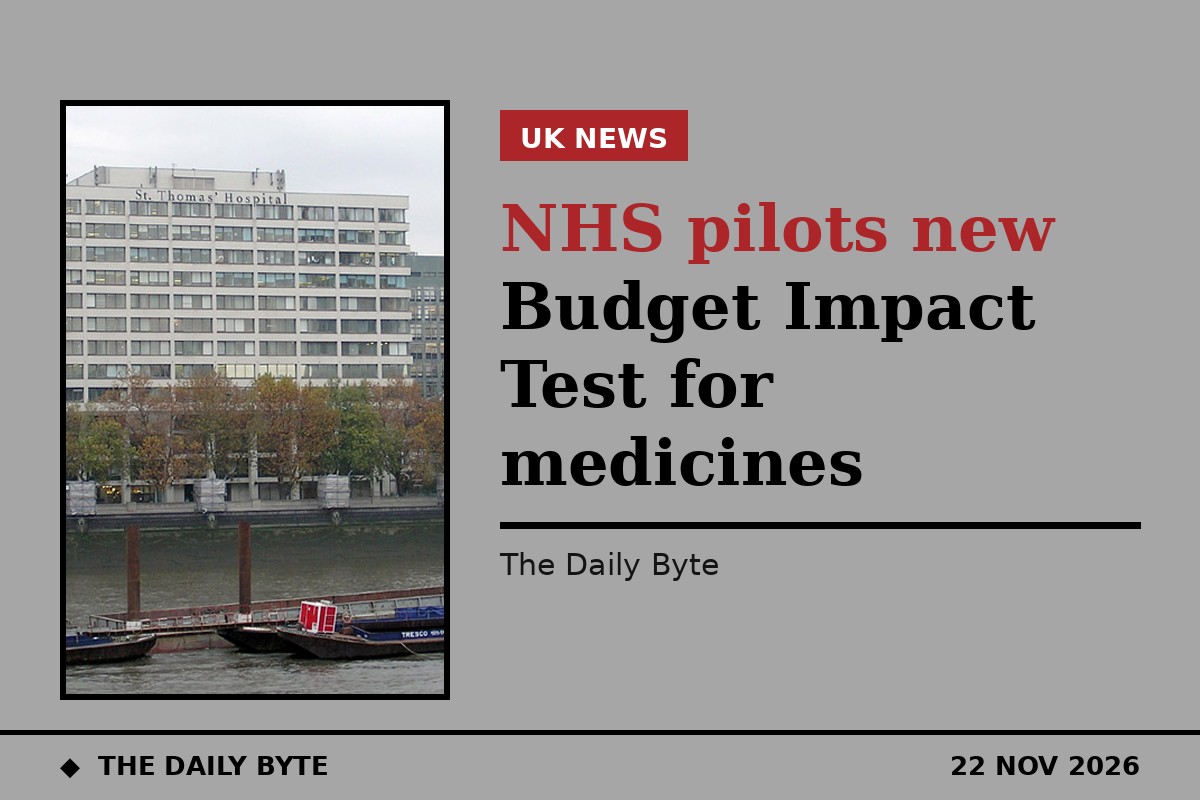
NHS England is launching a pilot that will test a more flexible use of the Budget Impact Test, the affordability check applied to expensive new medicines, in a bid to get innovative treatments to patients faster. The pilot will explore whether drug companies can fund the service changes needed to adopt a new medicine, with that funding offset against what they would otherwise pay in Budget Impact Test rebates.
The pilot was outlined by Jack Turner, Deputy Director of Medicines Negotiation and Access at NHS England, in a guest article published by the Association of the British Pharmaceutical Industry (ABPI) on 23 November 2026. It is the second in a series of pilots agreed through the Joint Sprint Taskforce, which brings together industry, the NHS, government, NICE and patient organisations.
How the Budget Impact Test works now
The Budget Impact Test was introduced to help the NHS manage the financial impact of new medicines that create significant additional costs. Under the current arrangements, a medicine expected to cost more than £40 million in any of its first three years on the NHS is subject to commercial negotiations with NHS England to manage its affordability. The threshold was doubled from £20 million in January 2025.
The problem, Turner explained, is that price is not always the barrier. Some new treatments need the care pathway around them to change first — new clinics, staff training, diagnostic capacity or follow-up services — and those service changes can hold up adoption even when a medicine is already judged cost-effective.
What the pilot will test
Under the pilot, where a pathway requires service transformation to support the adoption of an innovation, a company could provide funding for that transformation, offset against its Budget Impact Test rebate liability. Rather than requiring the price of a medicine to be cut further when it is already cost-effective, the approach explores whether some of that value can instead be used to fix the pathway problems that delay patient benefit.
A core principle is that any investment must support service transformation that delivers better care and outcomes for patients, with improvements embedded in routine practice rather than left as one-off projects. NHS England will retain control over how the activities are determined, designed and delivered, and arrangements will be considered case by case.
Eligibility will be limited to cases where the £40 million threshold is expected to be exceeded and there is a clear need for service transformation within the relevant care pathway. Companies in that position will be invited to discuss the pilot approach with NHS England. The pilot will be tested across different types of drugs, with different pathways and adoption challenges, to build evidence about where the approach works best.
Part of a wider push to speed up access
The pilot is one of a series agreed through the Joint Sprint Taskforce earlier this year, alongside a separate pilot testing whether removing local affordability barriers speeds up uptake of NICE-approved medicines for chronic obstructive pulmonary disease (COPD), chronic kidney disease and heart failure. That first pilot was described by NHS England's David Glover in an ABPI guest article on 9 October 2026, and pharmaphorum reported it is due to go live from April 2027, with details still being finalised in a Freedom of Information response on 6 November 2026.
The pilots also form part of commitments under the UK-US pharmaceutical trade deal, under which the two sides agreed fast-track pilots to get innovative medicines to NHS patients faster and support investment in the UK.
Frequently asked questions
What is the Budget Impact Test? It is an NHS England affordability check. A medicine expected to cost more than £40 million in any of its first three years is subject to commercial negotiations with NHS England. The threshold was doubled from £20 million in January 2025.
What is NHS England piloting? A more flexible approach in which a drug company funds the service transformation needed to adopt a new medicine, with that funding offset against its Budget Impact Test rebate liability, instead of the medicine's price being cut further.
Which medicines could be covered? Medicines where the £40 million threshold is expected to be exceeded and there is a clear need for service transformation in the care pathway. Cases will be considered individually; no specific medicines have been named.
When will the pilots go live? The first pilot in the series, on alternative funding approaches, is due to go live from April 2027, according to pharmaphorum's reporting. No go-live date has been given for the Budget Impact Test pilot itself.
Sources: ABPI / NHS England guest article by Jack Turner (23 November 2026); pharmaphorum on the wider NHS England pilot programme.