NHS productivity falls as hospital funding rises
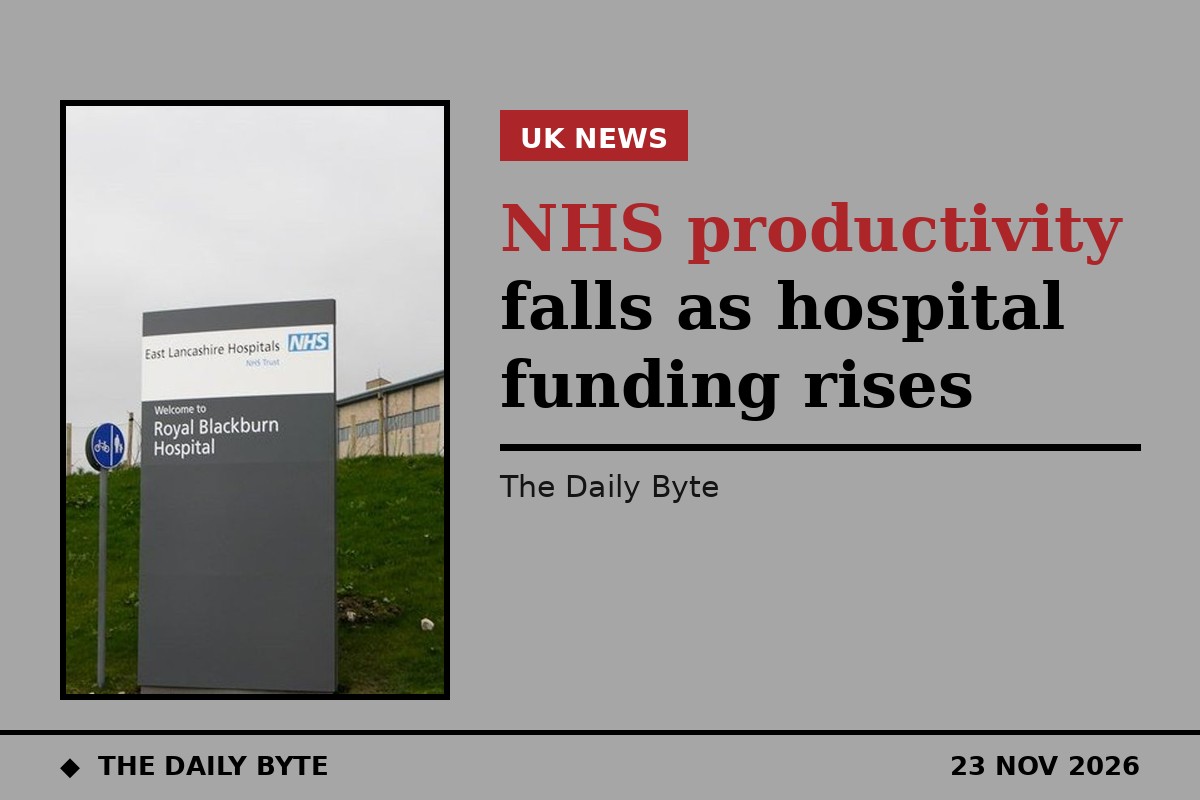
Some NHS hospitals in England treated fewer patients in 2026 despite receiving substantially more money, according to a new analysis of official figures by The Telegraph, published on 23 November 2026. The newspaper examined productivity data from 111 acute and specialist hospital trusts, comparing April to July 2026 with the same months last year, and found that several trusts received double-digit funding increases without any significant rise in treatment.
Productivity in this context means how much care — appointments, operations and A&E visits — a hospital delivers for the money and staff it has. When funding rises but treatment stays flat, productivity falls.
East Lancashire saw the sharpest fall
East Lancashire Hospitals NHS Trust had the starkest figures in the analysis. Its resources rose by 16 per cent, but appointments, operations and A&E visits remained stagnant, leaving productivity down 14 per cent. In September, 14 per cent of patients at the trust spent more than 12 hours in its emergency departments, compared with a national average of 10 per cent.
The Walton Centre, a specialist neuroscience hospital, recorded a 4.5 per cent rise in resources while treatment fell by 3.8 per cent, a productivity drop of 7.9 per cent. It also had long waits for treatment, with a median wait of 19.3 weeks between June and August, compared with 13.1 weeks nationally. University Hospitals Coventry and Warwickshire saw resources rise by 4.8 per cent in real terms while treatment fell by 0.4 per cent, a productivity decline of 4.9 per cent.
Some trusts did more with less
Not every trust went backwards. Royal Devon University Healthcare increased treatment by 11.7 per cent with little extra resource, meaning productivity rose by 11.1 per cent. Epsom and St Helier University Hospitals increased treatment by 8.5 per cent with no change in spending, and The Royal Marsden, the specialist cancer hospital, boosted treatment by 8.4 per cent despite a 1.6 per cent reduction in resources, a 10 per cent rise in productivity.
Reaction from ministers, the opposition and NHS England
Damian Hinds, the Shadow Health Secretary, told The Telegraph: “The scale of the waste in the NHS is simply unacceptable and we must make sure trusts spend every pound of taxpayers’ money responsibly.” He added that too much NHS cash had “vanished into inflation-busting pay deals without accompanying agreement on productivity”.
Dr Penny Dash, the chair of NHS England, said earlier this year that a “staggering increase” in spending had been accompanied by a “significant reduction in productivity”. Sir Jim Mackey, the NHS England chief executive, admitted earlier this year that the service had performed better when money was tight, saying: “We’ve performed better, we’ve got better results when things are actually quite tight.”
An NHS spokesperson pushed back on the figures, saying: “These figures are just a snapshot of the first part of the financial year and cover a period where activity in trusts was heavily disrupted by summer heatwaves.” The spokesperson added: “By contrast, in each of the last two complete financial years, the NHS has delivered record efficiencies of more than £10bn and exceeded productivity targets, while meeting key milestones in reducing waiting times for patients.”
Productivity is still below pre-pandemic levels
The dispute sits on top of a longer-running problem. The government’s 10 Year Health Plan for England, published on 3 July 2025, said the NHS productivity crisis had to be resolved urgently, and set a target of 2 per cent annual productivity growth. A House of Commons Library briefing notes that NHS productivity has not yet recovered to its pre-pandemic level and is estimated to be 5 to 11 per cent lower than in 2019/20.
Whether the April to July figures are a blip or a trend will become clearer when the full-year data is published. For now, the analysis gives both sides of the funding argument something to point at.
FAQ
What is NHS productivity? It is a measure of how much treatment — appointments, operations, scans and A&E visits — the NHS delivers for the money and staff it uses. If funding rises faster than treatment, productivity falls.
How far below pre-pandemic levels is NHS productivity? The House of Commons Library estimates it is 5 to 11 per cent lower than in 2019/20, depending on the measurement method used.
What is the government’s productivity target? The 10 Year Health Plan for England sets a target of 2 per cent annual productivity growth for the NHS.
Which trusts improved in the analysis? Royal Devon University Healthcare, Epsom and St Helier University Hospitals and The Royal Marsden all treated more patients with little or no extra spending. Read the full analysis as reported by GB News.