Nicaragua marks election day with no vote held
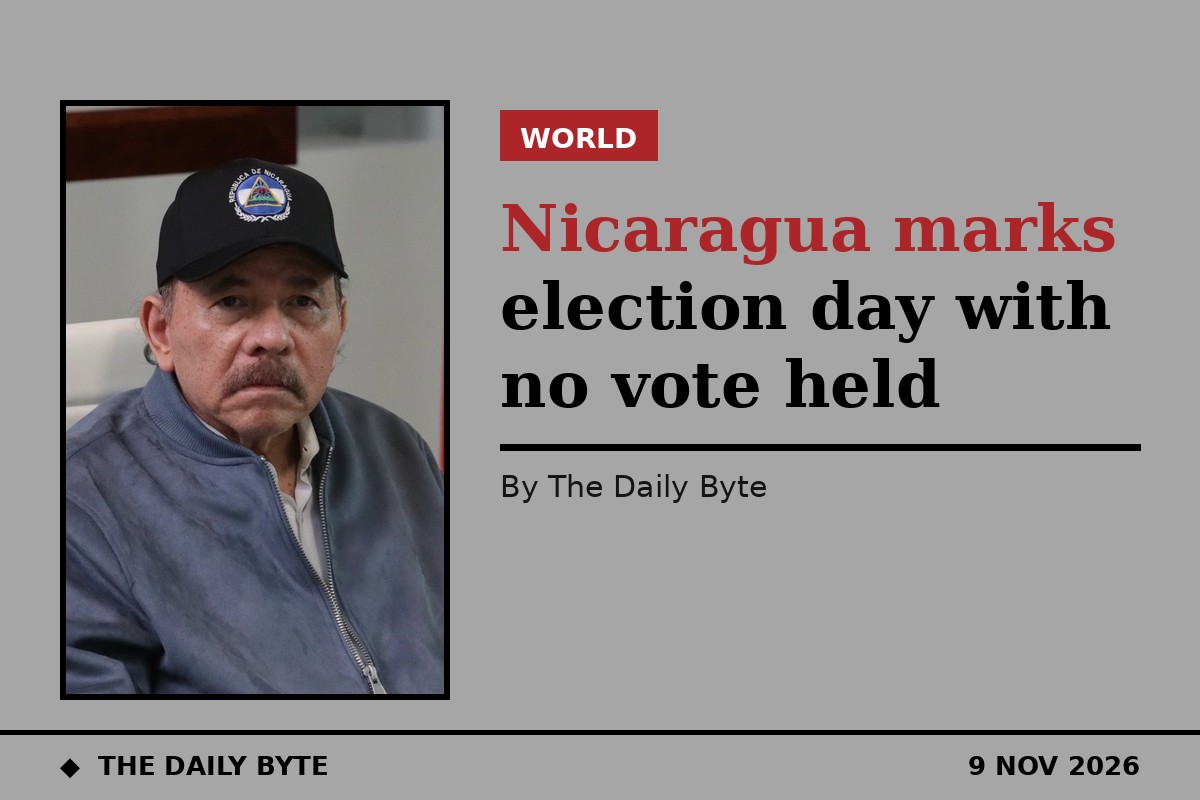
Sunday passed in Nicaragua without an election. It was the day Nicaraguans should have voted in presidential elections marking the end of Daniel Ortega's fourth term. Instead, no ballot was held, no polling stations opened, and the United States reminded the country of the vote that never happened.
"We have not forgotten that Nicaraguans should be voting in presidential elections today, as the fourth and illegitimate term of Daniel Ortega comes to an end," a senior US official, Assistant Secretary of State for Western Hemisphere Affairs Sarah Segura, wrote on X on Sunday. American officials said they remained committed to regional efforts to restore democracy in the Central American nation.
The empty election day is the result of a series of institutional changes pushed through by the Ortega government. In early 2025, the government approved a constitutional reform that changed 185 of the 198 articles of the constitution, extended presidential terms from five to six years, created the figure of the co-presidency for Ortega's wife, Rosario Murillo, and allowed for indefinite re-election.
How elections were abolished
On 19 July 2026, during an event marking the anniversary of the Sandinista Revolution, Ortega publicly declared that Nicaragua would no longer hold elections. "There won't be any more elections here for them to try to seize the government and seize power," he said in his speech, referring to the opposition.
Weeks later, in September, the pro-government National Assembly passed a new reform in its first reading extending presidential terms from six to seven years, effectively cancelling the 2026 elections and pushing the next vote to 2028. A final ratification is set for January 2027. Ortega, who has held power continuously since 2007 after an earlier term in the 1980s, has now removed even the formal mechanism through which power might have changed hands.
Nicaragua's last election, in 2021, was widely disputed after Ortega detained opponents and business leaders and criminalised dissent. The United Nations Human Rights Council has accused the Ortega-Murillo government of transforming the country into an authoritarian state, and its Group of Experts on Human Rights has concluded that abuses by the government amount to crimes against humanity committed as deliberate policy.
Political prisoners and disappearances
As of 23 October 2026, the Association for Memory and Justice for Nicaragua documented 72 political prisoners, 33 of whom are in a state of forced disappearance. The group has recorded a total of 1,506 political detentions since 2018. The United Nations Group of Experts on Human Rights has also verified 161 cases of forced disappearance and eight deaths in state custody since April of this year.
UN human rights chief Volker Turk condemned Ortega's July declaration, saying people of all political viewpoints must be allowed to vote and run for office, in line with the state's international human rights obligations. The Trump administration has described the Ortega government as a dictatorship and imposed sanctions on more than 2,350 Nicaraguan officials and their relatives.
Regional response through the OAS
The international response has largely been channelled through the Organization of American States. In August 2026, the United States launched a ministerial process, the first of its kind since 1978, with the support of 28 member states. On 2 October, a Meeting of Consultation of Ministers of Foreign Affairs approved a resolution demanding the release of political prisoners, the restoration of civil liberties and conditions for free elections.
The meeting created a Follow-up Ministerial Group to present recommendations within a 60-day period, placing its report in early December 2026. The Trump administration has also applied direct pressure, sanctioning two sons of Ortega and Murillo, regime officials and companies in the gold mining sector, while Secretary of State Marco Rubio labelled the regime an "enemy of humanity" in June 2026.
Nicaragua and Cuba maintain a long-standing political alliance, with the two governments supporting each other in international forums. For Nicaraguans, however, Sunday was simply a day on which an election should have taken place, and did not. The next date in the process is the OAS follow-up group's report in early December, followed by the planned final ratification of the constitutional reform in January.