Nikkei Rebounds 1.39% on Monday After Worst Week
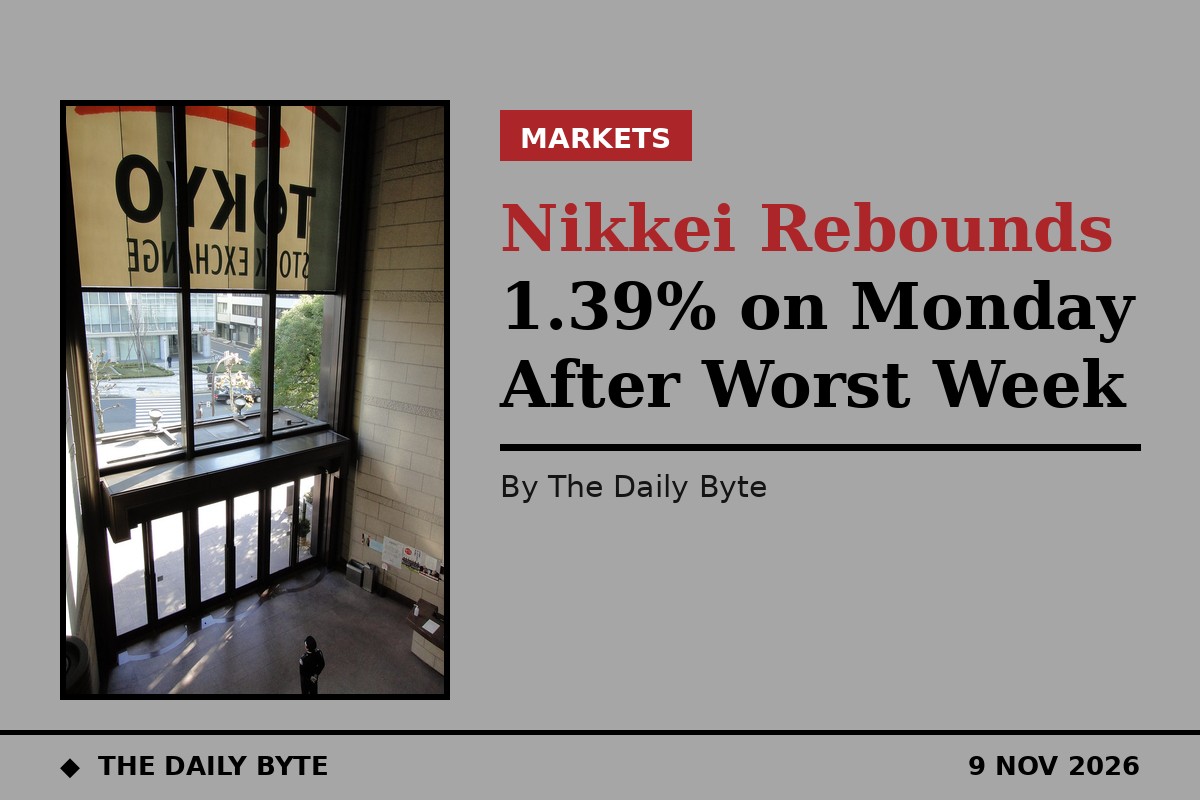
Japan's Nikkei 225 rose 1.39% in early trading on Monday 9 November, bouncing back after a brutal week in which the index entered a bear market and suffered one of its worst single-day falls on record.
The index opened 0.9% higher at 57,960.70, with gains across the board, and extended its rise to 58,234.25 by the morning session, a gain of 799 points on the day. The rebound follows Friday's 5.96% plunge, when the Nikkei shed 3,643.13 points to close at 57,434.77.
Over the week the index lost about 9.25%, and it remains down 15.64% over the past month. It is still up 15.68% so far this year, but it sits well below its 52-week high of 72,366.34. Monday's move is therefore a bounce inside a wider pullback rather than a clean break higher, and traders will be watching whether the gains hold through the close.
Wall Street steadies after AI rout
Tokyo took its cue from a steadier session on Wall Street on Friday. The S&P 500 gained 0.32% to close at 7,376.86, and the Nasdaq Composite rose 1.09% to 24,579.42, helped by renewed buying in chip stocks after Thursday's heavy sell-off. The Dow Jones Industrial Average slipped 0.46% to 51,285.73.
Even so, all three major American indexes ended last week lower. The S&P 500 lost 2.7% over the week, its largest weekly fall since April 2025, the Nasdaq fell 3.4% and the Dow slipped 0.9%. Thursday's rout was the worst single day for the Nasdaq since the Covid pandemic, wiping out about $2.3 trillion in technology market value as investors reassessed the AI data-centre buildout after the Democratic midterm sweep.
Volatility remains elevated. The VIX fear gauge fell 9.01% on Friday to 25.64, but that is still a reading that points to nervous trading. The US 10-year Treasury yield stood at 4.86%, and the dollar traded at 158.29 yen.
Mixed picture across Asia
Not every Asian market followed Tokyo higher. Australia's ASX 200 slipped 0.47% to 8,978.6 in early trade, despite having been tipped for a higher open. Hong Kong's Hang Seng had closed Friday down 1.27% at 24,481.86, and the Shanghai Composite finished 1.1% lower at 3,649.18. Singapore's Straits Times fell 2.21% over the week, while India's Sensex rose 2.13% to 80,999.4.
Attention now turns to the rest of the week's data and earnings. In the United States, the October consumer price index is due on Tuesday, and producer prices follow on Friday, with the figures likely to shape expectations for the Federal Reserve's December meeting. Earnings from AI-linked companies including CoreWeave and Nebius are also due this week, alongside reports from Cisco and Applied Materials on Thursday.
Taiwan is another market to watch on Monday, as its new short-selling curbs take effect and its NT$500 billion stabilisation fund stands ready to intervene after the Taiex lost 12% last week.
What to watch next
For Japan, the key question is whether Monday's rebound marks the start of a steadier week or simply a pause in a deeper correction. The Nikkei's one-month decline of more than 15% shows how quickly sentiment has turned after a year in which the index repeatedly set record highs on the back of the AI boom.
Investors will also be watching the yen, which has weakened sharply, and any fresh signals from Washington about regulation of AI infrastructure spending, the concern that triggered last week's global sell-off in the first place.