No DBS Check Needed for Work Experience
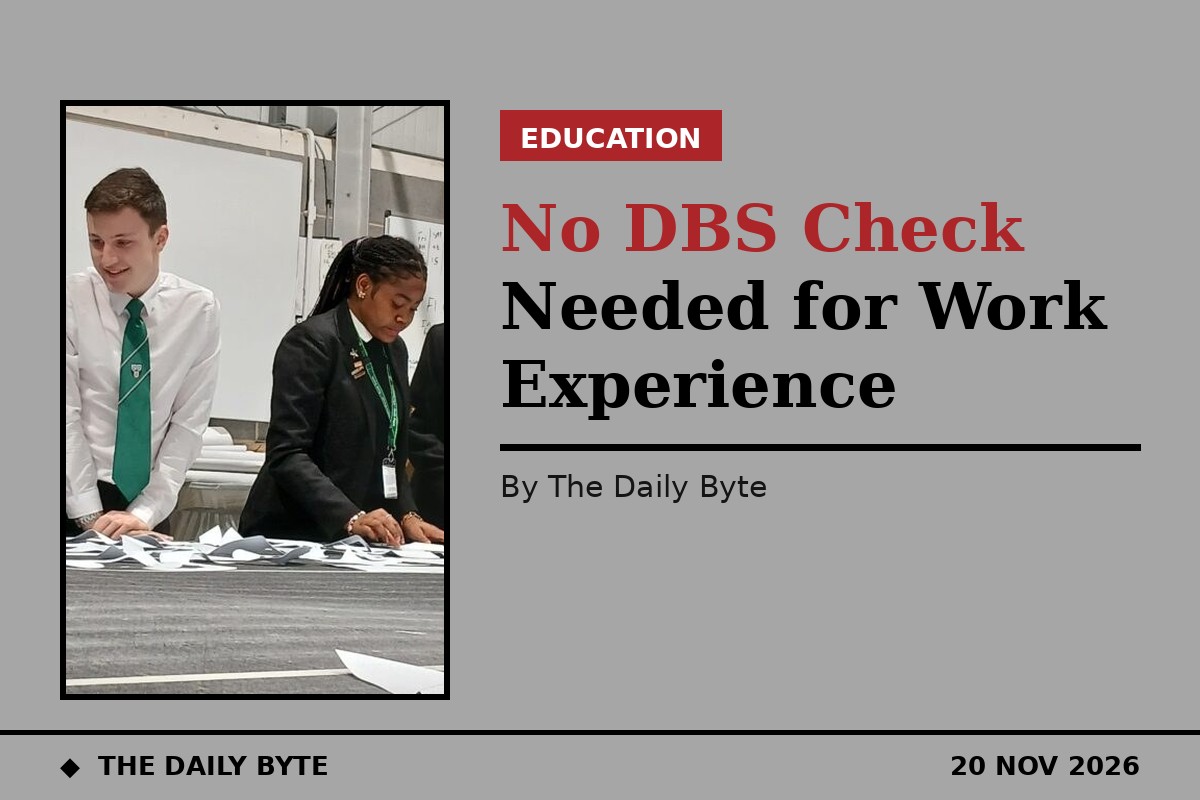
Employers hosting a school pupil for work experience are not legally required to obtain DBS checks for supervising staff, the Department for Education (DfE) has clarified, after weeks of confusion over new safeguarding rules.
The department said on Tuesday 17 November that employers “do not need to obtain a DBS check, including an enhanced DBS certificate with children’s barred list information, to offer work experience”. The clarification was reported by Schools Week on Friday 20 November and is set out in full in the government’s own guidance on work experience placements for under-16s.
What employers must still do
The clarification does not remove safeguarding duties. An employer must not allow someone to supervise a work experience placement where it knows, or has reason to believe, that the individual is barred from working with children. That applies whether the placement lasts longer than three days in a 30-day period or is shorter.
For young people aged 16 and over, the position is clearer still: supervisors do not need an enhanced DBS check with children’s barred list information, and such a check cannot be obtained for them because the supervision does not count as regulated activity. A DBS check is also not required for family members supervising a child on a placement.
Why the confusion arose
The uncertainty followed updates to safeguarding guidance stating that offering “teaching, training, instruction or care or supervision” for work placements for under-16s “frequently”, or for longer than three days in a 30-day period, counts as “regulated activity”. Supervisors of work placements had previously been exempt, but that changed after the Crime and Policing Act came into force last month.
The guidance itself did not explicitly say DBS checks were needed. It said only that schools “must not allow someone on the barred list” to take part — yet the only way to know whether someone is on the list is by carrying out an enhanced DBS check. Schools and employers warned that small businesses might stop offering placements rather than take on the extra administration.
Mixed welcome from the sector
Work experience providers welcomed the clarification. The Careers and Enterprise Company said it had “worked closely with the DfE to relay concerns raised by the sector” and that the guidance note “makes the position clear whilst emphasising the need for safeguarding to remain a priority”.
Alex Kelly, co-founder of work experience provider Unifrog, said: “We are happy with the new guidance, which is in keeping with the law, keeps young people safe, and follows common sense.” He added that it would take the sector a little time to digest, but that providers now had what they needed “for work experience to really flourish”.
Not everyone is satisfied. Dai Durbridge, a partner at law firm Browne Jacobson, said the guidance “seeks to remove the hurdle of employers needing to obtain an enhanced DBS”, but argued that relying on an employer to know about a barring “does not satisfy the requirement in law to ensure that an individual is not barred from regulated activity”. His view is that the guidance needs to change to reflect that work experience is not regulated activity.
Calls for free checks
A DBS check costs £41 for each person, not including processing fees. Nick Brook, chief executive of Futures For All, said the guidance was “clear and mercifully short”, but did not go as far as confirming that DBS checks, when needed, should be free to employers for work experience supervision.
The Milburn report, published on Tuesday, said the government should make DBS checks “required solely for government-supported work experience free”, and suggested testing “a direct barred-list checking route” which schools can already access. The government will decide whether to accept the report’s recommendations in due course. Education Secretary Lucy Powell called the findings “a clarion call for change”.
The DfE said it would “continue to monitor delivery and are exploring whether additional ways to simplify offering work experience placements are necessary, including potential legislative changes”.
The government expects schools to arrange two weeks of work experience for every pupil over the course of their secondary education. That includes a new requirement for a week of work experience activities in years 7 to 9, on top of the traditional week in years 10 to 11.
Sources: Schools Week, DBS checks not required for work experience, DfE clarifies; GOV.UK, Work experience placements for under 16s: DBS checks and regulated activity; Career Development Institute, DfE guidance removes safeguarding risk for work experience.