Nobel laureates urge UK to reverse CERN funding cut
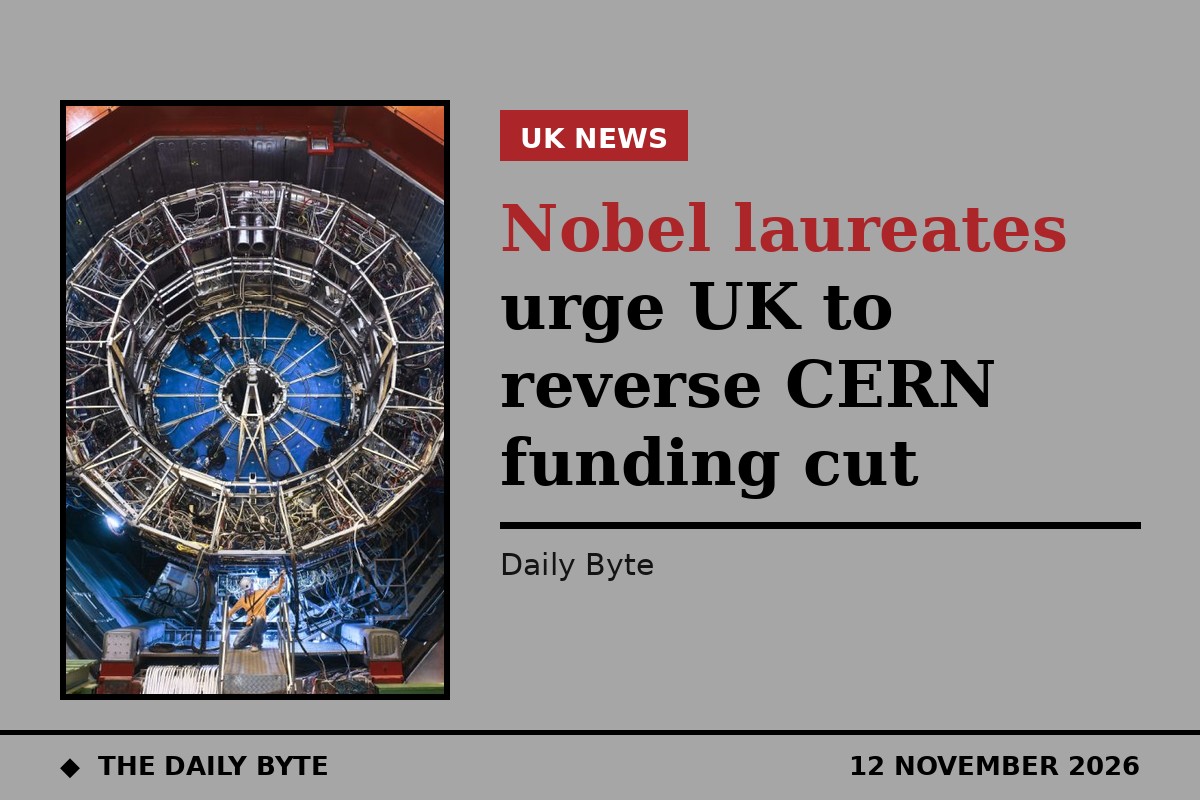
More than 400 leading physicists, including two Nobel laureates, have urged the UK government to reverse its decision to withdraw funding from an upgrade to an experiment at CERN, Europe's leading particle physics laboratory.
An open letter to the government, coordinated by early career physicist Matthew Kirk of Durham University, expresses deep concern about the funding cut to the LHCb detector on the Large Hadron Collider. Its signatories include physics Nobelists David Politzer and Giorgio Parisi, former CERN director-general Luciano Maiani, and more than 400 other senior physicists from the UK and overseas.
Until UK Research and Innovation (UKRI) decided to cut the promised funds in January, the UK had been leading the programme, known as LHCb Upgrade II. The letter is described as a final plea asking the government to reconsider the decision.
What the letter says
The letter states that LHCb delivers data that is essential for testing the most fundamental theories in physics, and that this data cannot be obtained anywhere else in the world. It adds that this work depends entirely on the LHCb Upgrade II programme, making it inconceivable that previously awarded funding has been cut when the experiment's capabilities are so irreplaceable.
The signatories warn that the withdrawal of funding gravely weakens the UK's scientific leadership in an area where it has historically been world leading. They also call on the government to publish in full the scientific basis on which the decision to cut funding was taken.
According to the letter, 10 months after the cut was first announced, UKRI and its Science and Technology Facilities Council have still been unable to communicate a clear reason for the decision.
The funding cut and what was lost
UK scientists said in July that a three-year pre-construction phase for the LHCb upgrade had been completed, building on earlier technical design reports and accounting for 5 million pounds of the planned 49.4 million pound upgrade.
The upgrade was intended to take advantage of the planned increase in the power of the Large Hadron Collider, known as the High-Luminosity LHC. Without it, the detector is expected to reach the end of its working life in the early 2030s after years of intense radiation damage.
Italy and the UK had been due to fund 40 per cent of the upgrade between them, but Italy's contribution now also looks uncertain. There are concerns within the CERN council that China could take over leadership of the LHCb upgrade, despite not paying a membership fee to CERN.
Why the UK's role matters
The letter explains that the UK forms a key part of the scientific base of the LHCb experiment. Researchers at UK institutions account for 15 per cent of the collaboration, and both of the experiment's two principal leadership roles are currently held by British scientists.
Kirk, a postdoctoral research associate at Durham University's Institute for Particle Physics Phenomenology, said the letter showed the strong support among colleagues who believe that progress in theoretical physics across Europe will be set back for a generation if the cut is not reversed.
He warned that unless the UK government changes course soon, even the best-case outcome for the future of the LHC would leave fundamental questions only partially answered.
Wider funding worries
The LHCb cut is part of a wider squeeze on UK funding for particle physics and astronomy. Television physicist Brian Cox and Chinese scientists have previously condemned the decision to withdraw funding from the project.
Some particle physicists and early career researchers have already indicated that they would like to leave the UK because of the wider funding crisis, and Kirk warned that going ahead with the decision would make that effect worse.
The letter is the latest attempt by the physics community to persuade ministers to restore the funding before the UK's leading role in the experiment is lost.