NVIDIA, Rebellions and SK Telecom Build Korea Sovereign AI
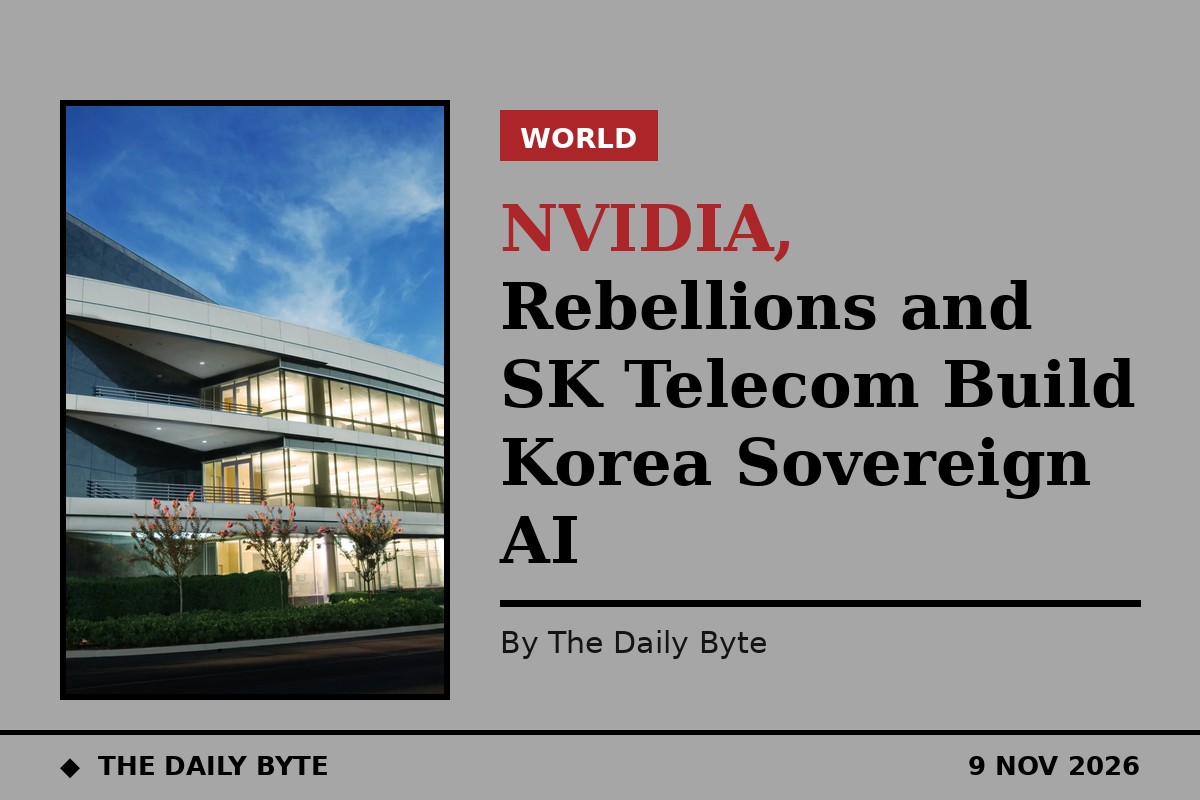
NVIDIA, Korean chip designer Rebellions and telecoms giant SK Telecom have announced a collaboration to build South Korea's sovereign AI infrastructure, linking Korean-designed AI processors into NVIDIA's data-centre platform. The deal was unveiled in Seoul on Monday 9 November at NVIDIA AI Day Seoul 2026, and is backed by South Korea's Ministry of Science and ICT.
Under the agreement, Rebellions will adopt NVIDIA NVLink Fusion to connect its next-generation Rebel R200 neural processing units to NVIDIA's open infrastructure platform for rack-scale inference, using NVIDIA's MGX rack architecture for system development. SK Telecom plans to deploy the resulting systems in its AI data centre to deliver full-stack sovereign AI, spanning infrastructure, proprietary models and public-facing services, including those under Korea's national "AI for All" project.
Korean chips plug into NVIDIA's platform
NVLink Fusion is NVIDIA's way of letting third-party accelerators work inside its data-centre ecosystem rather than outside it. The technology gives chipmakers access to NVIDIA's high-bandwidth, low-latency scale-up networking, which has historically been tied to NVIDIA's own graphics processors. The Rebellions deal is one of the first times the interconnect platform will integrate with non-NVIDIA processors at scale.
Rebellions is developing the R200 for low-latency, energy-efficient inference on frontier models, including multitrillion-parameter mixture-of-experts models. Its R200 systems are expected to be ready for deployment in 2028. The company's current ATOM-Max chips are already running inside several SK Telecom services, handling around 14 million requests and more than 4 billion tokens a day as of September 2026.
A wider Korean AI push
The collaboration sits inside a broader expansion of NVIDIA's work with Korea's Ministry of Science and ICT, covering semiconductors, data centres, models, skills and agent security. NVIDIA will work with three selected consortia and four Korean foundation-model builders, with deployment recipes covering SK Telecom's A.X K2, LG AI Research's K-EXAONE 2.0, Upstage's Solar Open 2 and Motif Technologies' Motif-3.
For SK Telecom, the deal adds a Korean-made inference chip to an AI factory plan already heavily built on NVIDIA hardware. The carrier plans a gigawatt-scale AI factory in Korea on NVIDIA's DSX AI Factory architecture, with an operational target of 2027, starting on the Blackwell platform and moving later to the upcoming Vera Rubin generation. Seoul has also set out a 21.3 trillion won AI push in its record 2027 budget, targeting a world-class sovereign model.
No financial terms were disclosed for Monday's announcement, and the release gives no purchase commitments beyond the 2028 target for the R200 systems. The test will be whether a Korean-designed chip can hold its own inside NVIDIA's ecosystem — and whether the partnership turns Seoul's sovereign AI ambitions into working infrastructure rather than announcements.


