Nvidia, Rebellions, SK Telecom Team Up on Korea AI
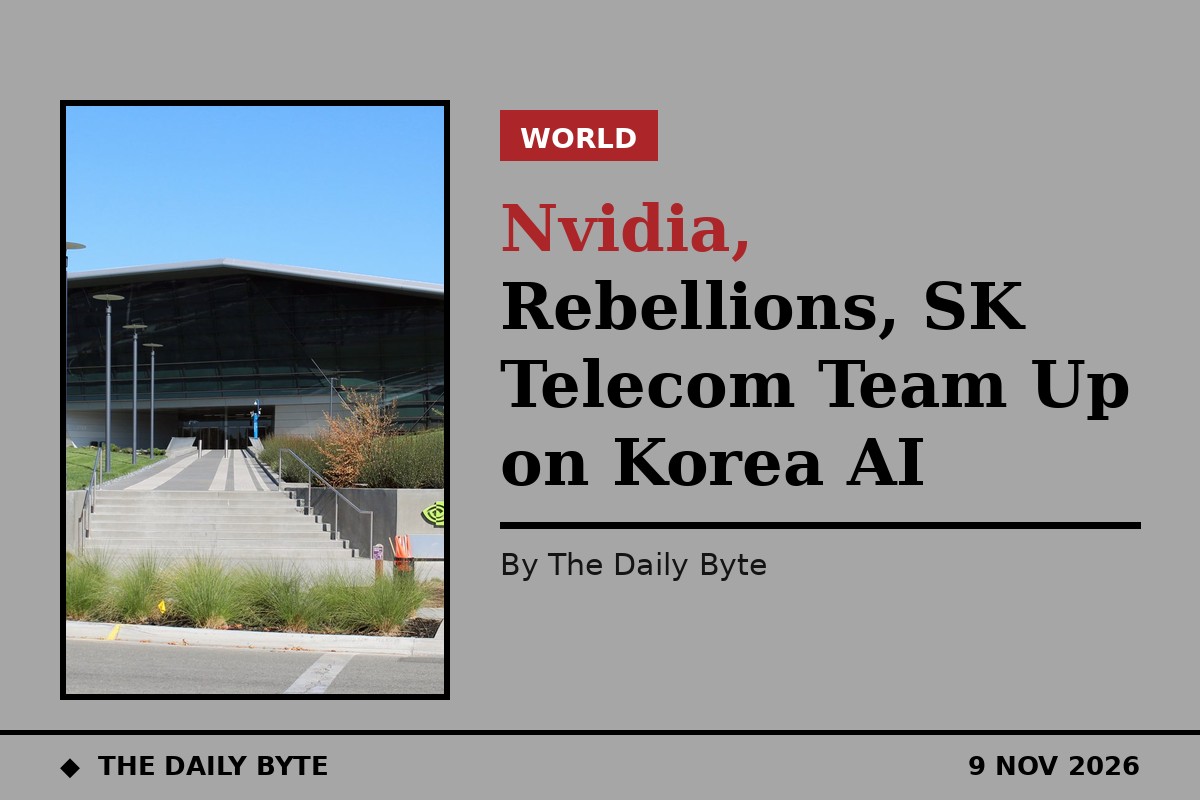
Nvidia, Korean chip startup Rebellions and SK Telecom have announced a collaboration to build sovereign AI infrastructure in South Korea, linking Korean-designed AI processors into Nvidia's data centre platform. The agreement was unveiled in Seoul on 9 November 2026 and is backed by South Korea's Ministry of Science and ICT.
At the centre of the deal is Nvidia NVLink Fusion, technology that lets third-party accelerators work inside Nvidia's ecosystem rather than outside it. Rebellions will use NVLink Fusion to connect its next-generation Rebel R200 neural processing units to Nvidia's open infrastructure platform for rack-scale inference, using Nvidia's MGX rack architecture for system development.
What each partner brings
Rebellions is developing the R200 for low-latency, energy-efficient inference on frontier AI models, including very large mixture-of-experts models. The company's R200 systems are expected to be ready for deployment in 2028, so the announcement is a development and deployment plan rather than infrastructure already in operation.
SK Telecom plans to deploy the resulting systems in its AI data centre, combining them with its own foundation models and public-facing services. The carrier says the work supports its vision for full-stack sovereign AI, spanning infrastructure, proprietary models and services, including those under the Korean government's AI for All project. Its A.X K2 model is among the Korean foundation models covered by the wider collaboration.
Rebellions' current ATOM-Max chips are already running inside several SK Telecom services. As of September 2026, those chips were handling around 14 million requests and more than 4 billion tokens a day, according to the announcement.
Government backing and wider Korea plan
Korea's Ministry of Science and ICT is supporting the collaboration, which it presents as a way to connect domestic semiconductor innovation with the infrastructure needed to deliver AI at scale. Bae Kyung-hoon, Korea's deputy prime minister and science and ICT minister, said the arrangement would enable Korean-developed neural processing units to enter the computing infrastructure market alongside Nvidia through NVLink Fusion.
SK Telecom president and chief executive Jung Jai-hun said combining the carrier's AI data centre and model capabilities with Korean AI semiconductors and global infrastructure technology would strengthen the company's sovereign AI competitiveness.
The chip collaboration sits inside a broader expansion of Nvidia's work with the ministry, announced the same day. That wider plan covers AI semiconductors, data centre infrastructure, talent, startups, models, agents and security, and includes Nvidia working with three selected consortia and four Korean foundation model builders, using Nvidia Dynamo software to optimise and scale AI inference. Deployment recipes cover SK Telecom's A.X K2, LG AI Research's K-EXAONE 2.0, Upstage's Solar Open 2 and Motif Technologies' Motif-3.
SK Telecom has separately set out plans for a gigawatt-scale AI factory in Korea built on Nvidia's DSX AI Factory architecture, with an operational target of 2027, starting on Nvidia's Blackwell platform and moving later to the upcoming Vera Rubin generation. No financial terms were disclosed for the 9 November announcement, and the release gives no purchase commitments or deployment dates beyond the 2028 target for the R200 systems.
The deal also follows earlier steps between the partners. In April 2026, SK Telecom, Rebellions and Arm signed an agreement on a joint AI inference server, and in July 2026 Nvidia and SK Group widened their relationship, with talk of a potential investment commitment of more than $500 billion, a figure the companies described as a possibility rather than a signed deal. Read more in Nvidia's blog on the expanded Korea collaboration and Unite.AI's report on the Rebellions announcement.


