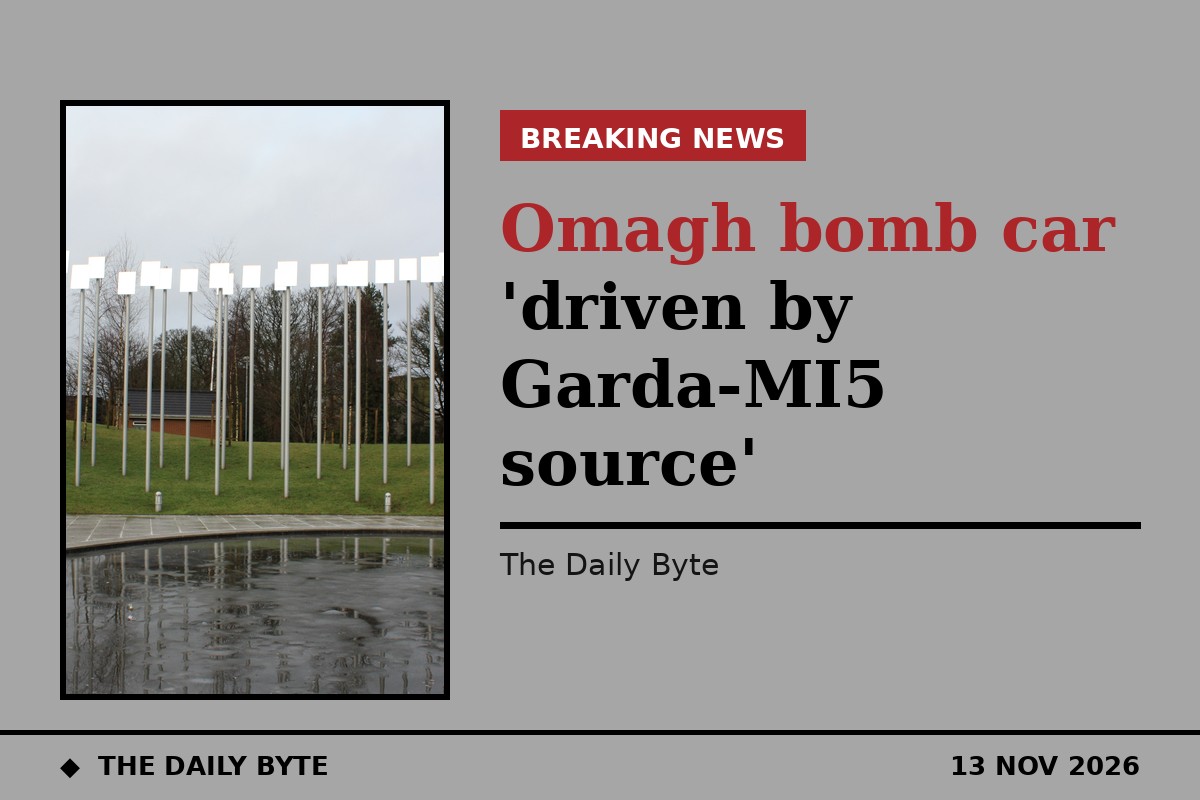
Omagh bomb car 'driven by Garda-MI5 source'
The former police officer who led the Omagh bomb investigation has told a public inquiry that he believes one of the people who brought the bomb to Omagh on the day of the attack was an agent run jointly by the Garda and MI5.
Retired Police Service of Northern Ireland Chief Superintendent Norman Baxter gave the evidence to the Omagh Bombing Inquiry in Belfast on Friday 13 November 2026, clarifying testimony he had given the day before. On Thursday, he told the inquiry he believed a human intelligence source had driven the car carrying the bomb across the border from the Republic of Ireland into Northern Ireland.
Asked to clarify on Friday, he said: "I should have concluded that the assessment is that that source was a Garda-MI5 source, and that's part of the reasoning in relation to referring to the Irish Republic." Counsel to the inquiry, Paul Greaney KC, said Mr Baxter had been careful not to name the source and that there was a good reason why the person was not being identified.
The Real IRA car bomb exploded on Market Street in Omagh on 15 August 1998, killing 29 people, including a woman who was pregnant with twins. It was the worst single atrocity of the Troubles in Northern Ireland. The inquiry, chaired by Lord Turnbull, was set up in February 2024 to examine whether the bombing could have been prevented by the UK authorities.
What Baxter told the inquiry
Mr Baxter was the senior investigating officer in charge of the Omagh investigation from May 2002 until he retired in November 2008. He was formerly head of the Serious Crime Branch at the Police Service of Northern Ireland.
Mr Greaney read from Mr Baxter's statement to the inquiry, in which the former officer said there were strong indications that the Garda and the Irish Republic had knowledge of dissident republican activity that was not shared with the Royal Ulster Constabulary or the Police Service of Northern Ireland before or after 15 August 1998.
Mr Baxter also told the inquiry that intelligence was held about those who carried out the Omagh bombing in relation to earlier attacks they had carried out. He described the policing failure before the atrocity as an "absolute failure" of counter-terror policing, and said the risk had been increasing from 1997 as republicanism split, yet the emerging threat was not dealt with.
"This was about risk management," he told the inquiry. "All policing is about risk, and the risk was increasing from 97 from the splits within republicanism, and the risks increased over the summer, and then Omagh happened, so in my view, there's a failure of risk management." He added: "I'm very proud of my time in the police, but this was a failure at leadership, a failure at government level, it just should not have happened."
He agreed that those responsible should have been stopped and said intelligence indicated there were ample opportunities to arrest individuals.
Families renew call for Irish inquiry
A solicitor for some of the bereaved families, Enda McGarrity, said the evidence heard so far raised very serious allegations about the role of Irish state agencies and made it abundantly clear that the Irish Government must establish its own independent statutory inquiry. He said the inquiry's jurisdictional limits made it very difficult in practice to investigate whether Irish state agencies could have prevented the bombing.
Shawneen Conway, whose brother Gareth Conway was killed in the bombing at the age of 18, said her family was still suffering and living with the effects of what happened. She said going through the inquiry almost 30 years later had been extremely difficult and deeply distressing, and that families still had many unanswered questions about what was known and whether everything possible was done to protect innocent lives.
Stephen Toal KC, lead counsel for bereaved families and survivors, said Mr Baxter had carried a huge burden on behalf of the victims for the past 25 years and thanked the former officer on their behalf.
What happens next
The inquiry's evidential hearings are continuing in Belfast, with Mr Baxter's evidence forming part of its examination of the key suspects and the intelligence held before the bombing. The inquiry must answer the central question of whether the UK state authorities could have prevented the attack, and it is also examining whether intelligence was shared properly between the UK and the Republic of Ireland.
RTÉ reported that Mr Baxter clarified on Friday that the source was a Garda-MI5 source, while British Bulletin also reported his evidence that the bombers had been allowed free rein and that the Irish government had information a bombing was imminent.