Oruc Reis Arrives in Karachi for Offshore Surveys
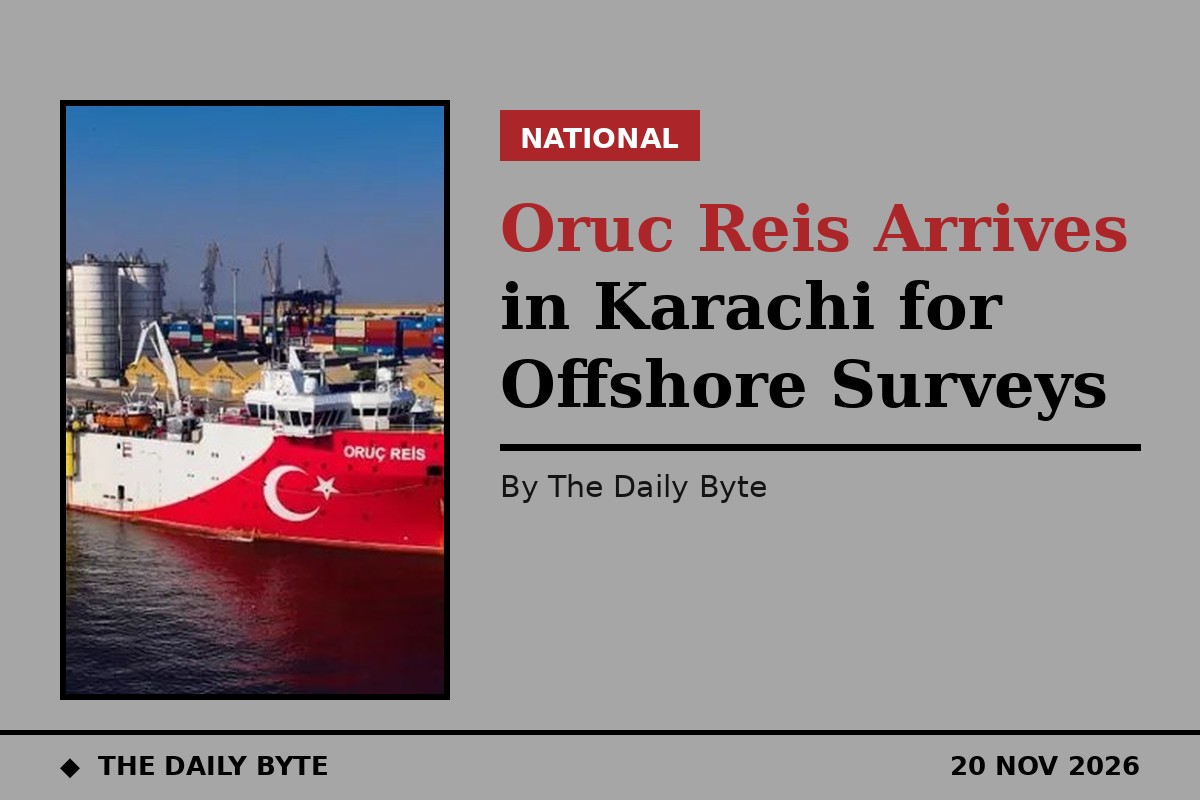
Türkiye’s seismic research vessel Oruç Reis has arrived at Karachi Port to begin offshore oil and gas surveys in Pakistani waters, reviving offshore hydrocarbon exploration in the country after a gap of nearly two decades.
A welcome ceremony was held at Karachi Port on Friday, attended by Turkish Minister of Energy and Natural Resources Alparslan Bayraktar, Pakistan’s Deputy Prime Minister and Foreign Minister Mohammad Ishaq Dar, and Federal Minister for Petroleum Ali Pervaiz Malik. Pakistan and Türkiye also signed agreements to expand cooperation in offshore oil and gas exploration, mineral development and energy.
Bayraktar said the vessel would carry out two- and three-dimensional seismic survey operations in the Indus and Makran basins, and that drilling was expected to start in 2027 at locations identified from the survey data.
Two survey phases off Karachi and Makran
The first phase is the Marjan 3D Seismic Project in the Indus-C Block, off Karachi, where Oruç Reis will collect three-dimensional seismic data across about 670 square kilometres. Preparations and data collection for that phase are expected to take around 50 days after the vessel reaches the survey area.
Once the Marjan survey is complete, the vessel will return to Karachi Port to prepare for its second assignment, the Makran 2D Seismic Project, under which it will acquire seismic data along about 2,353 kilometres of survey lines. That phase is expected to take around 25 days.
The vessel uses sound waves to examine underwater rock structures. Researchers then use the collected data to build three-dimensional images of geological formations, which help experts assess offshore oil and gas prospects and guide future exploration decisions. The seismic survey itself does not establish whether commercially viable oil or gas reserves are present.
A vessel built for deep-water surveys
Oruç Reis is an 87-metre seismic research vessel built in Türkiye in 2017 and operated by the state-owned Turkish Petroleum Corporation. It carries advanced seismic, acoustic and seabed surveying equipment, and is designed for both two- and three-dimensional seismic acquisition in offshore oil and gas exploration.
The vessel departed the port of Taçucu in Mersin on 30 October and reached Karachi after a 19-day voyage. The Pakistan mission is its second intercontinental assignment, following a nine-month seismic survey programme off Somalia, where it acquired three-dimensional seismic data across 4,464 square kilometres in three offshore blocks.
Under the agreements reached with Pakistani state energy companies, the survey work involves Oil and Gas Development Company Limited, Pakistan Petroleum Limited, Mari Energies and Government Holdings Private Limited. Dar described the vessel’s arrival as a new chapter of scientific exploration and strategic cooperation between Pakistan and Türkiye, built on the two countries’ longstanding friendship.
Exploration resumes after twenty years
The mission marks the resumption of offshore hydrocarbon exploration in Pakistan’s Indus and Makran basins after nearly 20 years, according to Pakistan’s Ministry of Energy (Petroleum Division). Turkish officials said the full survey campaign could take about five to six months, after which the data will be analysed and drilling locations chosen.
Bayraktar said the results of the seismic campaign would be used to identify locations for drilling operations that Türkiye aims to begin in 2027. If the surveys identify promising structures, full-scale drilling in the deep sea would follow in the early part of that year.
For Pakistan, the arrival of Oruç Reis is the first concrete step in a renewed attempt to map its offshore energy potential. The country has relied heavily on imported fuel, and the survey data will determine whether its offshore basins hold resources worth developing, or whether the search must continue elsewhere.