Pakistan Turns to $32 Spot LNG for Winter Gas Shortfall
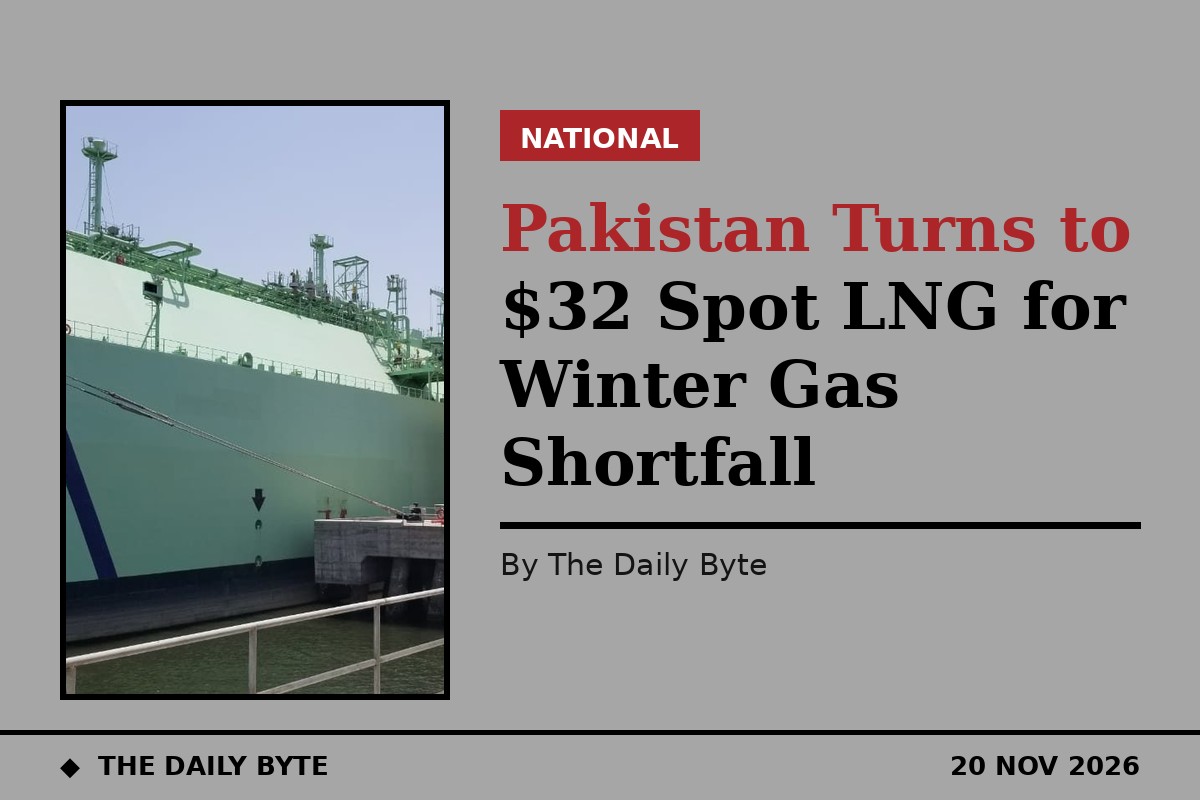
Pakistan has gone back to the international spot market for liquefied natural gas to cover its winter shortfall, re-issuing a tender for two cargoes after rejecting earlier bids as too expensive, with prices around $32 per million British thermal units.
State-owned Pakistan LNG Limited (PLL) first sought the two cargoes on 4 November, with prime ministerial approval, for delivery in the windows of 14–16 December and 9–11 January. The tender was then re-issued on 13 November after the first round drew bids of $27 to $31 per unit from two suppliers, which PLL turned down. Bids for the re-issued tender, numbered PLL/IMP/LNGT81, were due by 2pm on 18 November.
Each cargo is about 140,000 cubic metres, to be delivered ex-ship at Port Qasim in Karachi, meaning the seller carries the gas all the way to the terminal. The outcome of the re-issued tender had not been publicly confirmed at the time of writing, and reports differed on whether the lowest bids in the first round were rejected outright or sent to the PLL board.
Why Pakistan is buying on the spot market
Before the Iran war, Pakistan relied mostly on LNG supplied under long-term contracts with Qatar, which is far cheaper than spot cargoes. That changed in March, when Qatar declared force majeure on its exports after Iranian strikes damaged its Ras Laffan export hub.
Since then Pakistan has been forced to buy replacement cargoes on the spot market, where Asian and European buyers are competing ahead of winter and driving prices up. At around $32 per unit, and $33.50 to $34 once insurance, war-risk surcharges, freight and port handling are added, the delivered cost is roughly double what Pakistan pays under its Qatari contract.
The scale of the gap is large. Pakistan needs nine cargoes for December and eleven for January, and is trying to arrange eight to ten a month. With Qatari term supplies disrupted, it is expected to need ten additional spot cargoes between November 2026 and February 2027, pushing the winter procurement bill past $1 billion.
Strait of Hormuz adds to the risk
The supply position has been made worse by security risks around the Strait of Hormuz, through which the cargoes must travel. The News reported attacks on vessels carrying LNG to Pakistan and Bangladesh before they entered the strait, and some Qatari cargoes have only reached Pakistan after Iran directly assured Islamabad that vessels could pass safely.
The National Crisis Management Centre is monitoring the situation and remains in contact with Iran over three to four cargoes a month for December and January. That is a stopgap, not a solution: the shortfall is structural while Qatari term volumes remain disrupted, and every spot cargo bought at these prices adds to the cost of gas and power.
Households feel it first
The anticipated shortfall is already being passed on to consumers. The two gas utilities, Sui Northern Gas Pipelines and Sui Southern Gas Company, have restricted domestic gas to cooking hours since 4 November: from 6:30am to 9am, noon to 2:30pm, and 6pm to 9pm, with no end date announced.
The gas supply situation is expected to deteriorate further in December and January. The authorities are considering curtailing supplies to power, fertiliser, export-oriented and other industries to prioritise domestic needs during the peak winter months.
Expensive spot LNG also feeds into electricity costs. Gas regasified from imported LNG fires power plants, so cargoes bought at $32 a unit push up generation costs and, in time, tariffs. For households already living on eight hours of gas a day, the winter will test both supply and what families can afford to pay for it.
Sources
The News — Govt seeks spot LNG cargoes for December, January
OilPrice — Pakistan Scrambles for LNG as Winter Gas Crisis Deepens