Pakistan: AI Must Never Decide on Nuclear Weapons Use
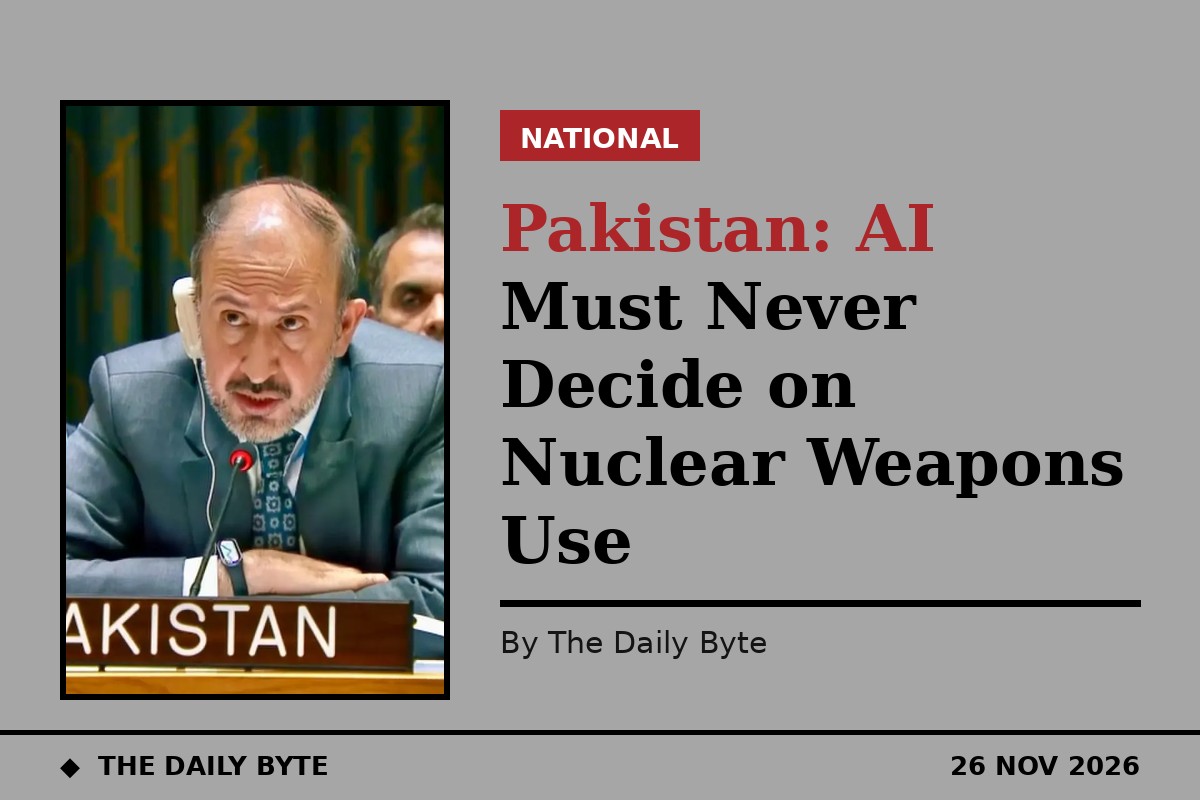
Pakistan has told the United Nations Security Council that decisions on the use of nuclear weapons must always remain under human control, warning that artificial intelligence must never be used to decide on nuclear use or to target nuclear command, control and communications systems.
Ambassador Syed Haider Shah, Pakistan's Permanent Representative to the United Nations, delivered the warning at the Security Council's high-level open debate on conflict resolution in an era of rapid technological change, held in New York on Tuesday, 24 November. The session was held under the Latvian presidency of the Council.
"This is most critical in the nuclear domain, where decisions on the use of nuclear weapons must remain under human control, and AI systems must never be used to target nuclear command, control and communications systems," Shah told the 15-member Council.
The statement sets out Pakistan's position on one of the most sensitive questions in the debate over military artificial intelligence: whether machines should ever be allowed a role in the gravest decisions a state can take. Pakistan's answer is that they should not.
Why AI raises the risk
Shah warned that the rapid development and convergence of emerging technologies were adding unprecedented speed, scale and complexity to international security challenges, potentially accelerating the global arms race. In the military domain, he said, artificial intelligence shortens the time leaders have to think during a crisis, raising the danger of errors and rushed decisions.
In the nuclear field, he argued, such a mistake could have consequences no country could undo. A false alarm or a misread signal, processed and acted on at machine speed, could compress the window for checking information or correcting an error before escalation became unstoppable.
He said technology itself was neutral, with its consequences determined by the intentions and motivations of those deploying it. But he stressed that human judgment and control must remain central at every stage of design, development and integration of technological systems, and called for guardrails and governance frameworks to make sure progress contributes to peace rather than becoming an instrument of domination or warfare.
The UN chief agrees
UN Secretary-General Antonio Guterres, who also addressed the debate, made the same point in his own terms: as long as nuclear weapons exist, only humans should decide whether to use them. He said today's wars had become testing grounds for AI-based targeting, and stressed that the fundamental principle of human control over the use of force must not be weakened by technological developments.
Guterres added that when civilians are killed or human rights are violated, responsibility cannot simply be shifted to an algorithm.
What Pakistan wants instead
Beyond the nuclear red line, Shah called for safeguards, regulations and governance frameworks for emerging technologies, and for military restraint and confidence-building measures to reduce the risk of miscalculation. He proposed crisis communication channels, deconfliction mechanisms and mutual restraint to reduce mistrust and prevent accidental escalation.
He also argued that the fragmented and widely dispersed nature of emerging technologies required multilayered governance frameworks, accountability mechanisms and, where necessary, legally binding instruments. "Delaying regulation to secure advantage and domination will not work," he cautioned, rejecting discriminatory approaches and forums with selective representation.
Pakistan also warned against technological monopolies and restrictions introduced in the name of safety being used to deny countries access to essential technologies, infrastructure or capabilities. All member states, particularly developing countries, retain an inalienable right to the peaceful use of technology, Shah said, and rules on emerging technologies, especially in arms control, should be developed in inclusive and representative multilateral forums under UN auspices.
His remarks carry particular weight for South Asia, where Pakistan and India both possess nuclear weapons and the security of nuclear command and control infrastructure remains central to strategic stability. Shah also pointed to the growing threats of misinformation, disinformation, fake news and cyberattacks, including assaults on critical infrastructure by both state and non-state actors, and said the UN Charter and international law apply in all situations, irrespective of the underlying technologies.
Frequently asked questions
What exactly did Pakistan ask for at the UN Security Council? Pakistan said decisions on the use of nuclear weapons must remain under human control, and that AI systems must never be used to target nuclear command, control and communications systems. It also called for inclusive, UN-led governance frameworks for emerging technologies.
Who delivered Pakistan's statement? Ambassador Syed Haider Shah, Pakistan's Permanent Representative to the United Nations, at the Security Council's high-level open debate on 24 November 2026.
Did the UN Secretary-General take the same position? Yes. Antonio Guterres said that as long as nuclear weapons exist, only humans should decide whether to use them, and that responsibility for civilian harm cannot be shifted to an algorithm.