Pakistan Calls India's Indus Move 'Outlaw Behaviour'
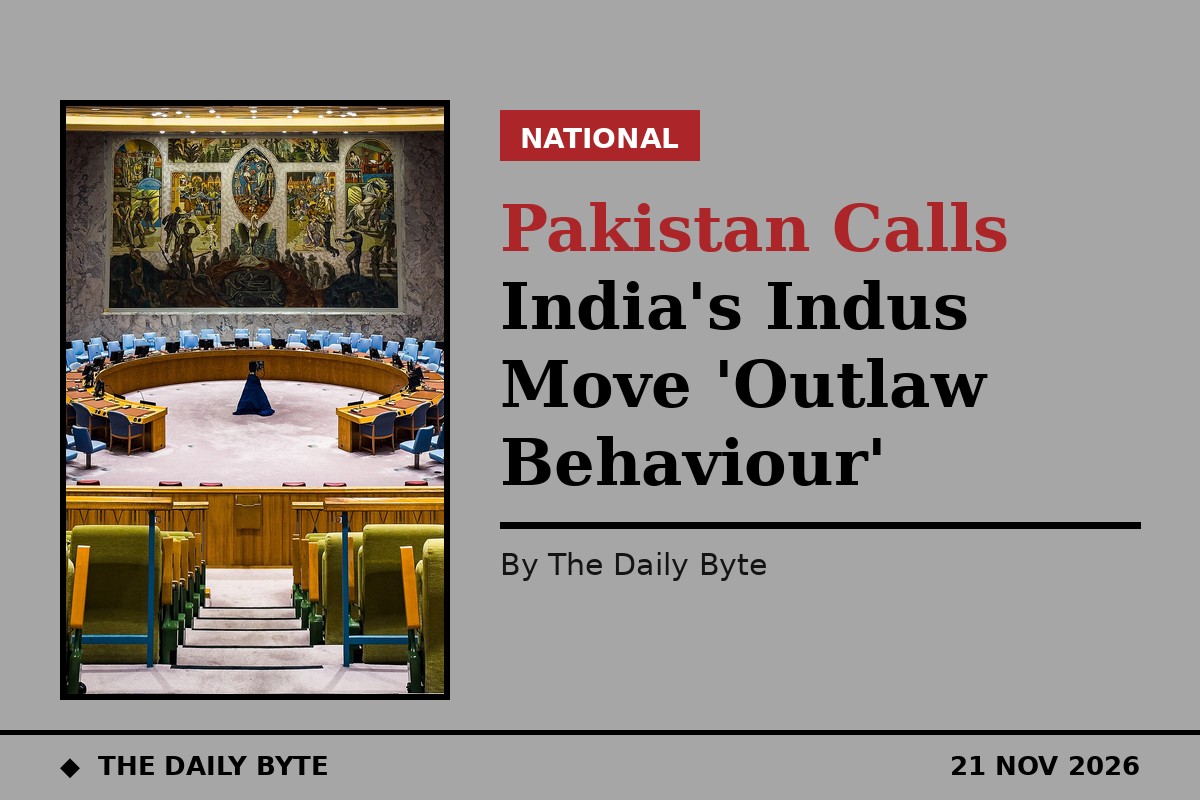
Pakistan has told the United Nations that India's decision to place the Indus Waters Treaty in abeyance is "outlaw behaviour" that violates international law and threatens the water security of more than 240 million people. The statement was made at a United Nations Security Council meeting in New York this week.
Ambassador Usman Jadoon, Pakistan's deputy permanent representative to the UN, accused India of "weaponizing water" by suspending the decades-old treaty and threatening downstream supplies. He warned that such actions endanger the livelihoods and well-being of more than 240 million people and risk escalation between the two neighbouring states.
Pakistan's case at the UN
Jadoon raised the dispute at an informal Security Council meeting convened by Liberia under the Arria-formula format, which examines how cooperation over natural resources can prevent conflict. The session, held on 18 November, brought together Council members, other UN member states and experts from international organisations, academia, the private sector and civil society.
Rejecting what he called India's "unlawful action", Jadoon pointed out that the Permanent Court of Arbitration had reaffirmed that the treaty remains fully in force and that India remains bound by its obligations. He cited an award by the court dated 31 August, which Pakistan says confirmed that the treaty cannot be set aside by one side alone.
"No state should be permitted to use shared natural resources as instruments of coercion or political pressure, in violation of international law and binding treaty obligations," the Pakistani envoy told delegates. He urged neighbours to settle disputes peacefully, citing Security Council resolution 2788 and Article 33 of the UN Charter, and said natural resources should serve development, shared prosperity and peace rather than exploitation and conflict.
The right of reply
After India's ambassador responded, First Secretary Ansar Shah exercised Pakistan's right of reply. He denounced what he called India's attempt to deflect and deny, and rejected the Indian envoy's remarks as frivolous and highly inappropriate.
"That is not treaty law; it is outlaw behaviour," Shah said, arguing that India was seeking the power to decide alone when the treaty applies, when it does not, and what new conditions should be read into it. "India's gross violation of the Indus Waters Treaty is violation of international law," he said, adding that the treaty contains no provision whatsoever for any unilateral action of this sort.
Shah also pointed out that while India argued the treaty was signed in 1960 and the world has changed, the UN Charter is even older. He said Pakistan rejects the Indian remarks about its domestic affairs and called on New Delhi to comply with international law and honour its obligations under international treaties and Security Council resolutions.
India's response
Indian Ambassador Harish Parvathaneni responded to Jadoon's remarks in the same meeting, accusing Pakistan of misusing the forum and insisting that India's position on the treaty was clear and consistent. He went on to target the role of the Pakistani Army, prompting Shah's reply.
The exchange underlined how far apart the two sides remain on the water dispute. Pakistan frames the suspension as a breach of a binding treaty with consequences for hundreds of millions of people downstream. India maintains that its position is clear and consistent, and has not accepted Pakistan's reading of the treaty or of the arbitration award.
Why the treaty matters
The Indus Waters Treaty was signed in 1960 and brokered by the World Bank. It allocates the eastern rivers, the Ravi, Beas and Sutlej, primarily to India, and the western rivers, the Indus, Jhelum and Chenab, largely to Pakistan. It contains no provision allowing either country to suspend or end it unilaterally.
India placed the treaty in abeyance in April 2025, after 26 people were killed in Jammu and Kashmir. New Delhi accused Islamabad of involvement in the attack, a charge Pakistan denied. Since then, Pakistan has raised the issue repeatedly in international forums, arguing that the suspension puts at risk the water supplies on which more than 240 million Pakistanis depend.
The Security Council debate did not produce a decision on the treaty itself. But Pakistan used the forum to put its position on the record before the Council and to press for a peaceful settlement under international law, while India used the same session to defend its stance and challenge Pakistan's use of the meeting.