Pakistan, China plan joint study to lift exports to $100bn
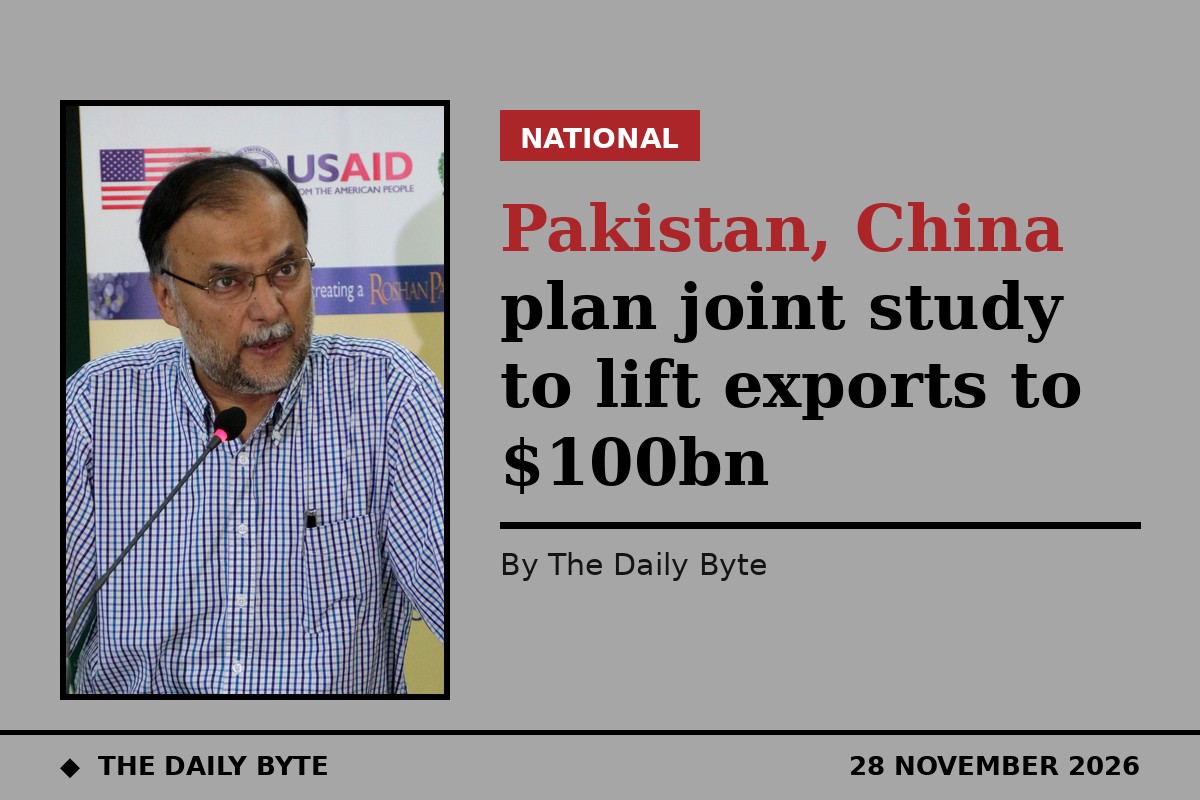
Pakistan and China have agreed to work on joint research aimed at lifting Pakistan's annual exports above US$100 billion by 2035, after Planning Minister Ahsan Iqbal met the head of China's Development Research Center in Beijing on Saturday.
Iqbal met Lu Hao, president of the Development Research Center (DRC) of China's State Council, to discuss research cooperation to increase Pakistan's exports and strengthen its economic sovereignty, according to the Press Information Department. The two sides discussed a proposed joint research project between the DRC and the Pakistan Institute of Development Economics (PIDE).
The project would draw lessons from China's economic experience and develop a practical roadmap for Pakistan's annual exports to exceed US$100 billion by 2035. Iqbal said his discussions with the Chinese leadership had centred on how, with China's cooperation, Pakistani manufacturers and farmers could increase sales of their products in global markets.
The $100 billion figure is ambitious. Pakistan's annual exports are reported at about $40 billion, so reaching the target would mean more than doubling export earnings within nine years. The government has made the goal a central part of its Uraan Pakistan economic plan, which also aims to build a $1 trillion economy by 2035. Iqbal has previously described expanding exports as a national emergency, arguing that the target is essential for the country's economic survival and for reducing reliance on foreign loans.
The Beijing meeting was part of a wider round of talks. On 26 November, Iqbal met Liu Haixing, a senior official of the Chinese Communist Party's International Department, and asked for preferential, zero-tariff access for Pakistani goods in the Chinese market. The request pointed to tariff concessions China has extended to African countries as a possible model. Iqbal said the aim was to raise Pakistan's annual exports to China from about $3 billion to between $20 billion and $25 billion.
He also sought support for a proposed Pakistan-China Knowledge Corridor that would help about 10,000 Pakistani scholars pursue doctoral studies and specialist research over ten years, with priority fields including artificial intelligence, engineering, advanced manufacturing, modern agriculture, biotechnology and mineral sciences.
The talks also covered the second phase of the China-Pakistan Economic Corridor, with industrial and agricultural cooperation, business partnerships, technology transfer, minerals and green development among the priorities. No new financing agreement was announced alongside the research proposal, and the reports do not give a timeline for when the joint DRC-PIDE study will begin.
The test for the plan will be whether research turns into export orders. Pakistan's exporters have long faced high energy costs, limited market access and stiff competition, and the government will need to show that the roadmap produces practical steps, not only targets. For now, the Beijing meeting puts a formal research track behind a number the government has repeated for months.
What was agreed in Beijing?
No deal was signed. The two sides discussed a proposed joint research project between China's Development Research Center and the Pakistan Institute of Development Economics, aimed at a practical roadmap for exports above $100 billion a year by 2035.
What else did Iqbal ask for?
In separate talks on 26 November, Iqbal asked China for zero-tariff access for Pakistani goods, aiming to lift exports to China from about $3 billion to $20-25 billion a year, and sought support for a Knowledge Corridor for about 10,000 scholars over ten years.