ECC Clears 416,000 Tonnes of Sugar Exports
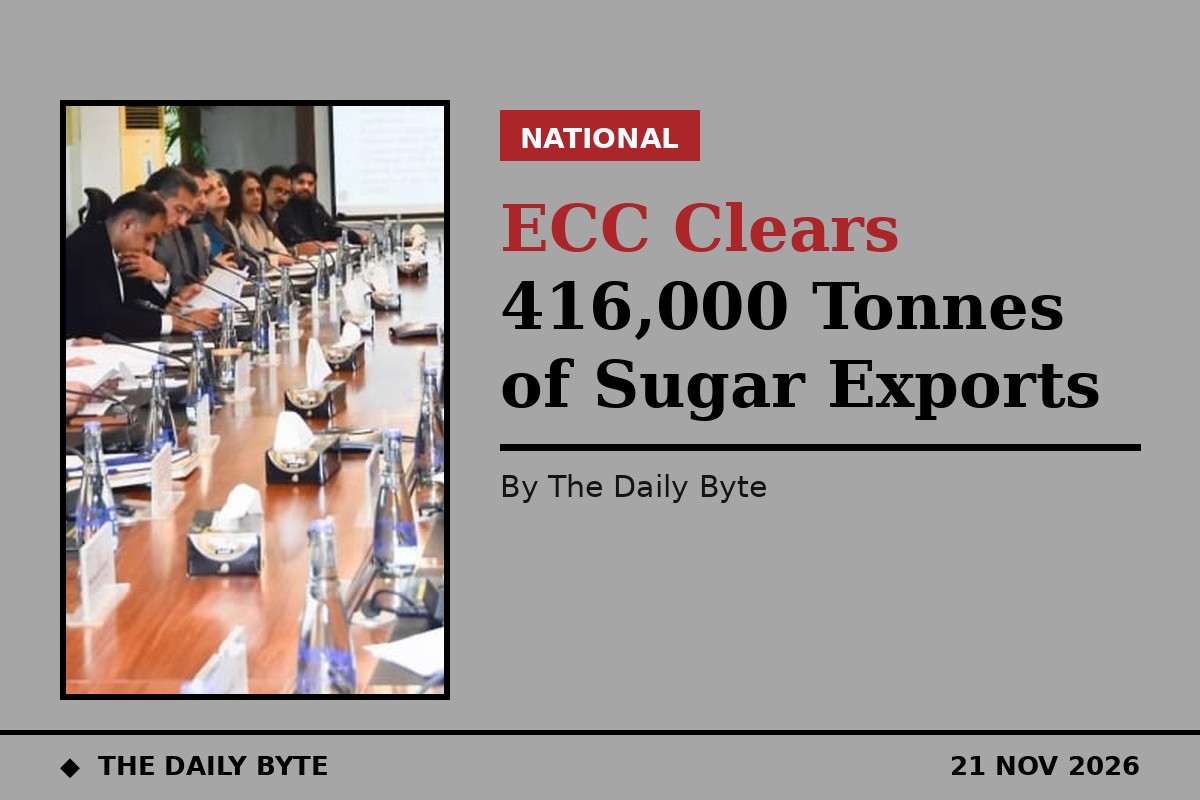
Pakistan's Economic Coordination Committee has approved the export of another 416,000 tonnes of sugar, the third such permission in four months, taking the quantity cleared for shipment this season to 724,000 tonnes. National Food Security Minister Rana Tanveer Hussain confirmed the decision to The Express Tribune, which reported it on Saturday, 21 November.
The committee, chaired by Finance Minister Muhammad Aurangzeb, met at the Finance Division in Islamabad on Friday, 20 November, as the new cane-crushing season was about to begin.
How the figures fit together
The two outlets that reported the decision give slightly different headline numbers, and the difference is a matter of what each counts. The Express Tribune reports 416,000 tonnes: 400,000 tonnes recommended by the Cabinet Committee on Export of Sugar, plus a further 16,000 tonnes for Sindh. The News, reporting the same meeting, puts the approval at 400,000 tonnes.
The season totals differ for the same reason. The Tribune counts three permissions: 108,000 tonnes of imported sugar cleared for export in August, 200,000 tonnes of locally produced sugar in mid-September, and Friday's 416,000 tonnes, giving 724,000 tonnes in all. The News counts only the two permissions for locally produced sugar, 200,000 tonnes plus 400,000 tonnes, giving 600,000 tonnes. Neither outlet disputes the underlying decision; they count different tranches.
What neither outlet could report is how the new quota will be divided. The government has not published the sugar summary, the allocation among mills or a shipment timetable. The Tribune reported that the summary was not circulated to the relevant ministries and was not part of the committee's regular agenda. The Finance Ministry's own announcement of the meeting did not state any quantity at all, saying only that the committee had considered the Cabinet Committee's recommendations on sugar exports to safeguard farmers through adequate price support.
Deregulation condition still unmet
The approval landed days before a meeting of the International Monetary Fund's executive board, which is due to consider Pakistan's request for the fifth 1 billion dollar tranche of its 7 billion dollar programme, a further 200 million dollars under a climate facility, and the Article IV report. The Fund has required Pakistan to deregulate the sugar sector fully and end the government's role in exporting and importing the commodity. That condition remains unmet, and Finance Secretary Imdadullah Bosal told the committee that one province had refused, according to The Express Tribune. Aurangzeb himself stressed the need to deregulate the sector at the same meeting, before the committee permitted another export from a sector it continues to regulate.
The government's own draft National Policy for De-regulation of the Sugar Sector describes a system constrained by zoning rules, administered prices and discretionary trade restrictions, which it says have distorted incentives and left mills operating at roughly 60 per cent of installed capacity. The draft puts average production at about 6.13 million tonnes a year, against domestic consumption of about 6.3 million tonnes, and says retail sugar prices have risen by an average of about 16 per cent a year over the past five years. Pakistan is the world's seventh-largest producer of refined sugar, with 79 mills concentrated in southern Punjab, northern and central Sindh and southern Khyber Pakhtunkhwa.
What it means for farmers, mills and shoppers
For millers, the quota is a chance to sell at international prices while domestic cane costs are set by the state. For growers, the government says the export programme is meant to support cane prices at the start of crushing. For consumers, the risk runs the other way: sugar leaves the country while domestic production is estimated below consumption, leaving imports or higher retail prices to fill the gap. That tension is why the government has spaced the permissions out, exporting in phases rather than in a single announcement.
The same committee meeting also eased conditions on the government's long-term export financing scheme for small and medium enterprises, waiving a requirement that 80 per cent of sales be exports and asking beneficiaries instead to reach exports equal to at least 50 per cent of projected sales within four years. It approved a 1 billion rupee technical grant for Pak-Arab Pipeline Company and 100 million rupees for the Minorities Welfare Fund, among other grants.
What happens next turns on three things: whether the IMF board clears the fifth tranche, when the government discloses the allocation and shipment timetable, and what happens to local prices once crushing is under way. Until the sugar summary is published, the practical answer to what changed is narrow: another 416,000 tonnes may leave Pakistan, and the condition attached to the IMF programme has still not been met.