Pakistan current account surplus $39m in October
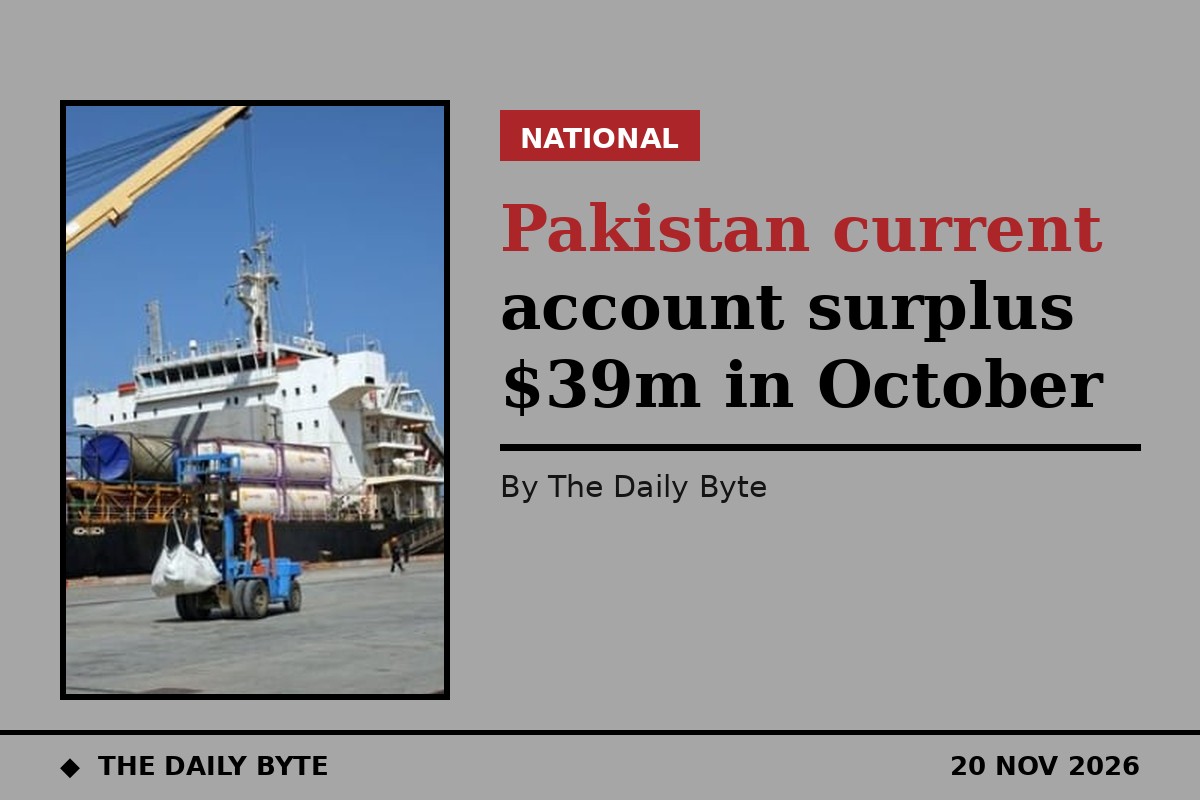
Pakistan's current account swung to a surplus of $39 million in October, its first surplus since May, as record workers' remittances and a narrower goods trade gap repaired the country's external position, State Bank of Pakistan data released on Tuesday showed.
The October result reversed a deficit of $371 million in September, an improvement of $410 million in a single month. It also compared favourably with a deficit of $307 million in October last year, underlining how far the external account has moved in twelve months.
Remittances did the heavy lifting
Money sent home by overseas Pakistanis remained the decisive support. Remittances rose 8 per cent on the month and 14 per cent on the year to $3.89 billion in October, the highest inflow ever recorded in that month, according to Waqas Ghani, head of research at JS Global.
The inflows covered 131 per cent of the monthly goods trade deficit. For the first four months of the 2026-27 fiscal year, remittances reached $14.8 billion, up 14 per cent from a year earlier, keeping the external account close to balance even as the trade gap widened.
The State Bank now expects remittances to reach $45 billion for the full fiscal year, although it has warned that economic conditions in the Gulf, where most overseas Pakistanis work, could affect inflows.
Trade gap narrowed in October
The goods trade deficit narrowed 6 per cent on the month to $2.96 billion. Goods imports fell 5 per cent to $5.9 billion, while exports slipped 4 per cent to $2.9 billion. The services trade deficit also shrank, falling 11 per cent to $245 million.
October's improvement came despite exports dipping, because imports fell faster. Total exports of goods and services reached $3.87 billion in the month, up nearly 12 per cent from a year earlier, helped by a 10 per cent rise in goods exports.
Four-month picture is still a deficit
The monthly surplus should not be mistaken for a clean bill of health. For July to October, the current account still recorded a deficit of $850 million, although that was 20 per cent smaller than the $1.062 billion deficit in the same period last year.
Analysts cautioned that the surplus remains fragile. Goods imports were up 9 per cent on the year, and the four-month trade deficit has widened 17 per cent. Sustaining external stability will therefore depend heavily on remittance growth continuing, Ghani said.
Some analysts have raised concerns about whether the strong growth in remittances can last if the conflict in the Middle East drags on and employment in the Gulf weakens. Remittances are masking weakness elsewhere in the external account, they said, and if inflows slow, pressure on foreign exchange liquidity could become considerably more visible.
Reserves and the IMF programme
The balance of payments data came a day after the State Bank said in its annual report for 2025-26 that a $3 billion Eurobond issued in September, together with its own dollar purchases and expected official inflows, should help lift its foreign exchange reserves towards four months of import cover.
The central bank expects its reserves to rise to $23 billion by the end of December 2026 and to $25 billion by June 2027. They stood at $21.57 billion as of November 6. Saudi Arabia rolled over its $3 billion deposit with Pakistan last week after it matured on October 31.
The International Monetary Fund's board is expected to meet in December to approve the next $1.2 billion tranche of Pakistan's loan programme. The State Bank has forecast the current account deficit at between zero and 1 per cent of gross domestic product for 2026-27, with imports expected to rise as the economy expands and tariffs are rationalised, while exports recover moderately on policy incentives and slightly stronger global demand.