SBP: Pakistan Economy Grew 3.7% in FY26, Jobs Lag Behind
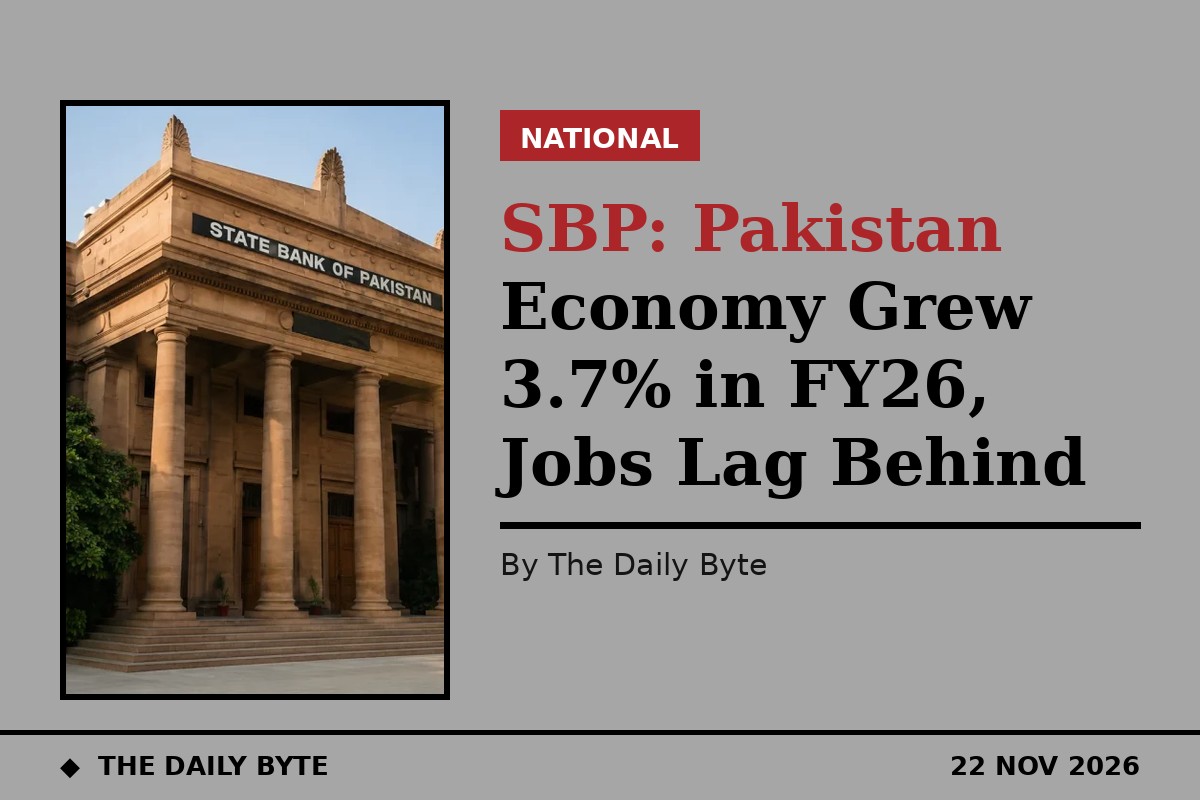
Pakistan's economy grew by 3.7 per cent in the financial year 2025-26, the State Bank of Pakistan has said in its annual report, but the central bank warns that growth alone is not creating enough jobs and that deep structural reforms are essential before the recovery can become strong and lasting.
The State Bank's Annual Report on the State of Pakistan's Economy for FY26, released on 17 November 2026, says the economy showed resilience against domestic and global shocks, including devastating monsoon floods, uncertainty over United States trade tariffs and the outbreak of conflict in the Middle East in late February 2026. Real GDP growth of 3.7 per cent was up from 3.1 per cent in the previous financial year, driven by a strong rebound in large-scale manufacturing, which also supported activity in agriculture and services.
Growth forecast at 3.5 to 4.5 per cent
Looking ahead, the State Bank projects real GDP growth of 3.5 to 4.5 per cent in FY27, anticipating a gradual recovery in domestic demand, improved performance in commodity-producing sectors and continued expansion in services. Inflation is expected to ease gradually towards the bank's medium-term target range of 5 to 7 per cent, although on average it is likely to remain above 7 per cent during the year.
The report notes that the bank thinks growth would have been above 4.0 per cent had the momentum of the first three quarters of the fiscal year carried into the last one. An energy shock triggered by the Middle East conflict pushed inflation above 11 per cent in May and June, and the State Bank raised its policy interest rate by one percentage point to 11.5 per cent in April as higher fuel costs spread through transport, production and household prices.
Reserves beat target as remittances surge
The State Bank's foreign exchange reserves rose to $18.4 billion by the end of June, up from $14.5 billion a year earlier and above the $18 billion target, supported by $8.1 billion in net foreign exchange purchases, a reduction in forward liabilities and sustained official inflows. Workers' remittances grew to $41.6 billion in FY26 and kept the current account deficit to just 0.1 per cent of GDP.
The flow of money from overseas Pakistanis has continued into the current financial year. Remittances reached $3.89 billion in October 2026 alone, and $14.8 billion in the first four months of FY27, about 14 per cent more than the same period a year earlier. The State Bank has raised its remittance forecast for FY27 to $45 billion and expects the current account deficit to stay between zero and 1 per cent of GDP.
Jobs warning at the heart of the report
The sharpest warning in the report concerns jobs. The central bank says growth is not creating enough work for a young and fast-growing population, with unemployment at 7.2 per cent, and warns that without deep structural reforms the country risks wasting the energy of the youngest large population in its history.
The World Bank, in its Pakistan Development Update published in October, makes the same point: about 3.6 million people reach working age in Pakistan every year, and growth of around 4.5 per cent in the medium term is too low to absorb them and raise per capita income significantly.
The State Bank links stronger buffers, fiscal consolidation and successful reviews under the International Monetary Fund programme to improved sovereign credit ratings and exchange rate stability. But its message is that stability is not enough. Exports surged to a record $11.4 billion in the first four months of FY27, and a $3 billion Eurobond issuance in September 2026 is expected to help build reserves towards four months of import cover. The report's conclusion is that only reforms to taxation, energy, state-owned enterprises and the business climate can turn a resilient year into lasting growth that creates jobs.