Pakistan Natural Resources Worth $8-10 Trillion, Dar Says
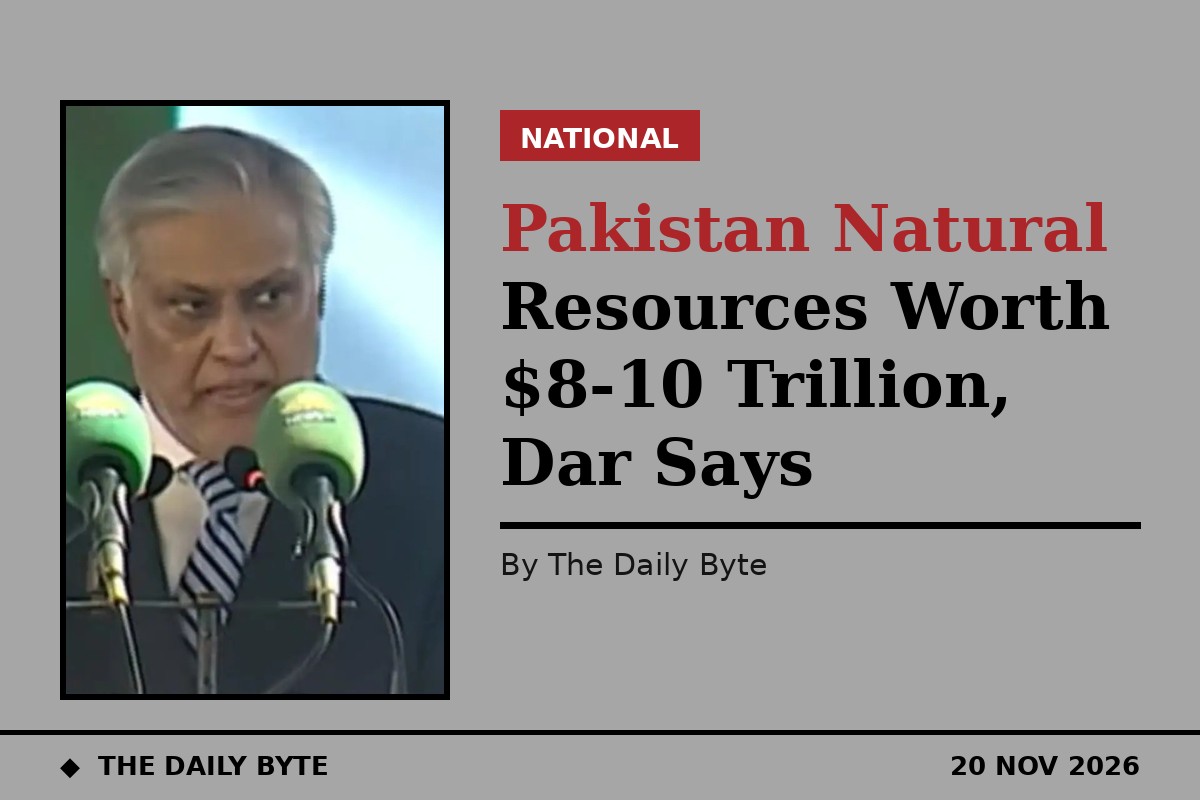
Pakistan's natural resources are worth between $8 trillion and $10 trillion at the "most conservative estimate", Deputy Prime Minister and Foreign Minister Ishaq Dar said on Friday, as he welcomed a Turkish seismic research vessel to Karachi.
Dar was speaking at a ceremony at Karachi Port to mark the arrival of the Oruc Reis, which docked on Thursday to begin offshore oil and gas exploration in Pakistani waters. He described the vessel's arrival as a historic moment in energy cooperation between Pakistan and Turkiye.
The estimate covers minerals, hydrocarbons, gemstones and rare earth materials, Dar said, and he used it to push back against descriptions of Pakistan as a heavily indebted country caught in a debt trap.
A vessel, a survey and a 2027 target
The Oruc Reis will collect three-dimensional seismic data across 670 square kilometres of Pakistan's Indus offshore basin, according to Turkish Energy Minister Alparslan Bayraktar, who also attended the ceremony. Exploration operations in fields identified by the survey are targeted to begin in 2027.
Dar said the seismic mission was expected to take about five to six months. He told the Turkish team, in a light-hearted remark reported from the ceremony, that they would not be allowed to leave without bringing good news of a discovery.
He was careful to add that seismic surveys cannot guarantee commercially viable discoveries. Offshore exploration, he said, is complex, capital-intensive and inherently uncertain, but no discovery can be made without seismic work and exploration first.
"Every successful journey of exploration begins with knowledge," Dar said, adding that the data collected by the vessel could improve understanding of the geological structures beneath the seabed and give future exploration plans a stronger foundation.
The debt comparison
Dar contrasted the resource estimate with Pakistan's liabilities. He said the federal government's debt stood at about $100 billion, rising to around $130 billion once the foreign-exchange liabilities of private companies and public-sector enterprises are included.
"Sometimes people talk about Pakistan being in debt, being a heavily indebted country, or being in a debt trap; I always negate that," he said, arguing that the country's resource potential was substantially greater than what it owes.
The comparison is politically potent, but it is not a reserve audit. Dar published no breakdown of the $8-10 trillion figure, no methodology and no date for the estimate, and the ceremony was not a venue at which the government presented new geological data.
What the figure is, and what it is not
The number is best read as a ministerial estimate of potential value, not as a valuation of proven reserves. Pakistan's mining sector remains small relative to the scale Dar described, accounting for less than 3% of gross domestic product, and much of the mineral wealth he cited is yet to be explored, let alone developed.
Even so, the government is pitching the sector hard to foreign investors. The remarks came days after the Pakistan Minerals Investment Forum opened in Islamabad on 12 November, where Dar invited global investors to explore the country's mining sector, with the Reko Diq copper-gold project in Balochistan at the centre of the pitch.
That project, in which Barrick holds 50%, the Balochistan government 25% and three federal state-owned companies the remaining 25%, is the largest single test of whether the headline numbers can be turned into production and revenue.
A long-term partnership with Turkiye
Dar said Islamabad sought a long-term energy partnership with Ankara covering offshore exploration, minerals and renewable energy, and referred to three memorandums of understanding signed between relevant Pakistani and Turkish agencies.
He called for closer collaboration between Pakistani and Turkish geologists, engineers, universities and research institutions, particularly in marine sciences, geoscience and offshore engineering, and assured the Turkish partners that the government would provide appropriate facilitation for the mission.
He also stressed maritime safety and environmental protection. "Our seas are an economic asset, but they are also a national trust. Development and environmental stewardship must proceed together," he said.
The test of the $8-10 trillion claim will not be another speech. It will be what the Oruc Reis finds beneath the Indus basin over the next five to six months, and whether the survey leads to drilling, investment and, eventually, production.