Pakistan Public Debt Hits Rs90.98 Trillion in FY26
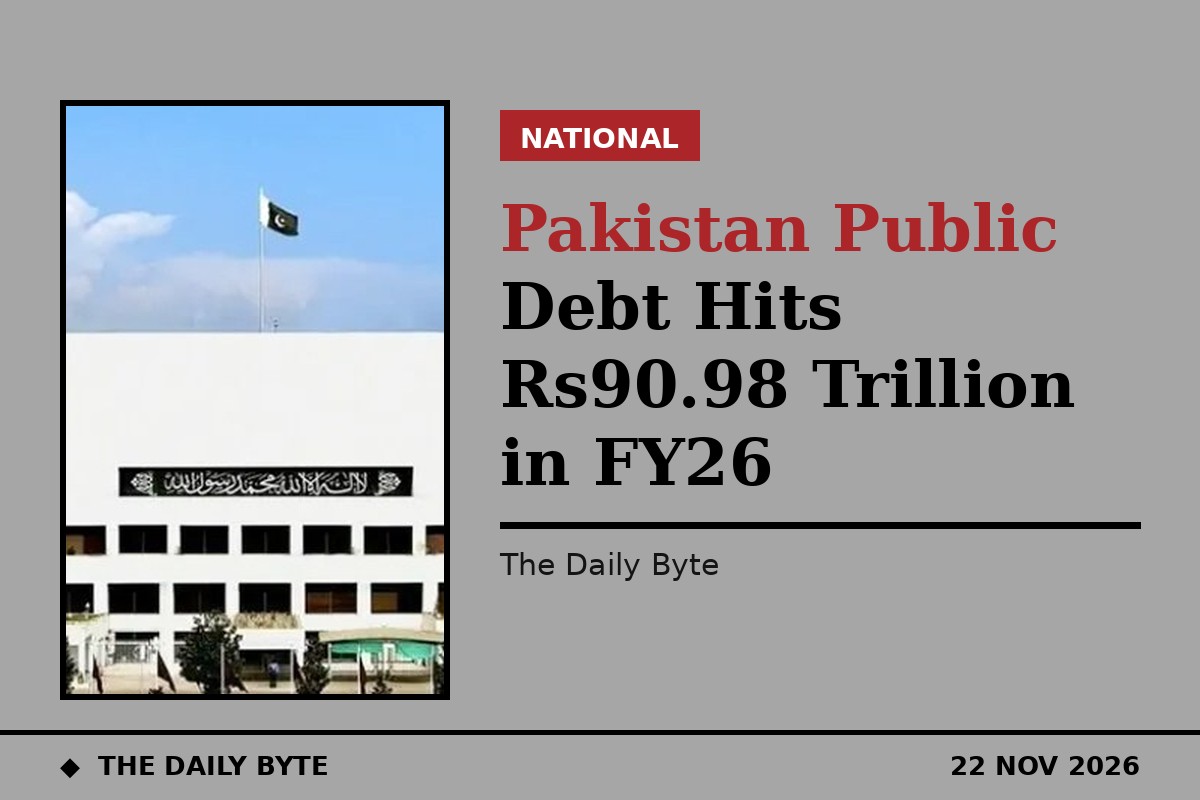
Pakistan's public and publicly guaranteed debt reached Rs90.98 trillion by the end of June 2026, rising by Rs6.2 trillion over the previous twelve months, according to the Ministry of Finance's Debt Sustainability Analysis for fiscal years 2027 to 2029.
The debt stock stood at Rs84.8 trillion at the end of June 2025, so the increase over fiscal year 2025-26 was about 7.3 per cent. Almost all of the rise came from public debt itself, which grew by Rs6.2 trillion, while publicly guaranteed debt edged up by only Rs0.01 trillion.
Debt burden falls as a share of the economy
Despite the higher stock in rupee terms, the burden of the debt fell when measured against the size of the economy. The ratio of public and publicly guaranteed debt to gross domestic product declined by 2.3 percentage points, from 74.3 per cent to 72 per cent.
The improvement reflects nominal economic growth running ahead of new borrowing, a pattern the ministry's analysis presents as the key reason the ratio moved down even as the absolute figure climbed.
Public debt alone was recorded at Rs86.7 trillion at the end of June 2026, compared with Rs80.5 trillion a year earlier. Domestic debt made up the bulk of it at Rs59.4 trillion, about 68.5 per cent of the total, while external debt stood at Rs27.3 trillion, equivalent to about US$98.1 billion and around 31.5 per cent of the total.
The ministry notes that the heavier domestic share means less exposure to exchange-rate swings than a debt stock dominated by foreign borrowing. Publicly guaranteed debt was almost unchanged at Rs4.28 trillion, against Rs4.27 trillion at the end of June 2025.
Deficit projected to narrow over three years
Looking ahead, the analysis projects the federal fiscal deficit narrowing gradually over the medium term, from 4.9 per cent of GDP in fiscal year 2027 to 4.2 per cent by fiscal year 2029. The federal primary balance is projected to remain at 0.7 per cent of GDP throughout the projection period.
At the consolidated level, provincial surpluses are expected to remain broadly stable at around 1.3 per cent of GDP. That would take the overall fiscal deficit from 3.6 per cent of GDP in fiscal year 2027 to 2.9 per cent by fiscal year 2029, while the overall primary surplus is projected to remain stable at around 2 per cent of GDP.
The ministry presents the figures as evidence that the debt path remains sustainable over the medium term, resting on continued revenue mobilisation and prudent spending. The analysis does not hide the scale of the task: the stock of debt is still rising in absolute terms, and keeping the ratio on its downward path depends on the deficit narrowing exactly as projected.
For households and businesses, the figures frame the choices facing the government. Debt servicing already absorbs a large share of public money, so every point of the deficit that is cut frees resources that would otherwise go to lenders rather than to public services and investment.