Pakistan's rooftop solar share hits 28% as households leave the grid, BBC reports
By The Daily Byte
·18 Nov 2026
·4 min read
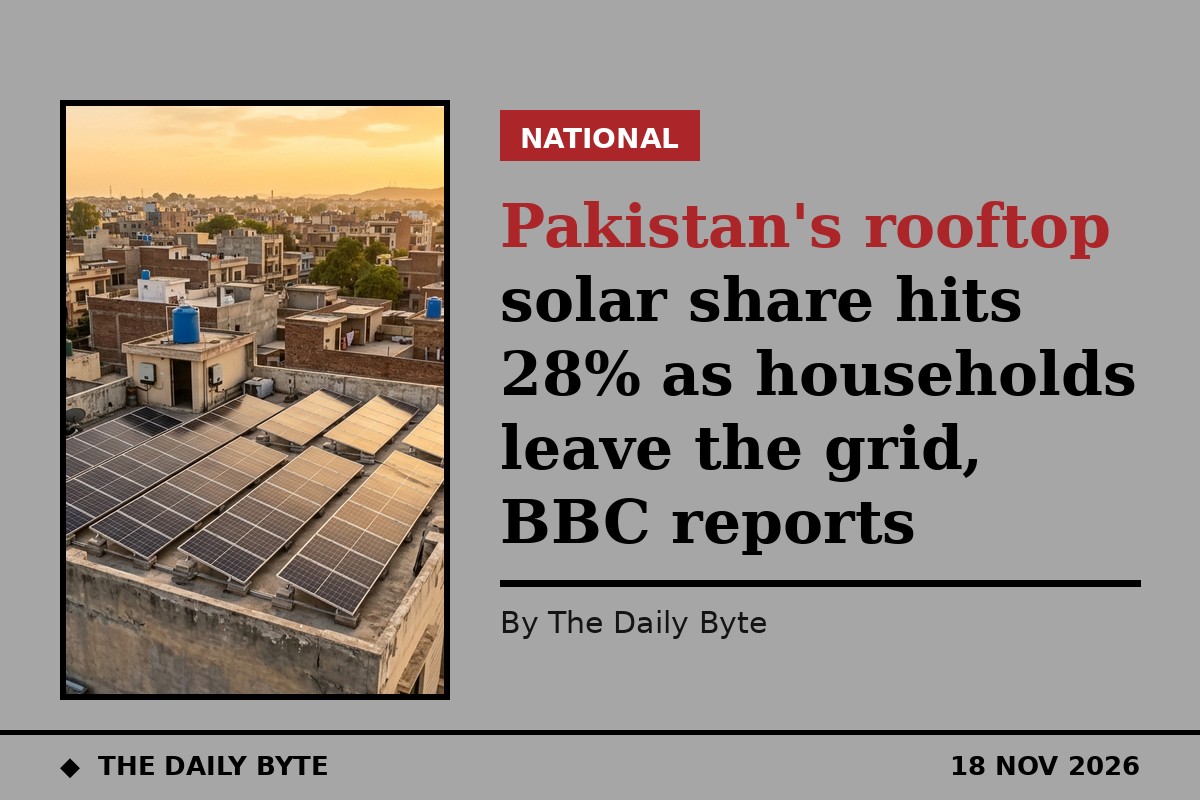
Solar power now supplies 28% of Pakistan's electricity, up from just 1% in 2018, after about seven million households installed their own rooftop panels, according to a BBC report published on 17 November and reported widely on 18 November.
The figures, from the Pakistan-based think tank Renewables First, describe one of the fastest household energy shifts anywhere in the world. The change was not driven by government policy, the BBC found, but by individual households reacting to soaring electricity prices and an often unreliable national grid.
Imported panels now cover the rooftops of homes and hospitals, farmers' fields and industrial sites across the country. The Dhaka-based TBS News, reporting the BBC's findings, said panels had become household necessities rather than luxuries, with some families even giving solar panels as wedding gifts.
## Why households switched
National electricity tariffs have more than doubled within a few years, according to Renewables First's Muhammad Hassan Dajana, while the cost of imported Chinese solar panels has fallen by 93%. That combination made rooftop solar cheaper than grid electricity for many families.
Energy Minister Awais Ahmad Leghari told the BBC that people had simply found another way to survive. Households interviewed by the broadcaster said they installed panels to escape high bills and load-shedding, and many still use the grid alongside their panels, particularly in the evenings.
Businesses have followed the same path. Kohinoor Textile Mills in Islamabad runs hundreds of machines on solar power during sunny periods and is adding industrial batteries to reduce its reliance on heavy fuel engines, its chief executive told the BBC.
## A grid left behind
The success of rooftop solar has created a serious problem for the national grid. As households and businesses generate their own electricity, fewer customers remain to pay the fixed costs of maintaining the network, pushing up bills for those who still depend on it.
Mr Leghari said the shift away from the grid had cost remaining electricity consumers more than $500 million a year over the past two years. Analysts warn the trend could create a two-tier system, with households unable to afford panels facing higher bills while public money props up the struggling utility.
The government has also changed its net-metering rules, under which households sell surplus electricity to the grid. Under the revised arrangements, the grid buys excess solar power at lower rates and sells electricity back to consumers at higher rates — a change criticised by business leaders, including the president of Faisalabad's Chamber of Commerce.
Mr Leghari defended the changes, saying that without them the remaining consumers would have faced an extra burden of at least Rs150 to Rs200 billion a year within two years.
## What happens next
Pakistan aims to generate up to 90% of its electricity from clean sources, including renewable energy and nuclear power, by the end of 2036, and to cut dependence on imported fuels from 26% to 4%.
Mr Dajana said the country's energy future could follow two paths: one in which solar and the grid work in parallel, showing how a gradual transition can succeed, and another in which Pakistan becomes a cautionary tale, burdened with a costly, declining grid.
The BBC report was published as COP31 pushes countries to move away from fossil fuels. Pakistan has become a poster child for solarisation — but the strain on its grid shows how quickly a household-led energy revolution can outpace the system built to support it.
## Frequently asked questions
**How much of Pakistan's electricity now comes from solar?**
Solar's share rose from 1% in 2018 to 28% in 2025, according to Renewables First, cited by the BBC. About seven million households now own solar panels.
**Why has the national grid suffered?**
As households generate their own power, fewer customers pay the fixed costs of the grid. The energy minister says the exodus has cost remaining consumers more than $500 million a year over the past two years.
**What is Pakistan's clean energy target?**
The government aims for up to 90% clean power by the end of 2036 and to cut dependence on imported fuels from 26% to 4%.
Sources: BBC News, "COP31: Pakistan's solar revolution has been so successful the national grid is lagging behind" (https://www.bbc.co.uk/news/articles/ckvg2n2q3103o); TBS News, "Pakistan's solar boom puts pressure on national power grid" (https://www.tbsnews.net/world/south-asia/pakistans-solar-boom-puts-pressure-national-power-grid-1606046).
Source
BBC News — https://www.bbc.co.uk/news/articles/ckvg2n2q3103o