Pakistan Seeks Zero-Tariff Access to China Markets
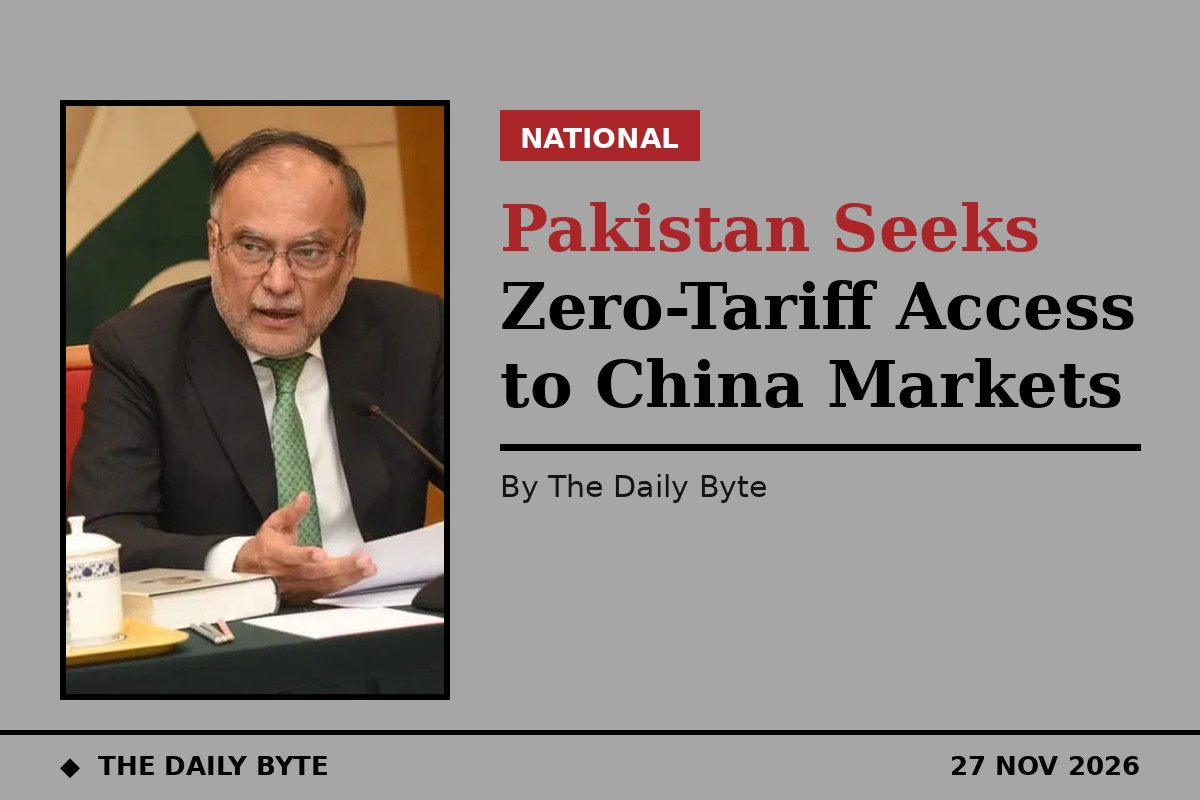
Pakistan has asked China for preferential, zero-tariff access for its goods, aiming to lift annual exports to China from about $3 billion to between $20 billion and $25 billion.
Planning Minister Ahsan Iqbal raised the request in Beijing on Wednesday 26 November, in a meeting with Liu Haixing, minister of the International Department of the Central Committee of the Communist Party of China. He pointed to the tariff concessions China has extended to African countries as a model that could be followed for Pakistani exports.
The request underlines how lopsided the trade between the two countries has become. In the 2025-26 fiscal year Pakistan imported $22.34 billion of goods from China and exported only $2.71 billion to it, according to figures reported by Express News, leaving a gap of about $19.6 billion.
China has not yet agreed to the request. The zero-tariff arrangement remains a proposal under discussion, and no Chinese decision or timeline has been announced. Iqbal said the initiative followed discussions held on 3 November and a proposal previously raised by Prime Minister Shehbaz Sharif with Chinese President Xi Jinping.
The Knowledge Corridor
Iqbal also sought Chinese support for a proposed Pakistan-China Knowledge Corridor, which would let around 10,000 Pakistani scholars pursue doctoral studies and specialised research over ten years. The programme would involve scholarships, partnerships with Chinese universities and co-financing, with priority given to artificial intelligence, engineering and advanced manufacturing, modern agriculture, biotechnology and mineral sciences.
In a separate meeting with Zhou Haibing, vice chairman of China’s National Development and Reform Commission, Iqbal sought early completion of the financing agreement for the 102-kilometre Thor Nullah-Raikot section of the Karakoram Highway. Express News put the value of the wider Thakot–Raikot project at Rs576 billion.
He also discussed Chinese participation in upgrading the ML-1 railway beyond the Karachi–Rohri section, saying Pakistan is exploring Asian Development Bank financing for it. On Gwadar, he sought regular shipping services and proposed a joint study on strategic petroleum storage. He further called for progress on the Kohala and Azad Pattan hydropower projects.
The discussions also covered the second phase of the China-Pakistan Economic Corridor, which the two sides want to align with Pakistan’s URAAN development programme and China’s 15th five-year plan. The first phase of CPEC attracted about $25 billion in investment, added more than 8,000 megawatts of electricity generation capacity and delivered 888 kilometres of highways and motorways, along with an estimated 236,000 direct and indirect jobs.
For Pakistani exporters, the prize is access to a market that imports nearly $3 trillion of goods a year. Whether that access comes, and on what terms, now depends on Beijing’s response to a request that is still only a proposal.