Pakistan seeks zero-tariff access to Chinese market
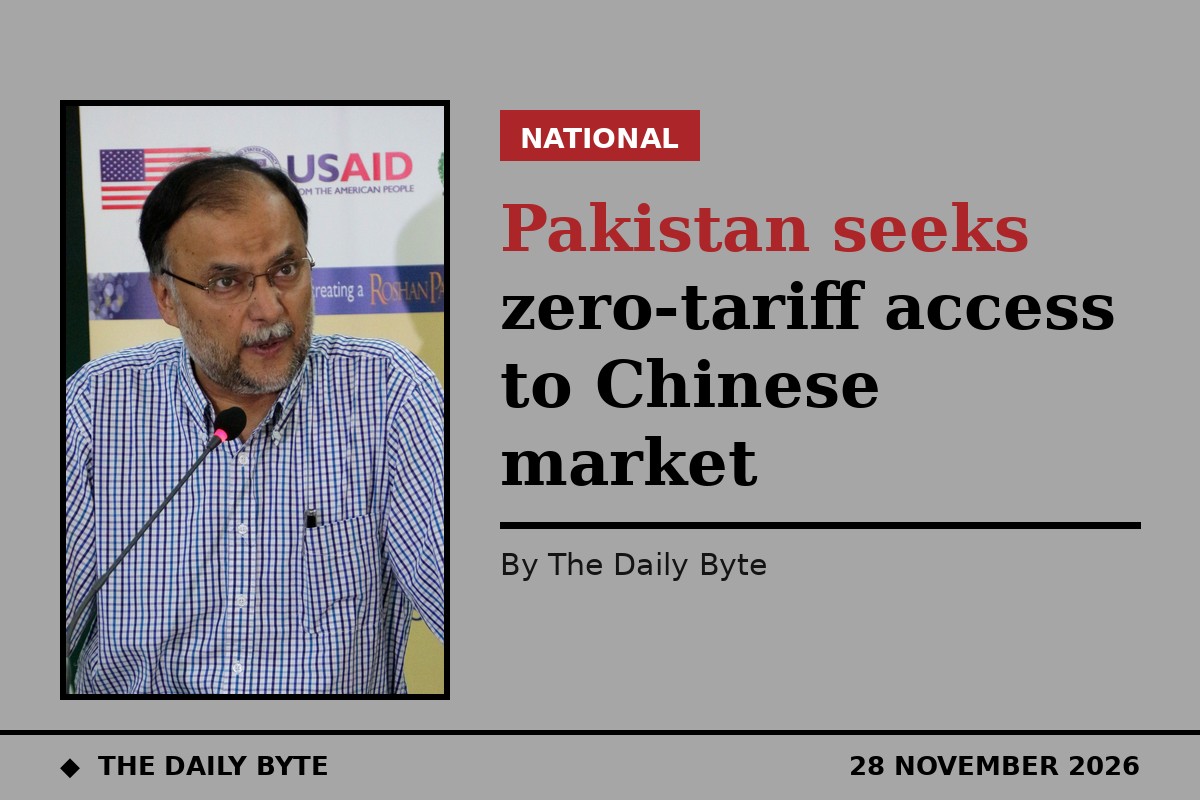
Pakistan has formally asked China for preferential, zero-tariff access for its goods in the Chinese market, setting an ambitious target of raising annual exports from about $3 billion to between $20 billion and $25 billion.
Planning Minister Ahsan Iqbal raised the request in Beijing on 26 November in a meeting with Liu Haixing, Minister of the International Department of the Central Committee of the Communist Party of China, according to an official statement issued on Friday. He was following up a proposal discussed on 3 November that Prime Minister Shehbaz Sharif had raised with President Xi Jinping.
In a separate meeting on Friday with Zhou Haibing, vice-chairman of China's National Development and Reform Commission, Iqbal proposed a non-reciprocal arrangement that would sit apart from the existing bilateral free trade agreement. He called for technical discussions between the two countries to settle which products would be covered, the rules of origin and an implementation timetable.
Closing a $19.6bn gap
Pakistan's case rests on a trade imbalance that has widened sharply. The planning ministry said Pakistan imported goods worth $22.34 billion from China in the 2025-26 fiscal year, while its exports to China amounted to just $2.71 billion, leaving a deficit of about $19.6 billion.
Iqbal pointed to the tariff concessions China has extended to African countries as a possible model. China granted zero-tariff treatment to the 53 African countries with which it has diplomatic relations from 1 May 2026 until 30 April 2028. He also noted that China imports nearly $3 trillion worth of goods a year, arguing that even a small share of that market would transform Pakistan's export earnings.
Pakistani officials argue that the concessions won under earlier phases of the free trade agreement have lost value because China later signed preferential arrangements with the Association of Southeast Asian Nations and other partners. The two countries now operate under the second phase of their agreement, which took effect in January 2020, and in May it was reported that Pakistan planned to seek unilateral tariff concessions on about 700 product lines under a proposed third phase.
Knowledge Corridor and CPEC's second phase
The minister also sought Chinese support for a proposed Pakistan-China Knowledge Corridor, which would help about 10,000 Pakistani scholars pursue doctoral studies and specialist research over ten years. The proposal covers scholarships, partnerships with leading Chinese universities and co-financing, with priority areas including artificial intelligence, engineering, advanced manufacturing, modern agriculture, biotechnology and mineral sciences.
On the China-Pakistan Economic Corridor, Iqbal identified industrial and agricultural cooperation, business partnerships, technology transfer, minerals and green development as priorities for the second phase. He said the first phase had attracted about $25 billion in investment, added more than 8,000 megawatts of generating capacity, delivered 888 kilometres of highways and motorways and created an estimated 236,000 direct and indirect jobs.
The discussions also covered financing for the 102-kilometre Thor Nullah-Raikot section of the Karakoram Highway, upgrades to the ML-1 railway line, four joint road feasibility studies including the proposed Babusar Tunnel, and restoring regular shipping through Gwadar with the help of the state-owned shipping company COSCO.
No decision yet
No Chinese response has been announced, and the statement gave no timeline, no list of products and no details of any safeguards China might require. Iqbal also reaffirmed Pakistan's commitment to the security of Chinese personnel and projects in Pakistan.
For now the request is a stated goal with an ambitious target, and its outcome will depend on talks that are still at an early stage. Whether Pakistan could take advantage of zero-tariff access is a second question: its exports to China have remained small and concentrated in a limited range of goods, so increasing sales would still depend on meeting Chinese standards, building supply capacity and finding buyers.