Pakistan UN Self-Determination Resolution Adopted
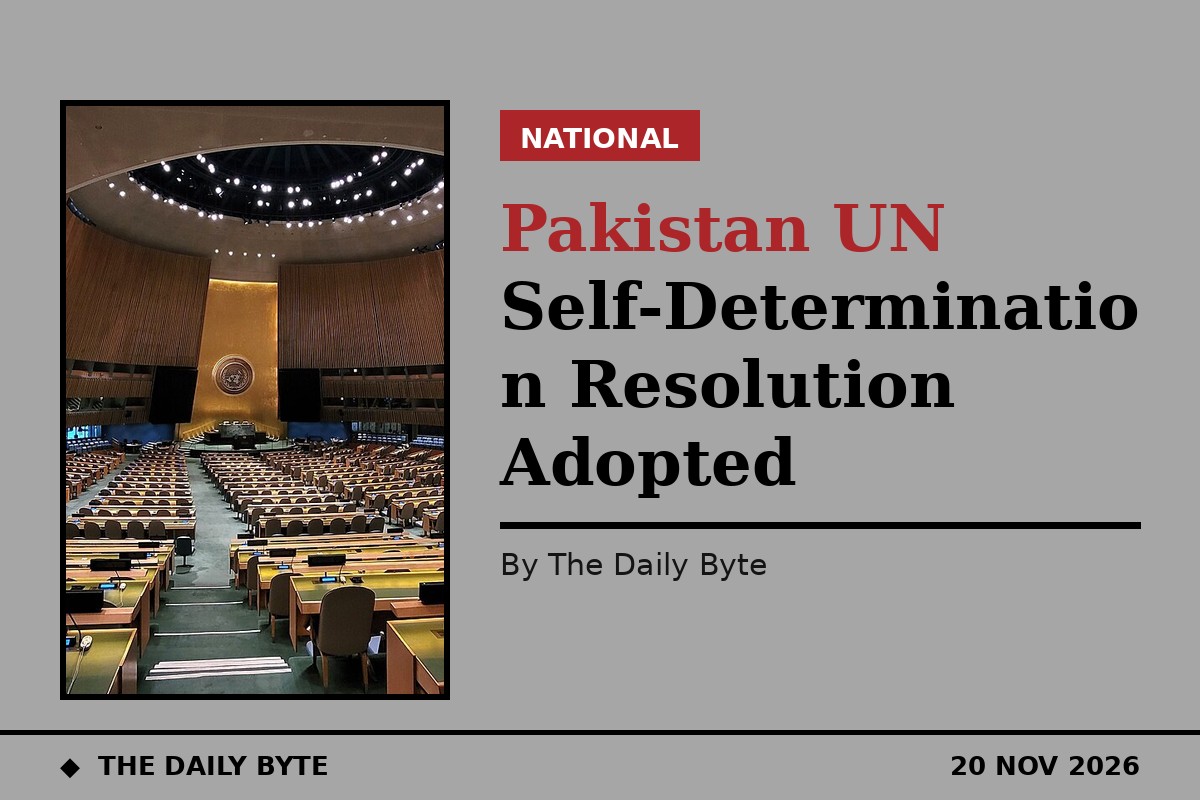
The United Nations General Assembly’s Third Committee has adopted by consensus a Pakistan-sponsored resolution reaffirming the right of peoples to self-determination, in a vote-free outcome that drew support from 62 co-sponsoring countries.
The resolution, titled “Universal Realisation of the Right of Peoples to Self-Determination”, was adopted without a vote on Thursday, 19 November, at the United Nations in New York. It was introduced by Pakistan’s Permanent Representative to the United Nations, Ambassador Syed Haider Shah.
Pakistan has sponsored the annual resolution since 1981, and its adoption by consensus means no member state called for a recorded vote. The text now goes forward for endorsement by the full General Assembly, which is expected to take it up next month.
What the resolution says
The resolution reaffirms the right of peoples to self-determination, in particular those living under colonialism, foreign domination and alien occupation. It presents self-determination as a universal and indivisible right, and expresses solidarity with people deprived of their fundamental rights and freedoms.
Addressing the committee, Ambassador Shah described self-determination as a fundamental principle of the United Nations Charter and a cornerstone of international law. He referred to Article 1(2) of the Charter, the common Article 1 of the International Covenants on Civil and Political Rights and on Economic, Social and Cultural Rights, the Declaration on Principles of International Law and General Assembly Resolution 1514.
He said the promise of self-determination remained unfulfilled for millions of people living under foreign occupation, and that the exercise of the right had transformed history by enabling millions of people to end foreign subjugation and establish independent states. The vast majority of United Nations member states, he added, had themselves achieved independence through the exercise of this right.
Ambassador Shah said the legitimate aspirations of occupied populations continued to face military oppression, excessive use of force, extrajudicial killings, arbitrary detention, enforced disappearances, restrictions on fundamental freedoms and attempts at demographic engineering. Such practices, he said, constituted serious violations of international law, weakened the credibility of the international legal order and undermined the principles of justice and human dignity.
Consensus without a vote
The resolution was adopted without a vote, a form of adoption that signals broad backing among the committee’s members. The Third Committee deals with social, humanitarian and cultural issues, including human rights, and its resolutions are routinely taken up by the full General Assembly.
To secure the widest possible support, the text named no specific country or territory. Ambassador Shah thanked the 62 countries that co-sponsored the initiative and encouraged other member states to join it. He said the support the resolution attracted across different regions reflected its continued relevance to situations involving foreign occupation and alien domination.
India urges caution on misuse
India’s delegate to the committee, Bhavika Mangalanandan, First Secretary at India’s Permanent Mission to the United Nations, told the committee that self-determination could not be used to subvert the territorial integrity of countries. She said the principle was a vehicle for decolonisation, not a justification for secession, and that attempts to reinterpret fundamental principles of the United Nations Charter for political objectives were unacceptable.
Mangalanandan said self-determination should not be invoked to encourage secession or to undermine the sovereignty and territorial integrity of independent nations. Her remarks came during the committee’s consideration of the Pakistan-proposed text, which was then adopted unanimously.
The resolution’s adoption keeps an annual diplomatic fixture in place. Pakistan has used the yearly text for more than four decades to press the principle at the United Nations, and this year’s consensus outcome means the measure proceeds to the General Assembly with the backing of its co-sponsors and without a recorded division in the committee.