Pakistan Takes ECO Chairmanship as Ministers Adopt Vision 2035
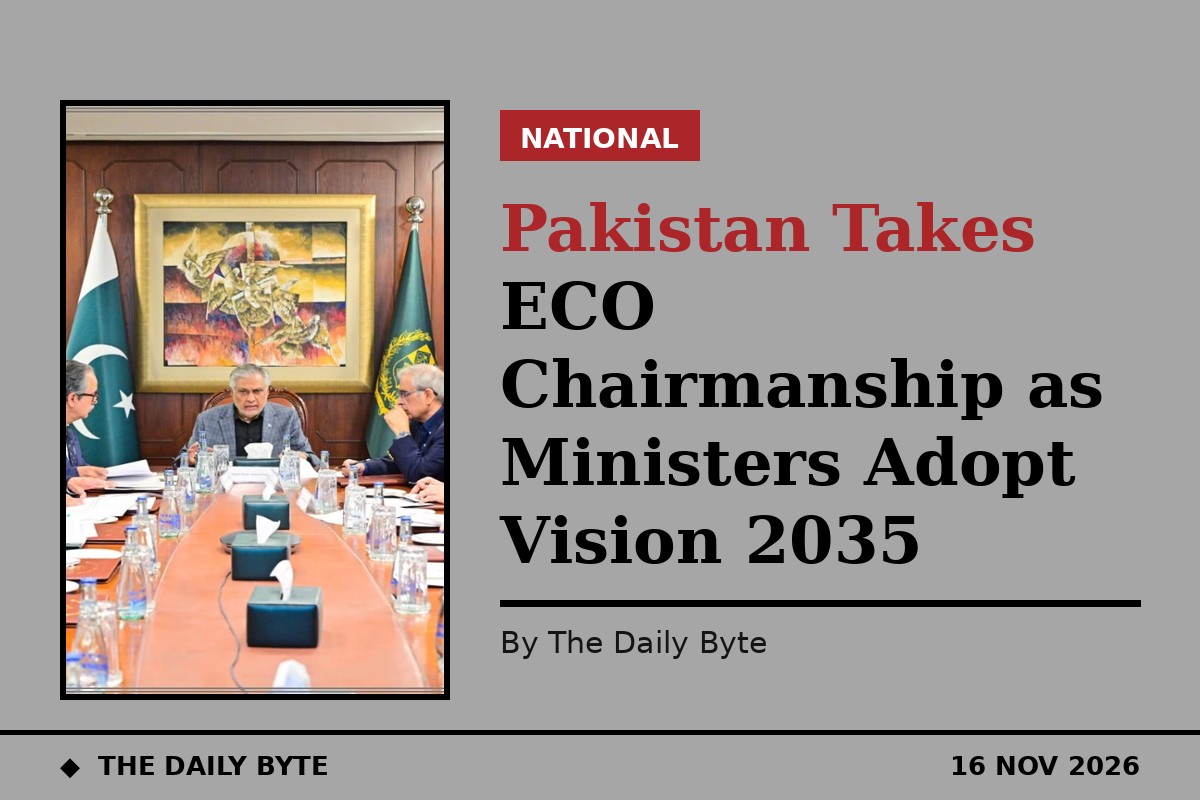
Pakistan has taken over the chairmanship of the Economic Cooperation Organization (ECO) for 2026-27, as foreign ministers from the ten-nation bloc concluded their 30th Council of Ministers meeting in Islamabad on Monday, 16 November 2026, adopting a new ten-year framework for regional cooperation. The meeting, held on 15-16 November under the theme "Reviving Regionalism for a Resilient ECO", was chaired by Deputy Prime Minister and Foreign Minister Ishaq Dar.
Closing the meeting, Dar called on member states to turn shared goals into measurable results. "Our task now is to translate our collective commitments into concrete action," he said. "This will require clear priorities, realistic timelines, and effective follow-up mechanisms." He thanked all delegations for their constructive engagement and said he looked forward to welcoming them back for the 31st meeting of the Council of Ministers in 2027.
Vision 2035 adopted alongside Islamabad Communique
Ministers formally adopted the Strategic Goals of Economic Cooperation 2035, known as ECO Vision 2035, alongside the Islamabad Communique. Dar described the adoption as an "important milestone in charting the future course of our organisation over the next decade", saying it provided a shared framework to advance regional priorities. The new vision succeeds ECO Vision 2025, which was adopted at the Islamabad Summit in 2017, and will guide the organisation's work on trade, transport, energy and investment cooperation through 2035.
Pakistan, a founding member of the ECO, said it was proud to assume the chairmanship and remained committed to implementing the organisation's charter, principles and vision. Dar said shared prosperity, respect for sovereignty, non-interference and cooperation based on mutual interests were the basic conditions for regional development.
Dar sets out five priorities for the chairmanship
Dar identified five key areas of focus for Pakistan's chairmanship: expanding trade and investment, strengthening regional connectivity, advancing the ECO Trade Agreement, building regional resilience and promoting human development. He said the region's natural resources, energy reserves, agricultural potential and strategic location offered considerable opportunities, but realising that potential required functioning transport corridors, efficient border procedures and predictable transit arrangements.
On trade, Dar said Pakistan would work towards wider market access, stronger regional value chains and greater private sector participation, particularly by small and medium-sized enterprises. On connectivity, he said Pakistan would seek to improve transport and transit links between Central Asia, South Asia and Pakistani ports on the Arabian Sea, with harmonised customs procedures and efficient border management. The negotiating strategy approved by ECO trade ministers in November 2025 provides a basis for modernising the agreement.
On regional resilience, Dar called for closer cooperation in disaster preparedness, early warning, water management and climate-resilient infrastructure. On human development, he highlighted education, research, innovation and vocational training. He stressed that the five priorities were interconnected and depended on collective effort.
Afghanistan's absence and the flag question
The ECO comprises Pakistan, Iran, Turkiye, Afghanistan, Azerbaijan, Kazakhstan, Kyrgyzstan, Tajikistan, Turkmenistan and Uzbekistan. No delegation from Afghanistan attended the meeting. Dar said Pakistan desired a peaceful, prosperous and stable Afghanistan, but meaningful progress towards regional cooperation required the Afghan authorities to address the legitimate security concerns of neighbouring countries, particularly the threat of terrorism.
At a later news briefing, Dar clarified that Pakistan does not recognise the Afghan interim government and that Afghanistan was not represented at the meeting. He said the flag of Afghanistan from the former democratic era had been used, and that the ECO Secretariat should have consulted Pakistan. He added that despite the border closure, Pakistan had allowed 1,000 containers into Afghanistan on humanitarian grounds.
Regional tensions raised at the meeting
Dar cautioned that peace and stability were essential for economic development, warning that conflict and insecurity could disrupt trade routes, energy supplies, investment and economic projects. "Peace and development reinforce each other," he said, adding that Pakistan remained deeply concerned about conflict and instability in the region and consistently advocated the peaceful resolution of disputes through dialogue and diplomacy in accordance with international law and the United Nations Charter.
He said Pakistan would continue its diplomatic efforts in support of dialogue, de-escalation and lasting regional stability, noting that he had held four meetings on the Iran issue and had met the Iranian foreign minister. Iranian Foreign Minister Abbas Araghchi, who attended the meeting, stressed the need for a reliable and sustainable regional energy mechanism to safeguard energy flows and stable supplies.
Senior officials had finalised the agenda and the draft communique on 15 November, chaired by Foreign Secretary Asim Iftikhar Ahmad. Dar wished Iran success in hosting the 18th ECO Summit on 3-4 December 2026. Further details are reported by GSRRA, republishing Dawn's report from the meeting, and by The Pakistan Observer.